

9. SACCHARIDES: ALTERNATE ROUTES OF METABOLISM
465
the elucidation of the exact nature of the glyoxalate cycle (208), which
consists of the combined operation of the isocitratase and malate synthetase reactions (209, 210), led workers to believe that this could be
important in the production of C 4 acids which are in turn fed into the
TCA cycle for biosynthetic functions. In any event, it is not surprising
to find that with such organisms as Zymomonas mobilis, which rely on
external supplies of amino acids for growth, glucose catabolism involves
only those pathways that will convert glucose to C 3 or C 2 compounds
such as lactic acid and ethanol.
B. POSSIBLE ROLE OF THE PENTOSE CYCLE IN METABOLISM
The exact role of the pentose cycle is not yet clear. The ready reversibility of the enzymes of the cycle, particularly in the nonoxidative
portion, raises the possibility that various intermediates may be synthesized from glucose by the pentose cycle, and further that these syntheses may be accomplished by reversal of the scheme, i.e., through the
use of transketolase and transaldolase. Aside from the obvious need for
ribose and deoxyribose in synthesis (211, 212) as well as for shikimic
acid (213), one such example involves the transport of carbon in photosynthesis, where a close relative of the cycle, ribulose 1,5-diphosphate,
serves as a primary acceptor of C0 2 (214, 215). The reactions that follow the incorporation of C0 2 involve both pentose cycle and glycolysis
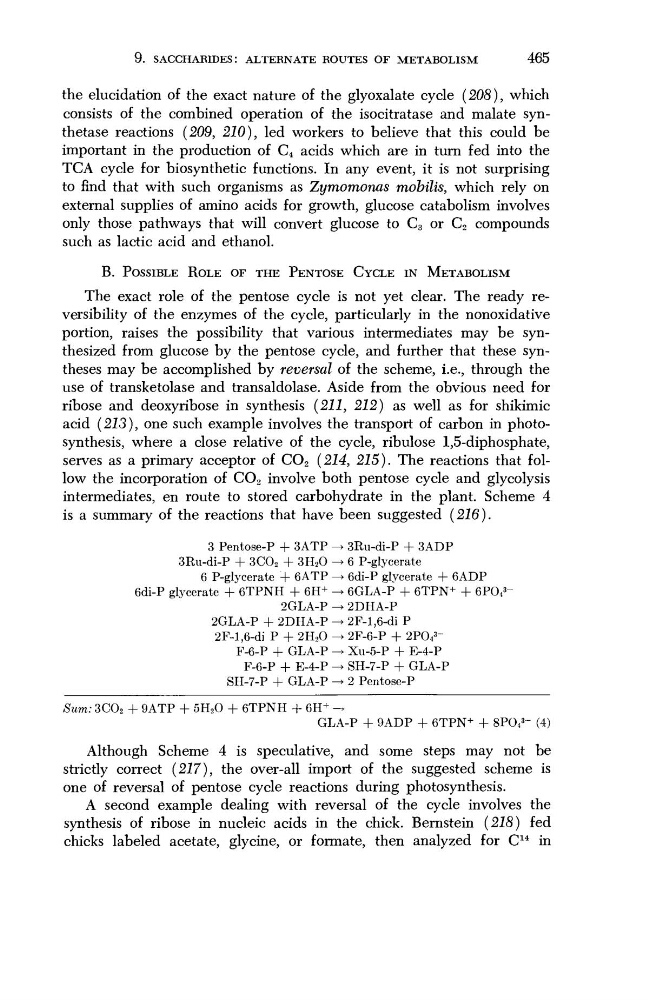
intermediates, en route to stored carbohydrate in the plant. Scheme 4
is a summary of the reactions that have been suggested (216).
3 Pentose-P + 3ATP -> 3Ru-di-P + 3ADP
3Ru-di-P + 3C0 2 + 3H 2 0 -> 6 P-glycerate
6 P-glycerate + 6ATP -* 6di-P glycerate + 6ADP
6di-P glycerate + 6TPNH + 6H+ -* 6GLA-P + 6TPN+ + 6P0 4
3 ~
2GLA-P -> 2DHA-P
2GLA-P + 2DHA-P -» 2F-l,6-di P
2F-l,6-di P + 2H 2 0 -> 2F-6-P + 2P0 4
3 ~
F-6-P + GLA-P -» Xu-5-P + E-4-P
F-6-P + E-4-P -> SH-7-P + GLA-P
SH-7-P + GLA-P -> 2 Pentose-P
Sum: 3C0 2 + 9ATP + 5H 2 0 + 6TPNH + 6H+ -*
GLA-P + 9ADP + 6TPN+ + 8P0 4
3 " (4)
Although Scheme 4 is speculative, and some steps may not be
strictly correct (217), the over-all import of the suggested scheme is
one of reversal of pentose cycle reactions during photosynthesis.
A second example dealing with reversal of the cycle involves the
synthesis of ribose in nucleic acids in the chick. Bernstein (218) fed
chicks labeled acetate, glycine, or formate, then analyzed for C
14 in
465
the elucidation of the exact nature of the glyoxalate cycle (208), which
consists of the combined operation of the isocitratase and malate synthetase reactions (209, 210), led workers to believe that this could be
important in the production of C 4 acids which are in turn fed into the
TCA cycle for biosynthetic functions. In any event, it is not surprising
to find that with such organisms as Zymomonas mobilis, which rely on
external supplies of amino acids for growth, glucose catabolism involves
only those pathways that will convert glucose to C 3 or C 2 compounds
such as lactic acid and ethanol.
B. POSSIBLE ROLE OF THE PENTOSE CYCLE IN METABOLISM
The exact role of the pentose cycle is not yet clear. The ready reversibility of the enzymes of the cycle, particularly in the nonoxidative
portion, raises the possibility that various intermediates may be synthesized from glucose by the pentose cycle, and further that these syntheses may be accomplished by reversal of the scheme, i.e., through the
use of transketolase and transaldolase. Aside from the obvious need for
ribose and deoxyribose in synthesis (211, 212) as well as for shikimic
acid (213), one such example involves the transport of carbon in photosynthesis, where a close relative of the cycle, ribulose 1,5-diphosphate,
serves as a primary acceptor of C0 2 (214, 215). The reactions that follow the incorporation of C0 2 involve both pentose cycle and glycolysis
intermediates, en route to stored carbohydrate in the plant. Scheme 4
is a summary of the reactions that have been suggested (216).
3 Pentose-P + 3ATP -> 3Ru-di-P + 3ADP
3Ru-di-P + 3C0 2 + 3H 2 0 -> 6 P-glycerate
6 P-glycerate + 6ATP -* 6di-P glycerate + 6ADP
6di-P glycerate + 6TPNH + 6H+ -* 6GLA-P + 6TPN+ + 6P0 4
3 ~
2GLA-P -> 2DHA-P
2GLA-P + 2DHA-P -» 2F-l,6-di P
2F-l,6-di P + 2H 2 0 -> 2F-6-P + 2P0 4
3 ~
F-6-P + GLA-P -» Xu-5-P + E-4-P
F-6-P + E-4-P -> SH-7-P + GLA-P
SH-7-P + GLA-P -> 2 Pentose-P
Sum: 3C0 2 + 9ATP + 5H 2 0 + 6TPNH + 6H+ -*
GLA-P + 9ADP + 6TPN+ + 8P0 4
3 " (4)
Although Scheme 4 is speculative, and some steps may not be
strictly correct (217), the over-all import of the suggested scheme is
one of reversal of pentose cycle reactions during photosynthesis.
A second example dealing with reversal of the cycle involves the
synthesis of ribose in nucleic acids in the chick. Bernstein (218) fed
chicks labeled acetate, glycine, or formate, then analyzed for C
14 in