

442
VERNON H. CHELDELIN, CHIH H. WANG, AND TSOO E. KING
1 C
1 CO 2
I
2 C
2 CH 3
CH 3
I
I
or I
3 C
3 CH 2 0H
COOH
I
COOH
4 C
4
I
I
5 C
5 HO-C-H
I
I
6 C
6
CH s
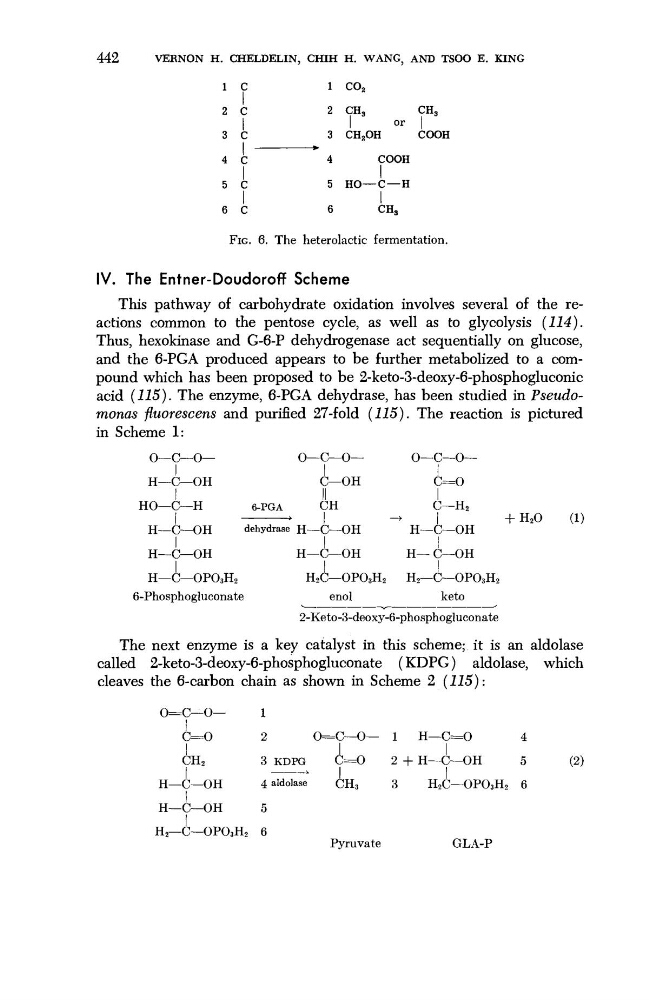
FIG. 6. The heterolactic fermentation.
IV. The Entner-Doudoroff Scheme
This pathway of carbohydrate oxidation involves several of the reactions common to the pentose cycle, as well as to glycolysis (114).
Thus, hexokinase and G-6-P dehydrogenase act sequentially on glucose,
and the 6-PGA produced appears to be further metabolized to a compound which has been proposed to be 2-keto-3-deoxy-6-phosphogluconic
acid (115). The enzyme, 6-PGA dehydrase, has been studied in Pseudomonas fluorescens and purified 27-fold (115). The reaction is pictured
in Scheme 1:
' - - - - - - - - - v - - - - - - - - - - - "
O-C-OI
H-C-OH
I
HO-C-H
I
H-C-OH
I
H-C-OH
I.
H-C-OP03H2
6-Phosphogluconate
O-C-OI
C-OH
II
6-PGA
CH
I
dehydrase H-C-OH
I
H-C-OH
I
H2C-OP0 3 H 2
enol
O-C-OI
C=O
I
C-H 2
~
I
H-C-OH
I
H-C-OH
I
H2-C-OP0 3 H 2
keto
(1)
2-Keto-3-deoxy-6-phosphogluconate
The next enzyme is a key catalyst in this scheme;. it is an aldolase
called 2-keto-3-deoxy-6-phosphogluconate (KDPG ) aldolase, which
cleaves the 6-carbon chain as shown in Scheme 2 (115):
O=C-O1
I
C=O
2
O=C-O- 1
H-C=O
4
I
I
I
CH2
3 KDPG
C=O
2 +H-C-OH
5
(2)
I
I
I
H-C-OH
4 aldolase
CH3
3
H2C-OP03H 2 6
I
H-C-OH
5
I
H 2 -C-OP03H2 6
Pyruvate
GL.A-P
VERNON H. CHELDELIN, CHIH H. WANG, AND TSOO E. KING
1 C
1 CO 2
I
2 C
2 CH 3
CH 3
I
I
or I
3 C
3 CH 2 0H
COOH
I
COOH
4 C
4
I
I
5 C
5 HO-C-H
I
I
6 C
6
CH s
FIG. 6. The heterolactic fermentation.
IV. The Entner-Doudoroff Scheme
This pathway of carbohydrate oxidation involves several of the reactions common to the pentose cycle, as well as to glycolysis (114).
Thus, hexokinase and G-6-P dehydrogenase act sequentially on glucose,
and the 6-PGA produced appears to be further metabolized to a compound which has been proposed to be 2-keto-3-deoxy-6-phosphogluconic
acid (115). The enzyme, 6-PGA dehydrase, has been studied in Pseudomonas fluorescens and purified 27-fold (115). The reaction is pictured
in Scheme 1:
' - - - - - - - - - v - - - - - - - - - - - "
O-C-OI
H-C-OH
I
HO-C-H
I
H-C-OH
I
H-C-OH
I.
H-C-OP03H2
6-Phosphogluconate
O-C-OI
C-OH
II
6-PGA
CH
I
dehydrase H-C-OH
I
H-C-OH
I
H2C-OP0 3 H 2
enol
O-C-OI
C=O
I
C-H 2
~
I
H-C-OH
I
H-C-OH
I
H2-C-OP0 3 H 2
keto
(1)
2-Keto-3-deoxy-6-phosphogluconate
The next enzyme is a key catalyst in this scheme;. it is an aldolase
called 2-keto-3-deoxy-6-phosphogluconate (KDPG ) aldolase, which
cleaves the 6-carbon chain as shown in Scheme 2 (115):
O=C-O1
I
C=O
2
O=C-O- 1
H-C=O
4
I
I
I
CH2
3 KDPG
C=O
2 +H-C-OH
5
(2)
I
I
I
H-C-OH
4 aldolase
CH3
3
H2C-OP03H 2 6
I
H-C-OH
5
I
H 2 -C-OP03H2 6
Pyruvate
GL.A-P