

440
VERNON H. CHELDELIN, CHIH H. WANG, AND TSOO E. KING
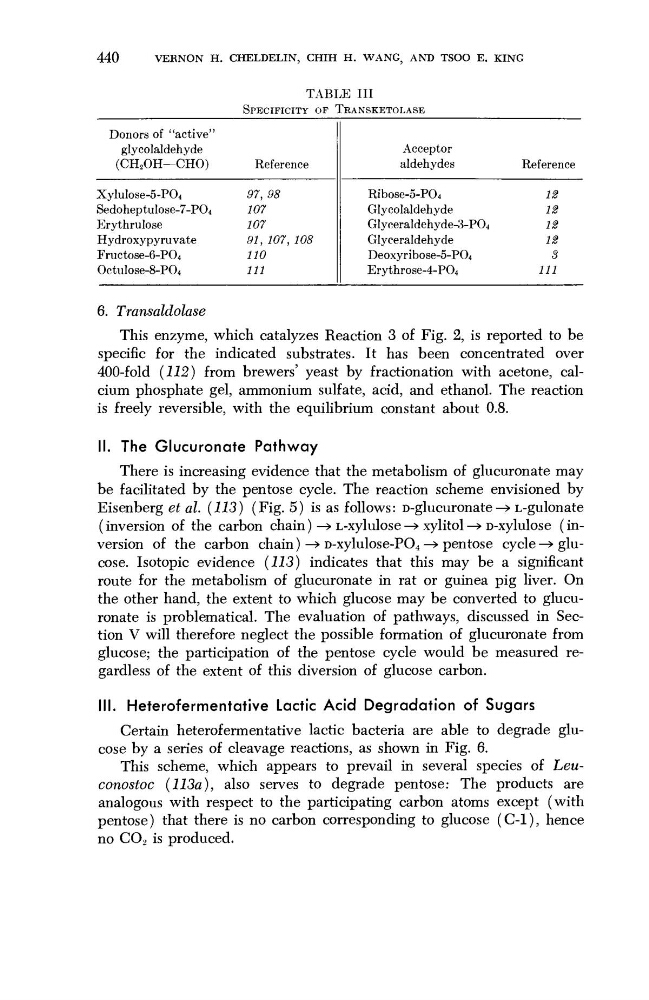
TABLE III
SPECIFICITY OF TRANSKETOLASE
Donors of "active"
glycolaldehyde
(CHoOH—CHO)
Xylulose-5-P0 4
Sedoheptulose-7-P0 4
Erythrulose
Hydroxypyruvate
Fructose-6-P0 4
Octulose-8-P0 4
Reference
97, 98
107
107
91, 107, 108
110
111
Acceptor
aldehydes
Ribose-5-P0 4
Glycolaldehyde
Glyceraldehyde-3-P0 4
Glyceraldehyde
Deoxyribose-5-P0 4
Erythrose-4-P0 4
Reference
12
12
12
12
3
111
6. Transaldolase
This enzyme, which catalyzes Reaction 3 of Fig. 2, is reported to be
specific for the indicated substrates. It has been concentrated over
400-fold (112) from brewers' yeast by fractionation with acetone, calcium phosphate gel, ammonium sulfate, acid, and ethanol. The reaction
is freely reversible, with the equilibrium constant about 0.8.
II. The Glucuronate Pathway
There is increasing evidence that the metabolism of glucuronate may
be facilitated by the pentose cycle. The reaction scheme envisioned by
Eisenberg et al. (113) (Fig. 5) is as follows: D-glucuronate—» L-gulonate
(inversion of the carbon chain) —» L-xylulose —> xylitol —> D-xylulose (inversion of the carbon chain) —» D-xylulose-P0 4 —» pentose cycle —» glucose. Isotopic evidence (113) indicates that this may be a significant
route for the metabolism of glucuronate in rat or guinea pig liver. On
the other hand, the extent to which glucose may be converted to glucuronate is problematical. The evaluation of pathways, discussed in Section V will therefore neglect the possible formation of glucuronate from
glucose; the participation of the pentose cycle would be measured regardless of the extent of this diversion of glucose carbon.
III. Heterofermentative Lactic Acid Degradation of Sugars
Certain heterofermentative lactic bacteria are able to degrade glucose by a series of cleavage reactions, as shown in Fig. 6.
This scheme, which appears to prevail in several species of Leuconostoc (113a), also serves to degrade pentose: The products are
analogous with respect to the participating carbon atoms except (with
pentose) that there is no carbon corresponding to glucose (C-l), hence
no C0 2 is produced.
VERNON H. CHELDELIN, CHIH H. WANG, AND TSOO E. KING
TABLE III
SPECIFICITY OF TRANSKETOLASE
Donors of "active"
glycolaldehyde
(CHoOH—CHO)
Xylulose-5-P0 4
Sedoheptulose-7-P0 4
Erythrulose
Hydroxypyruvate
Fructose-6-P0 4
Octulose-8-P0 4
Reference
97, 98
107
107
91, 107, 108
110
111
Acceptor
aldehydes
Ribose-5-P0 4
Glycolaldehyde
Glyceraldehyde-3-P0 4
Glyceraldehyde
Deoxyribose-5-P0 4
Erythrose-4-P0 4
Reference
12
12
12
12
3
111
6. Transaldolase
This enzyme, which catalyzes Reaction 3 of Fig. 2, is reported to be
specific for the indicated substrates. It has been concentrated over
400-fold (112) from brewers' yeast by fractionation with acetone, calcium phosphate gel, ammonium sulfate, acid, and ethanol. The reaction
is freely reversible, with the equilibrium constant about 0.8.
II. The Glucuronate Pathway
There is increasing evidence that the metabolism of glucuronate may
be facilitated by the pentose cycle. The reaction scheme envisioned by
Eisenberg et al. (113) (Fig. 5) is as follows: D-glucuronate—» L-gulonate
(inversion of the carbon chain) —» L-xylulose —> xylitol —> D-xylulose (inversion of the carbon chain) —» D-xylulose-P0 4 —» pentose cycle —» glucose. Isotopic evidence (113) indicates that this may be a significant
route for the metabolism of glucuronate in rat or guinea pig liver. On
the other hand, the extent to which glucose may be converted to glucuronate is problematical. The evaluation of pathways, discussed in Section V will therefore neglect the possible formation of glucuronate from
glucose; the participation of the pentose cycle would be measured regardless of the extent of this diversion of glucose carbon.
III. Heterofermentative Lactic Acid Degradation of Sugars
Certain heterofermentative lactic bacteria are able to degrade glucose by a series of cleavage reactions, as shown in Fig. 6.
This scheme, which appears to prevail in several species of Leuconostoc (113a), also serves to degrade pentose: The products are
analogous with respect to the participating carbon atoms except (with
pentose) that there is no carbon corresponding to glucose (C-l), hence
no C0 2 is produced.