

8. POLYSACCHARIDASES
411
occurrence of this enzyme in bacteria is most frequent. Extracts of
pneumococci of types I, II, III, VI, VIII, and XIII (328, 334-336), of
Clostridium welchii (330), Clostridium perfringens (334), strains of
hemolytic streptococci and staphylococci have been found to contain
hyaluronidase (332).
3. Properties
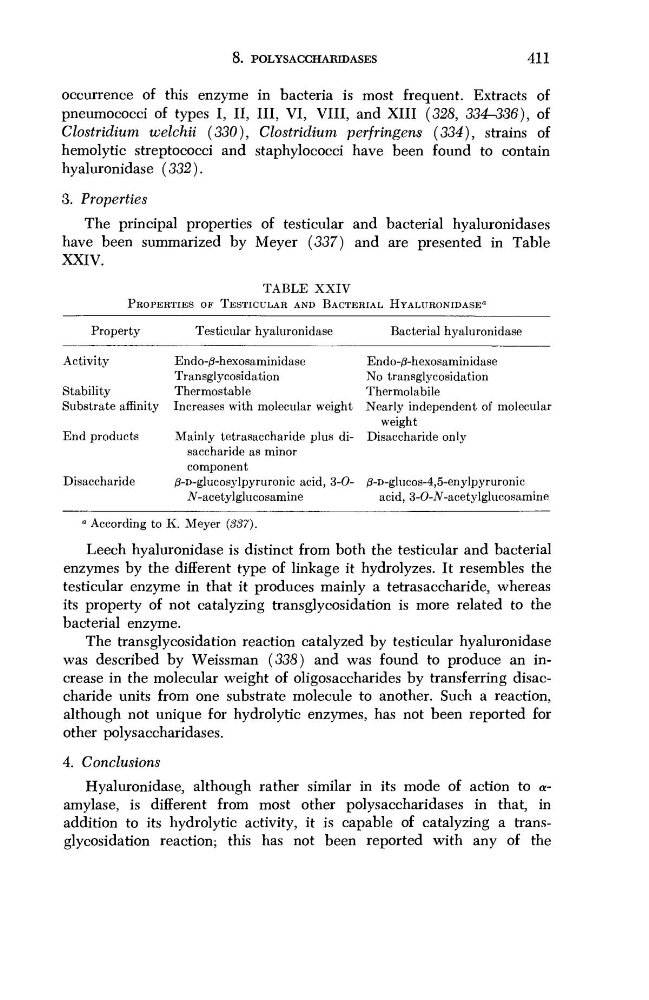
The principal properties of testicular and bacterial hyaluronidases
have been summarized by Meyer (337) and are presented in Table
XXIV.
TABLE XXIV
PROPERTIES OF TESTICULAR AND BACTERIAL HYALURONIDASE"
Property
Testicular hyaluronidase
Bacterial hyaluronidase
Activity
Endo-ß-hexosaminidase
Transglycosidation
Stability
Thermostable
Substrate affinity Increases with molecular weight
End products
Mainly tetrasaccharide plus disaccharide as minor
component
Disaccharide
ß-D-glucosylpyruronic acid, 3-07V-acetylglucosamine
Endo-/3-hexosaminidase
No transglycosidation
Thermolabile
Nearly independent of molecular
weight
Disaccharide only
ß-D-glucos-4,5-enylpyruronic
acid, 3-0-A/-acetylglucosamine
a According to K. Meyer {337).
Leech hyaluronidase is distinct from both the testicular and bacterial
enzymes by the different type of linkage it hydrolyzes. It resembles the
testicular enzyme in that it produces mainly a tetrasaccharide, whereas
its property of not catalyzing transglycosidation is more related to the
bacterial enzyme.
The transglycosidation reaction catalyzed by testicular hyaluronidase
was described by Weissman (338) and was found to produce an increase in the molecular weight of oligosaccharides by transferring disaccharide units from one substrate molecule to another. Such a reaction,
although not unique for hydrolytic enzymes, has not been reported for
other polysaccharidases.
4. Conclusions
Hyaluronidase, although rather similar in its mode of action to aamylase, is different from most other polysaccharidases in that, in
addition to its hydrolytic activity, it is capable of catalyzing a transglycosidation reaction; this has not been reported with any of the
411
occurrence of this enzyme in bacteria is most frequent. Extracts of
pneumococci of types I, II, III, VI, VIII, and XIII (328, 334-336), of
Clostridium welchii (330), Clostridium perfringens (334), strains of
hemolytic streptococci and staphylococci have been found to contain
hyaluronidase (332).
3. Properties
The principal properties of testicular and bacterial hyaluronidases
have been summarized by Meyer (337) and are presented in Table
XXIV.
TABLE XXIV
PROPERTIES OF TESTICULAR AND BACTERIAL HYALURONIDASE"
Property
Testicular hyaluronidase
Bacterial hyaluronidase
Activity
Endo-ß-hexosaminidase
Transglycosidation
Stability
Thermostable
Substrate affinity Increases with molecular weight
End products
Mainly tetrasaccharide plus disaccharide as minor
component
Disaccharide
ß-D-glucosylpyruronic acid, 3-07V-acetylglucosamine
Endo-/3-hexosaminidase
No transglycosidation
Thermolabile
Nearly independent of molecular
weight
Disaccharide only
ß-D-glucos-4,5-enylpyruronic
acid, 3-0-A/-acetylglucosamine
a According to K. Meyer {337).
Leech hyaluronidase is distinct from both the testicular and bacterial
enzymes by the different type of linkage it hydrolyzes. It resembles the
testicular enzyme in that it produces mainly a tetrasaccharide, whereas
its property of not catalyzing transglycosidation is more related to the
bacterial enzyme.
The transglycosidation reaction catalyzed by testicular hyaluronidase
was described by Weissman (338) and was found to produce an increase in the molecular weight of oligosaccharides by transferring disaccharide units from one substrate molecule to another. Such a reaction,
although not unique for hydrolytic enzymes, has not been reported for
other polysaccharidases.
4. Conclusions
Hyaluronidase, although rather similar in its mode of action to aamylase, is different from most other polysaccharidases in that, in
addition to its hydrolytic activity, it is capable of catalyzing a transglycosidation reaction; this has not been reported with any of the