

406
PETER BERNFELD
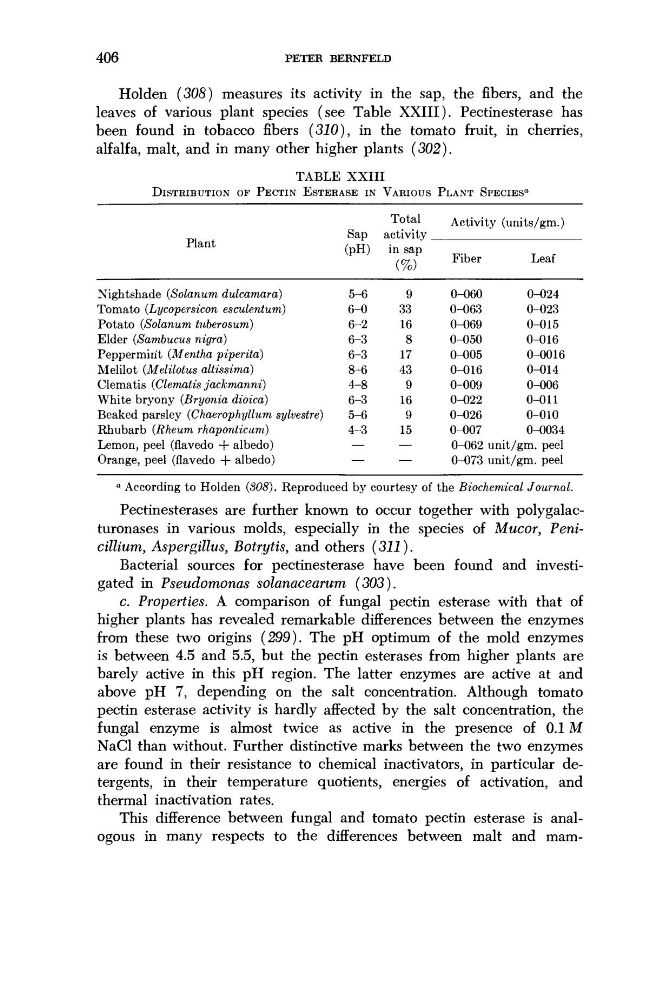
Holden (308) measures its activity in the sap, the fibers, and the
leaves of various plant species (see Table XXIII). Pectinesterase has
been found in tobacco fibers (310), in the tomato fruit, in cherries,
alfalfa, malt, and in many other higher plants (302).
TABLE XXIII
DISTRIBUTION OF PECTIN ESTERASE IN VARIOUS PLANT SPECIES"
Plant
Nightshade (Solarium dulcamara)
Tomato (Lycopersicon esculentum)
Potato (Solarium tuberosum)
Elder (Sambucus nigra)
Peppermint (Mentha piperita)
Melilot (Melilotus altissima)
Clematis (Clematis jackmanni)
White bryony (Bryonia dioica)
Beaked parsley (Chaerophyllum sylvestre)
Rhubarb (Rheum rhaponticum)
Lemon, peel (flavedo + albedo)
Orange, peel (flavedo + albedo)
Sap
(pH)
5-6
6-0
6-2
6-3
6-3
8-6
4-8
6-3
5-6
4-3
—
—
Total
activity _
in sap
(%)
9
33
16
8
17
43
9
16
9
15
—
—
Activity (units/gm.)
Fiber
0-060
0-063
0-069
0-050
0-005
0-016
0-009
0-022
0-026
0-007
0-062i
0-073 i
Leaf
0-024
0-023
0-015
0-016
0-0016
0-014
0-006
0-011
0-010
0-0034
anit/gm. peel
anit/gm. peel
° According to Holden (308). Reproduced by courtesy of the Biochemical Journal.
Pectinesterases are further known to occur together with polygalacturonases in various molds, especially in the species of Mucor, Penicillium, AspergUlus, Botrytis, and others (311).
Bacterial sources for pectinesterase have been found and investigated in Pseudomonas solanacearum (303).
c. Properties. A comparison of fungal pectin esterase with that of
higher plants has revealed remarkable differences between the enzymes
from these two origins (299). The pH optimum of the mold enzymes
is between 4.5 and 5.5, but the pectin esterases from higher plants are
barely active in this pH region. The latter enzymes are active at and
above pH 7, depending on the salt concentration. Although tomato
pectin esterase activity is hardly affected by the salt concentration, the
fungal enzyme is almost twice as active in the presence of 0.1 M
NaCl than without. Further distinctive marks between the two enzymes
are found in their resistance to chemical inactivators, in particular detergents, in their temperature quotients, energies of activation, and
thermal inactivation rates.
This difference between fungal and tomato pectin esterase is analogous in many respects to the differences between malt and mam-
PETER BERNFELD
Holden (308) measures its activity in the sap, the fibers, and the
leaves of various plant species (see Table XXIII). Pectinesterase has
been found in tobacco fibers (310), in the tomato fruit, in cherries,
alfalfa, malt, and in many other higher plants (302).
TABLE XXIII
DISTRIBUTION OF PECTIN ESTERASE IN VARIOUS PLANT SPECIES"
Plant
Nightshade (Solarium dulcamara)
Tomato (Lycopersicon esculentum)
Potato (Solarium tuberosum)
Elder (Sambucus nigra)
Peppermint (Mentha piperita)
Melilot (Melilotus altissima)
Clematis (Clematis jackmanni)
White bryony (Bryonia dioica)
Beaked parsley (Chaerophyllum sylvestre)
Rhubarb (Rheum rhaponticum)
Lemon, peel (flavedo + albedo)
Orange, peel (flavedo + albedo)
Sap
(pH)
5-6
6-0
6-2
6-3
6-3
8-6
4-8
6-3
5-6
4-3
—
—
Total
activity _
in sap
(%)
9
33
16
8
17
43
9
16
9
15
—
—
Activity (units/gm.)
Fiber
0-060
0-063
0-069
0-050
0-005
0-016
0-009
0-022
0-026
0-007
0-062i
0-073 i
Leaf
0-024
0-023
0-015
0-016
0-0016
0-014
0-006
0-011
0-010
0-0034
anit/gm. peel
anit/gm. peel
° According to Holden (308). Reproduced by courtesy of the Biochemical Journal.
Pectinesterases are further known to occur together with polygalacturonases in various molds, especially in the species of Mucor, Penicillium, AspergUlus, Botrytis, and others (311).
Bacterial sources for pectinesterase have been found and investigated in Pseudomonas solanacearum (303).
c. Properties. A comparison of fungal pectin esterase with that of
higher plants has revealed remarkable differences between the enzymes
from these two origins (299). The pH optimum of the mold enzymes
is between 4.5 and 5.5, but the pectin esterases from higher plants are
barely active in this pH region. The latter enzymes are active at and
above pH 7, depending on the salt concentration. Although tomato
pectin esterase activity is hardly affected by the salt concentration, the
fungal enzyme is almost twice as active in the presence of 0.1 M
NaCl than without. Further distinctive marks between the two enzymes
are found in their resistance to chemical inactivators, in particular detergents, in their temperature quotients, energies of activation, and
thermal inactivation rates.
This difference between fungal and tomato pectin esterase is analogous in many respects to the differences between malt and mam-