

404
PETER BERNFELD
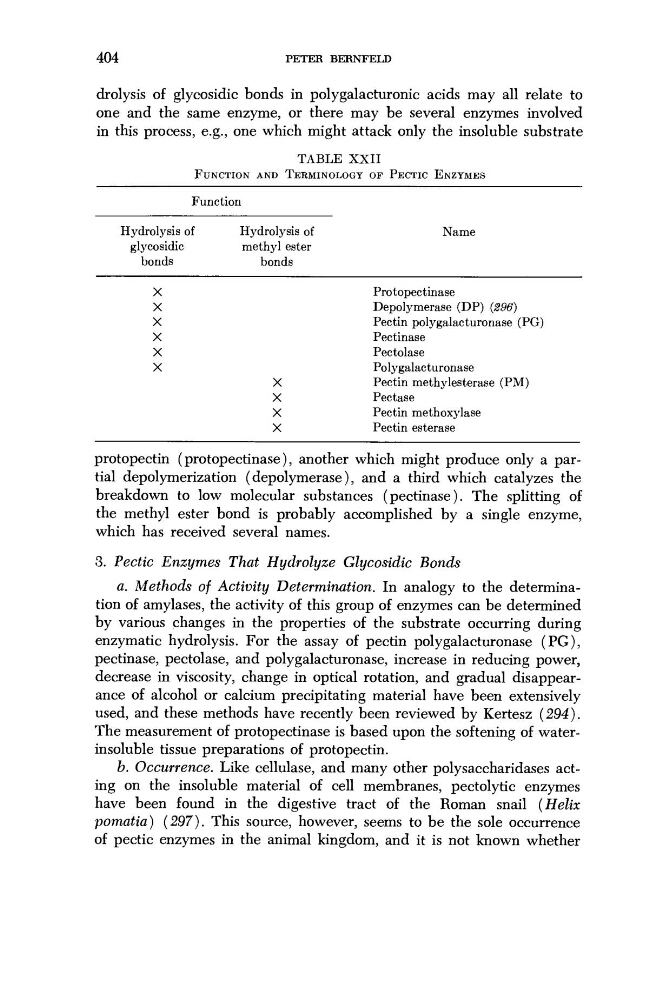
drolysis of glycosidic bonds in polygalacturonic acids may all relate to
one and the same enzyme, or there may be several enzymes involved
in this process, e.g., one which might attack only the insoluble substrate
TABLE XXII
FUNCTION AND TERMINOLOGY OF PECTIC ENZYMES
Hydrolysis
glycosidic
bonds
X
X
X
X
X
X
Function
of
Hydrolysis of
methyl ester
bonds
X
X
X
X
Name
Protopectinase
Depolymerase (DP) (296)
Pectin polygalacturonase (PG)
Pectinase
Pectolase
Polygalacturonase
Pectin methylesterase (PM)
Pectase
Pectin methoxylase
Pectin esterase
protopectin (protopectinase), another which might produce only a partial depolymerization (depolymerase), and a third which catalyzes the
breakdown to low molecular substances (pectinase). The splitting of
the methyl ester bond is probably accomplished by a single enzyme,
which has received several names.
3. Pectic Enzymes That Hydrolyze Glycosidic Bonds
a. Methods of Activity Determination. In analogy to the determination of amylases, the activity of this group of enzymes can be determined
by various changes in the properties of the substrate occurring during
enzymatic hydrolysis. For the assay of pectin polygalacturonase (PG),
pectinase, pectolase, and polygalacturonase, increase in reducing power,
decrease in viscosity, change in optical rotation, and gradual disappearance of alcohol or calcium precipitating material have been extensively
used, and these methods have recently been reviewed by Kertesz (294).
The measurement of protopectinase is based upon the softening of waterinsoluble tissue preparations of protopectin.
b. Occurrence. Like cellulase, and many other polysaccharidases acting on the insoluble material of cell membranes, pectolytic enzymes
have been found in the digestive tract of the Roman snail (Helix
pomatia) (297). This source, however, seems to be the sole occurrence
of pectic enzymes in the animal kingdom, and it is not known whether
PETER BERNFELD
drolysis of glycosidic bonds in polygalacturonic acids may all relate to
one and the same enzyme, or there may be several enzymes involved
in this process, e.g., one which might attack only the insoluble substrate
TABLE XXII
FUNCTION AND TERMINOLOGY OF PECTIC ENZYMES
Hydrolysis
glycosidic
bonds
X
X
X
X
X
X
Function
of
Hydrolysis of
methyl ester
bonds
X
X
X
X
Name
Protopectinase
Depolymerase (DP) (296)
Pectin polygalacturonase (PG)
Pectinase
Pectolase
Polygalacturonase
Pectin methylesterase (PM)
Pectase
Pectin methoxylase
Pectin esterase
protopectin (protopectinase), another which might produce only a partial depolymerization (depolymerase), and a third which catalyzes the
breakdown to low molecular substances (pectinase). The splitting of
the methyl ester bond is probably accomplished by a single enzyme,
which has received several names.
3. Pectic Enzymes That Hydrolyze Glycosidic Bonds
a. Methods of Activity Determination. In analogy to the determination of amylases, the activity of this group of enzymes can be determined
by various changes in the properties of the substrate occurring during
enzymatic hydrolysis. For the assay of pectin polygalacturonase (PG),
pectinase, pectolase, and polygalacturonase, increase in reducing power,
decrease in viscosity, change in optical rotation, and gradual disappearance of alcohol or calcium precipitating material have been extensively
used, and these methods have recently been reviewed by Kertesz (294).
The measurement of protopectinase is based upon the softening of waterinsoluble tissue preparations of protopectin.
b. Occurrence. Like cellulase, and many other polysaccharidases acting on the insoluble material of cell membranes, pectolytic enzymes
have been found in the digestive tract of the Roman snail (Helix
pomatia) (297). This source, however, seems to be the sole occurrence
of pectic enzymes in the animal kingdom, and it is not known whether