

396
PETER BERNFELD
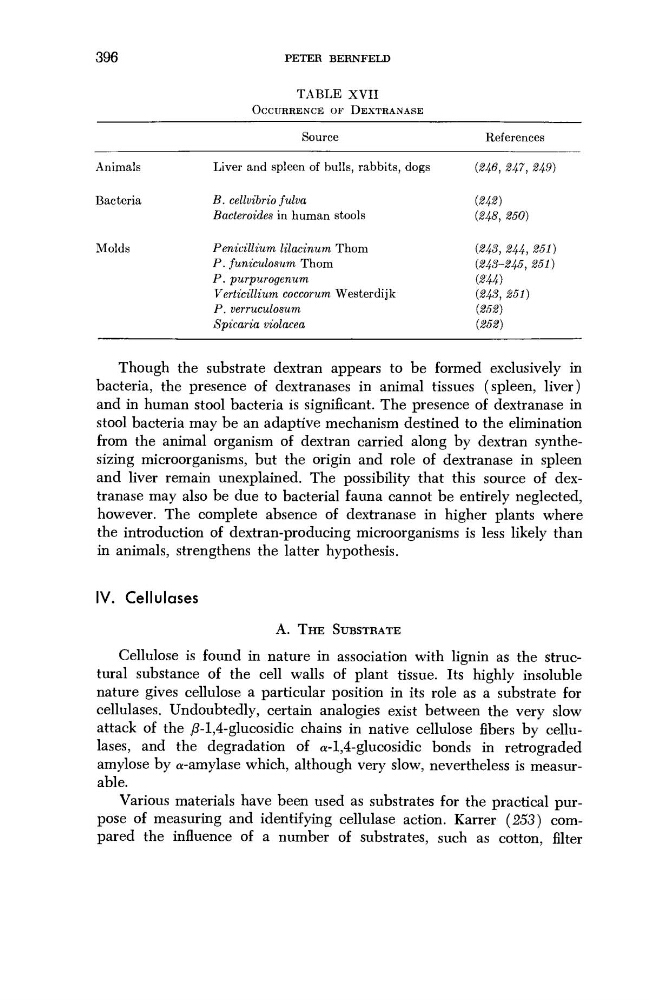
TABLE XVII
OCCURRENCE OF DEXTRANASE
Source
References
Animals
Liver and spleen of bulls, rabbits, dogs
(246, 247, 249)
Bacteria
B. cellvibrio fulva
Bacteroides in human stools
{248, 250)
Molds
Penicillium lilacinum Thorn
(243, 244, 251)
P. funiculosum Thorn
(243-245, 251)
P. purpurogenum
(244)
Verticillium coccorum Westerdijk
(243, 251)
P. verruculosum
Spicaria violacea
Though the substrate dextran appears to be formed exclusively in
bacteria, the presence of dextranases in animal tissues (spleen, liver)
and in human stool bacteria is significant. The presence of dextranase in
stool bacteria may be an adaptive mechanism destined to the elimination
from the animal organism of dextran carried along by dextran synthesizing microorganisms, but the origin and role of dextranase in spleen
and liver remain unexplained. The possibility that this source of dextranase may also be due to bacterial fauna cannot be entirely neglected,
however. The complete absence of dextranase in higher plants where
the introduction of dextran-producing microorganisms is less likely than
in animals, strengthens the latter hypothesis.
IV. Celluloses
A. THE SUBSTRATE
Cellulose is found in nature in association with lignin as the structural substance of the cell walls of plant tissue. Its highly insoluble
nature gives cellulose a particular position in its role as a substrate for
cellulases. Undoubtedly, certain analogies exist between the very slow
attack of the ß-l,4-glucosidic chains in native cellulose fibers by cellulases, and the degradation of a-l,4-glucosidic bonds in retrograded
amylose by α-amylase which, although very slow, nevertheless is measurable.
Various materials have been used as substrates for the practical purpose of measuring and identifying cellulase action. Karrer (253) compared the influence of a number of substrates, such as cotton, filter
W)
(252)
(252)
PETER BERNFELD
TABLE XVII
OCCURRENCE OF DEXTRANASE
Source
References
Animals
Liver and spleen of bulls, rabbits, dogs
(246, 247, 249)
Bacteria
B. cellvibrio fulva
Bacteroides in human stools
{248, 250)
Molds
Penicillium lilacinum Thorn
(243, 244, 251)
P. funiculosum Thorn
(243-245, 251)
P. purpurogenum
(244)
Verticillium coccorum Westerdijk
(243, 251)
P. verruculosum
Spicaria violacea
Though the substrate dextran appears to be formed exclusively in
bacteria, the presence of dextranases in animal tissues (spleen, liver)
and in human stool bacteria is significant. The presence of dextranase in
stool bacteria may be an adaptive mechanism destined to the elimination
from the animal organism of dextran carried along by dextran synthesizing microorganisms, but the origin and role of dextranase in spleen
and liver remain unexplained. The possibility that this source of dextranase may also be due to bacterial fauna cannot be entirely neglected,
however. The complete absence of dextranase in higher plants where
the introduction of dextran-producing microorganisms is less likely than
in animals, strengthens the latter hypothesis.
IV. Celluloses
A. THE SUBSTRATE
Cellulose is found in nature in association with lignin as the structural substance of the cell walls of plant tissue. Its highly insoluble
nature gives cellulose a particular position in its role as a substrate for
cellulases. Undoubtedly, certain analogies exist between the very slow
attack of the ß-l,4-glucosidic chains in native cellulose fibers by cellulases, and the degradation of a-l,4-glucosidic bonds in retrograded
amylose by α-amylase which, although very slow, nevertheless is measurable.
Various materials have been used as substrates for the practical purpose of measuring and identifying cellulase action. Karrer (253) compared the influence of a number of substrates, such as cotton, filter
W)
(252)
(252)