

1. FATTY ACID OCCURRENCE AND DISTRIBUTION
27
comparisons between the fatty acids of different species will be concerned with the main fatty depots.
It is convenient when making comparisons between fatty acids in
the lipids of different species to commence with the fats of aquatic
origin, to proceed to those of land animals, and finally to the fats of
vegetable origin. As noted by Hilditch and Lovern (140), there is a
gradual simplification in fatty acid composition as we proceed from
the simpler to the more highly organized forms of life. In Table III the
decreasing complexity of fatty acid composition—from aquatic species
through amphibians, reptiles, birds, and mammals—parallels, to some
extent, evolutionary development. Although the present author (151)
regards the fats of the diet as being largely responsible for this, nevertheless it is convenient to deal with the animals in the order outlined
and to separate aquatic species from land animals and land plants,
each group of which has its own characteristic differences in respect
of types and distribution of fatty acids in its lipids.
B. FATS OF AQUATIC SPECIES
The fats of aquatic species are characterized by the low content of
saturated acids (mainly palmitic acid), by their wide range of unsaturated fatty acids, and especially by the large amounts of C 20 and C 22
highly unsaturated acids. The last-mentioned also occur in the organ
phospholipids of land mammals but are present only in traces in their
depot fats. As in land animals the Ci 6 and Ci 8 unsaturated acids are
mainly monounsaturated.
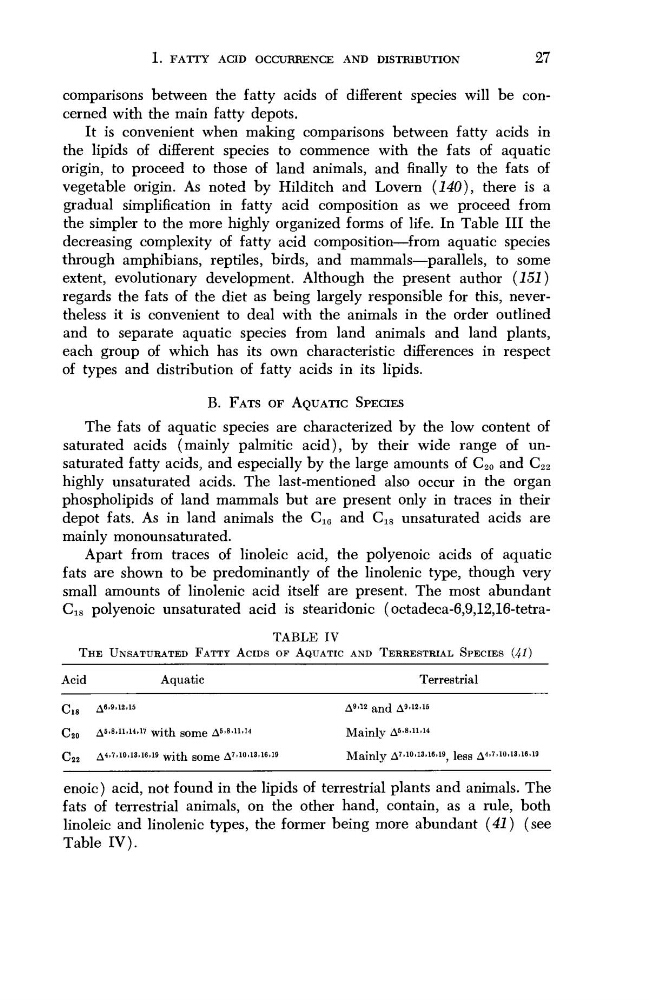
Apart from traces of linoleic acid, the polyenoic acids of aquatic
fats are shown to be predominantly of the linolenic type, though very
small amounts of linolenic acid itself are present. The most abundant
Ci 8 polyenoic unsaturated acid is stearidonic (octadeca-6,9,12,16-tetraTABLE IV
THE UNSATURATED FATTY ACIDS OF AQUATIC AND TERRESTRIAL SPECIES (41)
Acid
Aquatic
C 18 Δ
6
'
9
·
12
»
15
C20
A5.8.11,14,17 with βΟΠΙΘ Δ«·»·"·
14
C22
Δ
4 ·
7 '
10 '
13 ·
16 ·
19 with some Δ
7 '
10 -
13 ·
16 -
19
Terrestrial
Δ
9 -
1 * and Δ
9 '
12 ·
15
Mainly Δ
5 ·»11 ·
14
Mainly Δ
7 '
10 ·
13 -
16 -
19 , less Δ
4 ·
7 '
10 ·
13 ·
16 '
19
enoic) acid, not found in the lipids of terrestrial plants and animals. The
fats of terrestrial animals, on the other hand, contain, as a rule, both
linoleic and linolenic types, the former being more abundant (41) (see
Table IV).
27
comparisons between the fatty acids of different species will be concerned with the main fatty depots.
It is convenient when making comparisons between fatty acids in
the lipids of different species to commence with the fats of aquatic
origin, to proceed to those of land animals, and finally to the fats of
vegetable origin. As noted by Hilditch and Lovern (140), there is a
gradual simplification in fatty acid composition as we proceed from
the simpler to the more highly organized forms of life. In Table III the
decreasing complexity of fatty acid composition—from aquatic species
through amphibians, reptiles, birds, and mammals—parallels, to some
extent, evolutionary development. Although the present author (151)
regards the fats of the diet as being largely responsible for this, nevertheless it is convenient to deal with the animals in the order outlined
and to separate aquatic species from land animals and land plants,
each group of which has its own characteristic differences in respect
of types and distribution of fatty acids in its lipids.
B. FATS OF AQUATIC SPECIES
The fats of aquatic species are characterized by the low content of
saturated acids (mainly palmitic acid), by their wide range of unsaturated fatty acids, and especially by the large amounts of C 20 and C 22
highly unsaturated acids. The last-mentioned also occur in the organ
phospholipids of land mammals but are present only in traces in their
depot fats. As in land animals the Ci 6 and Ci 8 unsaturated acids are
mainly monounsaturated.
Apart from traces of linoleic acid, the polyenoic acids of aquatic
fats are shown to be predominantly of the linolenic type, though very
small amounts of linolenic acid itself are present. The most abundant
Ci 8 polyenoic unsaturated acid is stearidonic (octadeca-6,9,12,16-tetraTABLE IV
THE UNSATURATED FATTY ACIDS OF AQUATIC AND TERRESTRIAL SPECIES (41)
Acid
Aquatic
C 18 Δ
6
'
9
·
12
»
15
C20
A5.8.11,14,17 with βΟΠΙΘ Δ«·»·"·
14
C22
Δ
4 ·
7 '
10 '
13 ·
16 ·
19 with some Δ
7 '
10 -
13 ·
16 -
19
Terrestrial
Δ
9 -
1 * and Δ
9 '
12 ·
15
Mainly Δ
5 ·»11 ·
14
Mainly Δ
7 '
10 ·
13 -
16 -
19 , less Δ
4 ·
7 '
10 ·
13 ·
16 '
19
enoic) acid, not found in the lipids of terrestrial plants and animals. The
fats of terrestrial animals, on the other hand, contain, as a rule, both
linoleic and linolenic types, the former being more abundant (41) (see
Table IV).