

388
PETER BERNFELD
Further distinction between cereal a- and ß-amylases is possible
because of the higher stability of ß-amylase at low pH (216) and because of the higher heat stability of a-amylase (21, 22, 122). Thus,
/?-amylase activity will be eliminated from a mixture of the two enzymes
by 20 minutes' heating to 70° with no appreciable loss of a-amylase,
and storage at pH 3.5 in the cold will selectively remove the a-amylase.
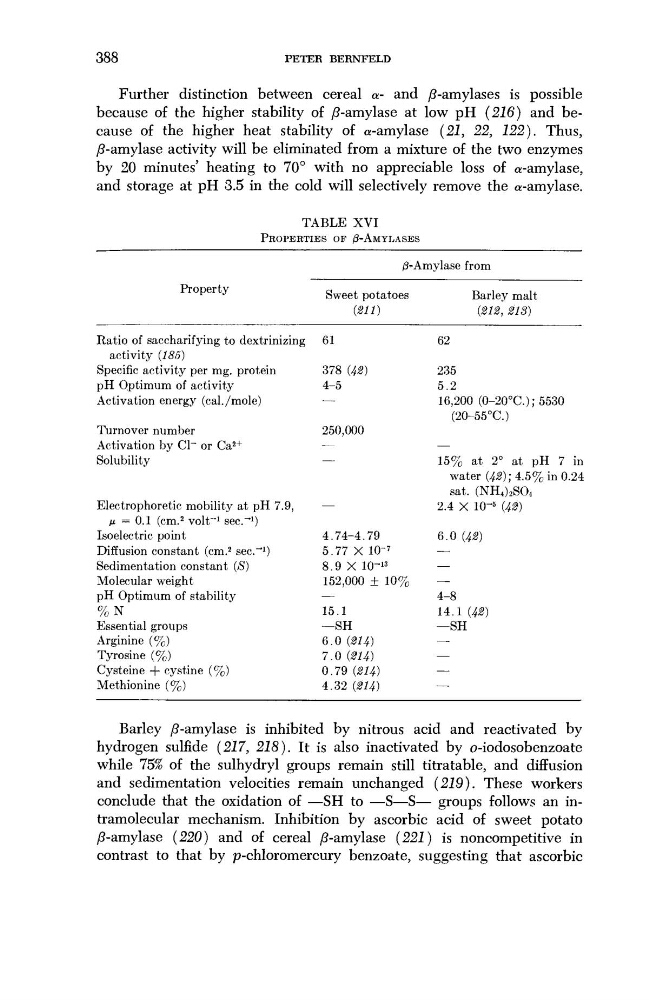
TABLE XVI
PROPERTIES OF /3-AMYLASES
Property
Ratio of saccharifying to dextrinizing
activity {185)
Specific activity per mg. protein
pH Optimum of activity
Activation energy (cal./mole)
Turnover number
Activation by Cl~ or Ca
2+
Solubility
Electrophoretic mobility at pH 7.9,
μ = 0.1 (cm.
2 volt"
1 sec.^
1 )
Isoelectric point
Diffusion constant (cm.
2 sec.^
1 )
Sedimentation constant (S)
Molecular weight
pH Optimum of stability
%N _
Essential groups
Arginine (%)
Tyrosine (%)
Cysteine + cystine (%)
Methionine (%)
ß-Amylase from
Sweet potatoes
378 (418)
4-5
250,000
—
—
4.74-4.79
5.77 X 10~
7
8.9 X 10¹³
152,000 + 10%
—
15.1
—SH
6.0 (214)
7.0 (214)
0.79 (214)
4.32 (214)
Barley malt
(212, 213)
62
235
5.2
16,200 (0-20°C.);5530
(20-55°C.)
—
15% at 2° at pH 7 in
water (42); 4.5% in 0.24
sat. (NH 4 ) 2 S0 4
2.4 X 10⁵ (42)
6.0 (42)
—
—
—
4-8
14.1 (42)
—SH
—
—
—
—
Barley ß-amylase is inhibited by nitrous acid and reactivated by
hydrogen sulfide (217, 218). It is also inactivated by o-iodosobenzoate
while 75% of the sulhydryl groups remain still titratable, and diffusion
and sedimentation velocities remain unchanged (219). These workers
conclude that the oxidation of —SH to —S—S— groups follows an intramolecular mechanism. Inhibition by ascorbic acid of sweet potato
/?-amylase (220) and of cereal /3-amylase (221) is noncompetitive in
contrast to that by p-chloromercury benzoate, suggesting that ascorbic
PETER BERNFELD
Further distinction between cereal a- and ß-amylases is possible
because of the higher stability of ß-amylase at low pH (216) and because of the higher heat stability of a-amylase (21, 22, 122). Thus,
/?-amylase activity will be eliminated from a mixture of the two enzymes
by 20 minutes' heating to 70° with no appreciable loss of a-amylase,
and storage at pH 3.5 in the cold will selectively remove the a-amylase.
TABLE XVI
PROPERTIES OF /3-AMYLASES
Property
Ratio of saccharifying to dextrinizing
activity {185)
Specific activity per mg. protein
pH Optimum of activity
Activation energy (cal./mole)
Turnover number
Activation by Cl~ or Ca
2+
Solubility
Electrophoretic mobility at pH 7.9,
μ = 0.1 (cm.
2 volt"
1 sec.^
1 )
Isoelectric point
Diffusion constant (cm.
2 sec.^
1 )
Sedimentation constant (S)
Molecular weight
pH Optimum of stability
%N _
Essential groups
Arginine (%)
Tyrosine (%)
Cysteine + cystine (%)
Methionine (%)
ß-Amylase from
Sweet potatoes
378 (418)
4-5
250,000
—
—
4.74-4.79
5.77 X 10~
7
8.9 X 10¹³
152,000 + 10%
—
15.1
—SH
6.0 (214)
7.0 (214)
0.79 (214)
4.32 (214)
Barley malt
(212, 213)
62
235
5.2
16,200 (0-20°C.);5530
(20-55°C.)
—
15% at 2° at pH 7 in
water (42); 4.5% in 0.24
sat. (NH 4 ) 2 S0 4
2.4 X 10⁵ (42)
6.0 (42)
—
—
—
4-8
14.1 (42)
—SH
—
—
—
—
Barley ß-amylase is inhibited by nitrous acid and reactivated by
hydrogen sulfide (217, 218). It is also inactivated by o-iodosobenzoate
while 75% of the sulhydryl groups remain still titratable, and diffusion
and sedimentation velocities remain unchanged (219). These workers
conclude that the oxidation of —SH to —S—S— groups follows an intramolecular mechanism. Inhibition by ascorbic acid of sweet potato
/?-amylase (220) and of cereal /3-amylase (221) is noncompetitive in
contrast to that by p-chloromercury benzoate, suggesting that ascorbic