

382
PETER BERNFELD
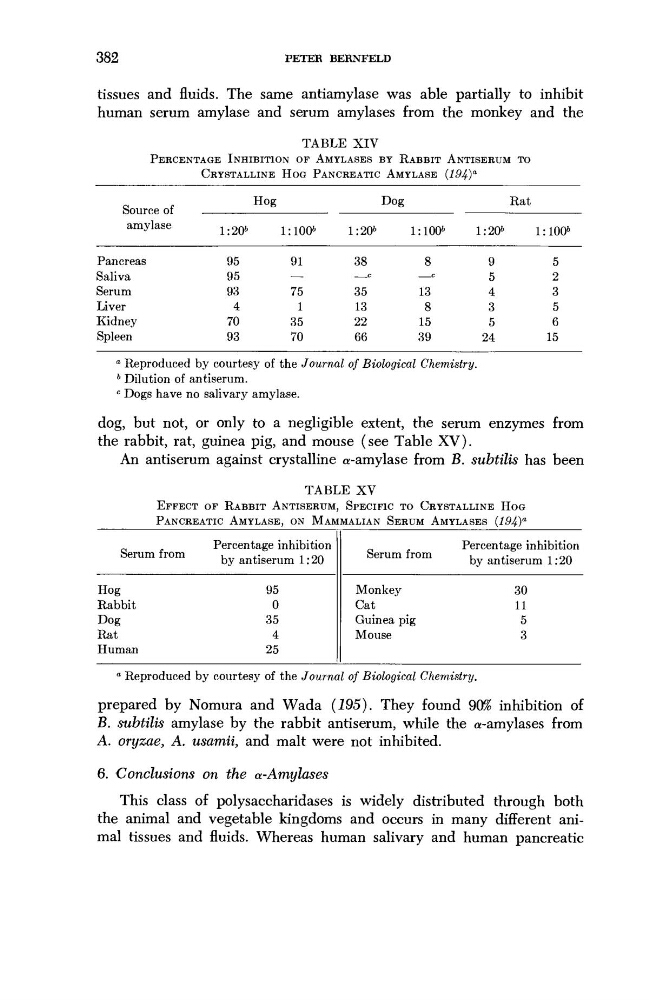
tissues and fluids. The same antiamylase was able partially to inhibit
human serum amylase and serum amylases from the monkey and the
TABLE XIV
PERCENTAGE INHIBITION OF AMYLASES BY RABBIT ANTISERUM TO
CRYSTALLINE HOG PANCREATIC AMYLASE {194Y
Source of
amylase
Pancreas
Saliva
Serum
Liver
Kidney
Spleen
1:20
6
95
95
93
4
70
93
Hog
1:100
6
91
—
75
1
35
70
1:20
6
38
c
35
13
22
66
Dog
1:100
6
8
c
13
8
15
39
1:20
6
9
5
4
3
5
24
Rat
1:100
&
5
2
3
5
6
15
° Reproduced by courtesy of the Journal of Biological Chemistry.
b Dilution of antiserum.
c Dogs have no salivary amylase.
dog, but not, or only to a negligible extent, the serum enzymes from
the rabbit, rat, guinea pig, and mouse (see Table XV).
An antiserum against crystalline α-amylase from B. subtilis has been
TABLE XV
EFFECT OF RABBIT ANTISERUM, SPECIFIC TO CRYSTALLINE HOG
PANCREATIC AMYLASE, ON MAMMALIAN SERUM AMYLASES (194)
a
Serum from
Percentage inhibition
by antiserum 1:20
Hog
Rabbit
Dog
Rat
Human
95
0
35
4
25
Serum from
Percentage inhibition
by antiserum 1:20
Monkey
Cat
Guinea pig
Mouse
30
11
5
3
1 Reproduced by courtesy of the Journal of Biological Chemistry.
prepared by Nomura and Wada (195). They found 90% inhibition of
B. subtilis amylase by the rabbit antiserum, while the α-amylases from
A. oryzae, A. usamii, and malt were not inhibited.
6. Conclusions on the a-Amylases
This class of polysaccharidases is widely distributed through both
the animal and vegetable kingdoms and occurs in many different animal tissues and fluids. Whereas human salivary and human pancreatic
PETER BERNFELD
tissues and fluids. The same antiamylase was able partially to inhibit
human serum amylase and serum amylases from the monkey and the
TABLE XIV
PERCENTAGE INHIBITION OF AMYLASES BY RABBIT ANTISERUM TO
CRYSTALLINE HOG PANCREATIC AMYLASE {194Y
Source of
amylase
Pancreas
Saliva
Serum
Liver
Kidney
Spleen
1:20
6
95
95
93
4
70
93
Hog
1:100
6
91
—
75
1
35
70
1:20
6
38
c
35
13
22
66
Dog
1:100
6
8
c
13
8
15
39
1:20
6
9
5
4
3
5
24
Rat
1:100
&
5
2
3
5
6
15
° Reproduced by courtesy of the Journal of Biological Chemistry.
b Dilution of antiserum.
c Dogs have no salivary amylase.
dog, but not, or only to a negligible extent, the serum enzymes from
the rabbit, rat, guinea pig, and mouse (see Table XV).
An antiserum against crystalline α-amylase from B. subtilis has been
TABLE XV
EFFECT OF RABBIT ANTISERUM, SPECIFIC TO CRYSTALLINE HOG
PANCREATIC AMYLASE, ON MAMMALIAN SERUM AMYLASES (194)
a
Serum from
Percentage inhibition
by antiserum 1:20
Hog
Rabbit
Dog
Rat
Human
95
0
35
4
25
Serum from
Percentage inhibition
by antiserum 1:20
Monkey
Cat
Guinea pig
Mouse
30
11
5
3
1 Reproduced by courtesy of the Journal of Biological Chemistry.
prepared by Nomura and Wada (195). They found 90% inhibition of
B. subtilis amylase by the rabbit antiserum, while the α-amylases from
A. oryzae, A. usamii, and malt were not inhibited.
6. Conclusions on the a-Amylases
This class of polysaccharidases is widely distributed through both
the animal and vegetable kingdoms and occurs in many different animal tissues and fluids. Whereas human salivary and human pancreatic