

8. POLYSACCHARIDASES
365
(J). Salivary amylase. The concentration of this enzyme, formerly
also called ptyalin, depends very much on the animal species. According to Oppenheimer (47) three main classes of the potency of salivary
amylase in various animals can be distinguished: (a) High activities
in man and ape (48), in most fungivores and herbivores; i.e., lamb,
rabbit, rat, mouse, guinea pig, squirrel (49); exceptions are the horse,
beef, goat, rabbit, deer, and sheep (50-52). (b) Low activities in omnivores, i.e., swine, bear; in ruminants, i.e., beef, sheep, goat, deer, (c)
No activity in carnivores; i.e., dog and cat (53, 54).
The activity of salivary amylase in the horse has been reported to
be low by some investigators and inexistent by others (55, 56), but a
zymogen has been described in the saliva of horses which is believed
to be activated to amylase by oxygen (43).
Amylase has further been found in the saliva of amphibians, like
the frog and toad (57), and in the oral mucosa of fishes (43), but no
salivary amylase could be detected in birds (chicken) (58).
With certain exceptions some relationship appears to exist between
the starch content of the food of an animal species and the activity of
salivary amylase of the animal. It has to be realized, however, that the
above classification is rough and does not apply to every animal species.
Furthermore, considerable differences in the amylase potency exist
within each group. Thus, it has been reported that the average salivary
amylase activity in the rat (91,000-1,340,000/100ml.) is several times
that in human saliva (50,000-200,000 units/100 ml.) (45), but wide
variations exist in both.
TABLE III
AMYLASE LEVELS OF MOUSE SUBMAXILLARY-SUBLINGUAL GLANDS (59)
a
Strain
CFW
C57BL/6
C3H
DBA/1
F!(C3H-DBA/1)
Number of animals
22
14
35
41
15
Mean amylase level
6
0.15 (0.012)
c
0.14 (0.006)
0.19 (0.008)
0.10 (0.003)
0.15 (0.008)
α Reproduced by courtesy of the Society for Experimental Biology and Medicine.
b Measured according to the method of Myers et al. (60) and expressed in terms of
milligrams of reducing sugar found per milligram wet weight of gland.
c Standard error of mean in parentheses.
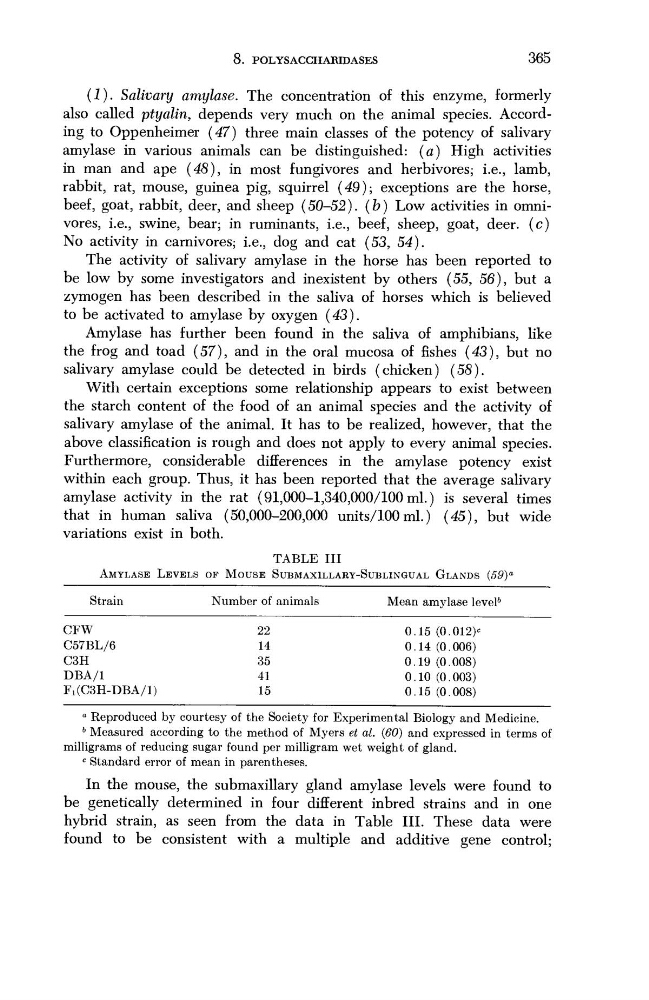
In the mouse, the submaxillary gland amylase levels were found to
be genetically determined in four different inbred strains and in one
hybrid strain, as seen from the data in Table III. These data were
found to be consistent with a multiple and additive gene control;
365
(J). Salivary amylase. The concentration of this enzyme, formerly
also called ptyalin, depends very much on the animal species. According to Oppenheimer (47) three main classes of the potency of salivary
amylase in various animals can be distinguished: (a) High activities
in man and ape (48), in most fungivores and herbivores; i.e., lamb,
rabbit, rat, mouse, guinea pig, squirrel (49); exceptions are the horse,
beef, goat, rabbit, deer, and sheep (50-52). (b) Low activities in omnivores, i.e., swine, bear; in ruminants, i.e., beef, sheep, goat, deer, (c)
No activity in carnivores; i.e., dog and cat (53, 54).
The activity of salivary amylase in the horse has been reported to
be low by some investigators and inexistent by others (55, 56), but a
zymogen has been described in the saliva of horses which is believed
to be activated to amylase by oxygen (43).
Amylase has further been found in the saliva of amphibians, like
the frog and toad (57), and in the oral mucosa of fishes (43), but no
salivary amylase could be detected in birds (chicken) (58).
With certain exceptions some relationship appears to exist between
the starch content of the food of an animal species and the activity of
salivary amylase of the animal. It has to be realized, however, that the
above classification is rough and does not apply to every animal species.
Furthermore, considerable differences in the amylase potency exist
within each group. Thus, it has been reported that the average salivary
amylase activity in the rat (91,000-1,340,000/100ml.) is several times
that in human saliva (50,000-200,000 units/100 ml.) (45), but wide
variations exist in both.
TABLE III
AMYLASE LEVELS OF MOUSE SUBMAXILLARY-SUBLINGUAL GLANDS (59)
a
Strain
CFW
C57BL/6
C3H
DBA/1
F!(C3H-DBA/1)
Number of animals
22
14
35
41
15
Mean amylase level
6
0.15 (0.012)
c
0.14 (0.006)
0.19 (0.008)
0.10 (0.003)
0.15 (0.008)
α Reproduced by courtesy of the Society for Experimental Biology and Medicine.
b Measured according to the method of Myers et al. (60) and expressed in terms of
milligrams of reducing sugar found per milligram wet weight of gland.
c Standard error of mean in parentheses.
In the mouse, the submaxillary gland amylase levels were found to
be genetically determined in four different inbred strains and in one
hybrid strain, as seen from the data in Table III. These data were
found to be consistent with a multiple and additive gene control;