

7. MONOSACCHARIDES AND OLIGOSACCHARIDES
331
contributed much to our subsequent knowledge of the structure of
agar, in numerous papers published in the Bulletin of the Chemical
Society of Japan and elsewhere (199).
In 1954 O'Neill reported the isolation of a derivative of the optical
isomer of the above substance, namely 3,6-anhydro-D-galactose (XC)
from the fcappa-carrageenin of Chondrus crispus (200) and E. E.
Percival simultaneously isolated the same substance from Chondrus
whole polysaccharide (201).
Whether the units derived from the 3,6-anhydro sugars are formed
by the algae in vivo, or whether they arise during isolation through
loss of sulfate ester groups with concomitant formation of the internal
ether is not known. It is important to note that the 3,6-anhydrohexose
gives some color tests normally attributable to hexuloses, e.g., the
Selivanoff reaction.
Polysaccharides from other red algae, Gliopeltis furcate and Chondrus oceUatus, both contain 3,6-anhydro-L-galactose units (107a, 110a).
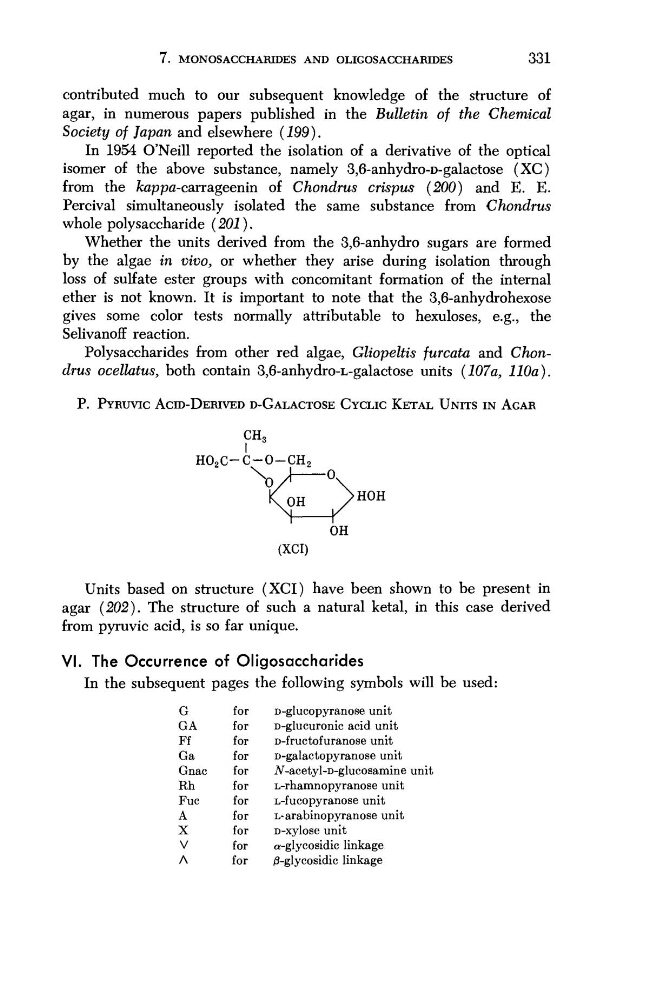
P. PYRUVIC ACID-DERIVED D-GALACTOSE CYCLIC KETAL UNITS IN AGAR
CH 3
H0 2 C-C-0-CH 2
OH
>
H0H
OH
(XCI)
Units based on structure (XCI) have been shown to be present in
agar (202). The structure of such a natural ketal, in this case derived
from pyruvic acid, is so far unique.
VI. The Occurrence of Oligosaccharides
In the subsequent pages the following symbols will be used:
D-glucopyranose unit
D-glucuronic acid unit
D-fructofuranose unit
D-galactopyranose unit
7V-acetyl-D-glucosamine unit
L-rhamnopyranose unit
L-fucopyranose unit
L-arabinopyranose unit
D-xylose unit
α-glycosidic linkage
Λ
for
/3-glycosidic linkage
G
GA
Ff
Ga
Gnac
Rh
Fuc
A
X
V
for
for
for
for
for
for
for
for
for
for
331
contributed much to our subsequent knowledge of the structure of
agar, in numerous papers published in the Bulletin of the Chemical
Society of Japan and elsewhere (199).
In 1954 O'Neill reported the isolation of a derivative of the optical
isomer of the above substance, namely 3,6-anhydro-D-galactose (XC)
from the fcappa-carrageenin of Chondrus crispus (200) and E. E.
Percival simultaneously isolated the same substance from Chondrus
whole polysaccharide (201).
Whether the units derived from the 3,6-anhydro sugars are formed
by the algae in vivo, or whether they arise during isolation through
loss of sulfate ester groups with concomitant formation of the internal
ether is not known. It is important to note that the 3,6-anhydrohexose
gives some color tests normally attributable to hexuloses, e.g., the
Selivanoff reaction.
Polysaccharides from other red algae, Gliopeltis furcate and Chondrus oceUatus, both contain 3,6-anhydro-L-galactose units (107a, 110a).
P. PYRUVIC ACID-DERIVED D-GALACTOSE CYCLIC KETAL UNITS IN AGAR
CH 3
H0 2 C-C-0-CH 2
OH
>
H0H
OH
(XCI)
Units based on structure (XCI) have been shown to be present in
agar (202). The structure of such a natural ketal, in this case derived
from pyruvic acid, is so far unique.
VI. The Occurrence of Oligosaccharides
In the subsequent pages the following symbols will be used:
D-glucopyranose unit
D-glucuronic acid unit
D-fructofuranose unit
D-galactopyranose unit
7V-acetyl-D-glucosamine unit
L-rhamnopyranose unit
L-fucopyranose unit
L-arabinopyranose unit
D-xylose unit
α-glycosidic linkage
Λ
for
/3-glycosidic linkage
G
GA
Ff
Ga
Gnac
Rh
Fuc
A
X
V
for
for
for
for
for
for
for
for
for
for