

7. MONOSACCHARIDES AND OLIGOSACCHARIDES
329
CHO
I
H—C—OH
I
H—C—O · CONH 2
I
CH 3 0—C—H
I
c
/l\
CH 3 OHCH3
(LXXXVIII)
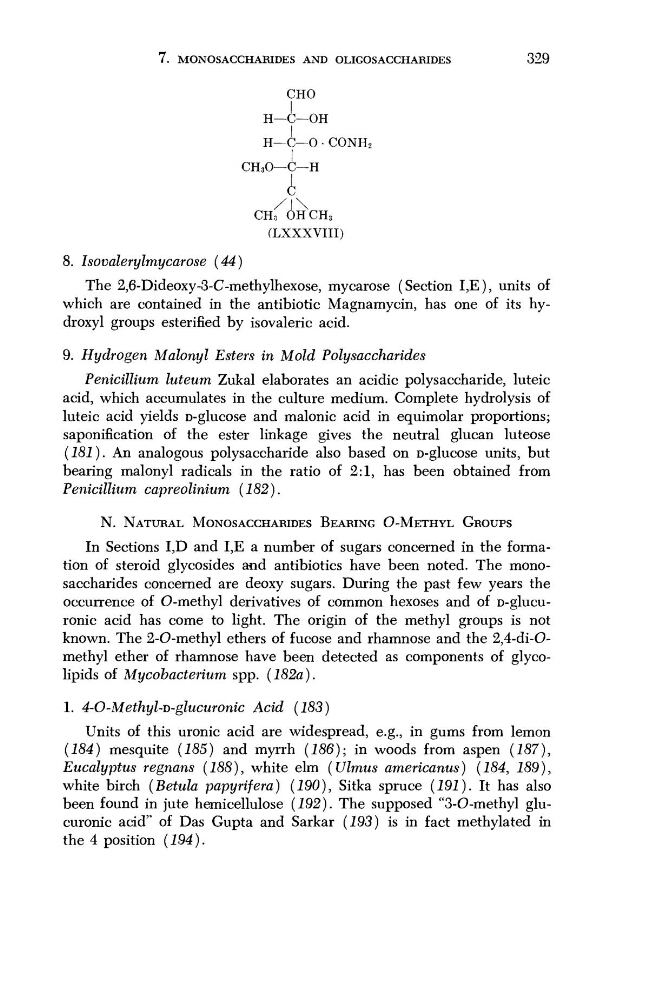
8. Isovalerylmycarose (44)
The 2,6-Dideoxy-3-C-methylhexose, mycarose (Section I,E), units of
which are contained in the antibiotic Magnamycin, has one of its hydroxyl groups esterified by isovaleric acid.
9. Hydrogen Malonyl Esters in Mold Polysaccharides
Penicillium luteum Zukal elaborates an acidic polysaccharide, luteic
acid, which accumulates in the culture medium. Complete hydrolysis of
luteic acid yields D-glucose and malonic acid in equimolar proportions;
saponification of the ester linkage gives the neutral glucan luteose
(181). An analogous polysaccharide also based on D-glucose units, but
bearing malonyl radicals in the ratio of 2:1, has been obtained from
Penicillium capreolinium (182).
N. NATURAL MONOSACCHARIDES BEARING O-METHYL GROUPS
In Sections I,D and I,E a number of sugars concerned in the formation of steroid glycosides and antibiotics have been noted. The monosaccharides concerned are deoxy sugars. During the past few years the
occurrence of O-methyl derivatives of common hexoses and of D-glucuronic acid has come to light. The origin of the methyl groups is not
known. The 2-O-methyl ethers of fucose and rhamnose and the 2,4-di-Omethyl ether of rhamnose have been detected as components of glycolipids of Mycobacterium spp. (182a).
1. 4-O-Methyl-O-glucuronic Acid (183)
Units of this uronic acid are widespread, e.g., in gums from lemon
(184) mesquite (185) and myrrh (186); in woods from aspen (187),
Eucalyptus regnans (188), white elm (Ulmus americanus) (184, 189),
white birch (Betula papyrifera) (190), Sitka spruce (191). It has also
been found in jute hemicellulose (192). The supposed "3-O-methyl glucuronic acid" of Das Gupta and Sarkar (193) is in fact methylated in
the 4 position (194).
329
CHO
I
H—C—OH
I
H—C—O · CONH 2
I
CH 3 0—C—H
I
c
/l\
CH 3 OHCH3
(LXXXVIII)
8. Isovalerylmycarose (44)
The 2,6-Dideoxy-3-C-methylhexose, mycarose (Section I,E), units of
which are contained in the antibiotic Magnamycin, has one of its hydroxyl groups esterified by isovaleric acid.
9. Hydrogen Malonyl Esters in Mold Polysaccharides
Penicillium luteum Zukal elaborates an acidic polysaccharide, luteic
acid, which accumulates in the culture medium. Complete hydrolysis of
luteic acid yields D-glucose and malonic acid in equimolar proportions;
saponification of the ester linkage gives the neutral glucan luteose
(181). An analogous polysaccharide also based on D-glucose units, but
bearing malonyl radicals in the ratio of 2:1, has been obtained from
Penicillium capreolinium (182).
N. NATURAL MONOSACCHARIDES BEARING O-METHYL GROUPS
In Sections I,D and I,E a number of sugars concerned in the formation of steroid glycosides and antibiotics have been noted. The monosaccharides concerned are deoxy sugars. During the past few years the
occurrence of O-methyl derivatives of common hexoses and of D-glucuronic acid has come to light. The origin of the methyl groups is not
known. The 2-O-methyl ethers of fucose and rhamnose and the 2,4-di-Omethyl ether of rhamnose have been detected as components of glycolipids of Mycobacterium spp. (182a).
1. 4-O-Methyl-O-glucuronic Acid (183)
Units of this uronic acid are widespread, e.g., in gums from lemon
(184) mesquite (185) and myrrh (186); in woods from aspen (187),
Eucalyptus regnans (188), white elm (Ulmus americanus) (184, 189),
white birch (Betula papyrifera) (190), Sitka spruce (191). It has also
been found in jute hemicellulose (192). The supposed "3-O-methyl glucuronic acid" of Das Gupta and Sarkar (193) is in fact methylated in
the 4 position (194).