

7. MONOSACCHARIDES AND OLIGOSACCHARIDES
325
L. URONIC ACIDS
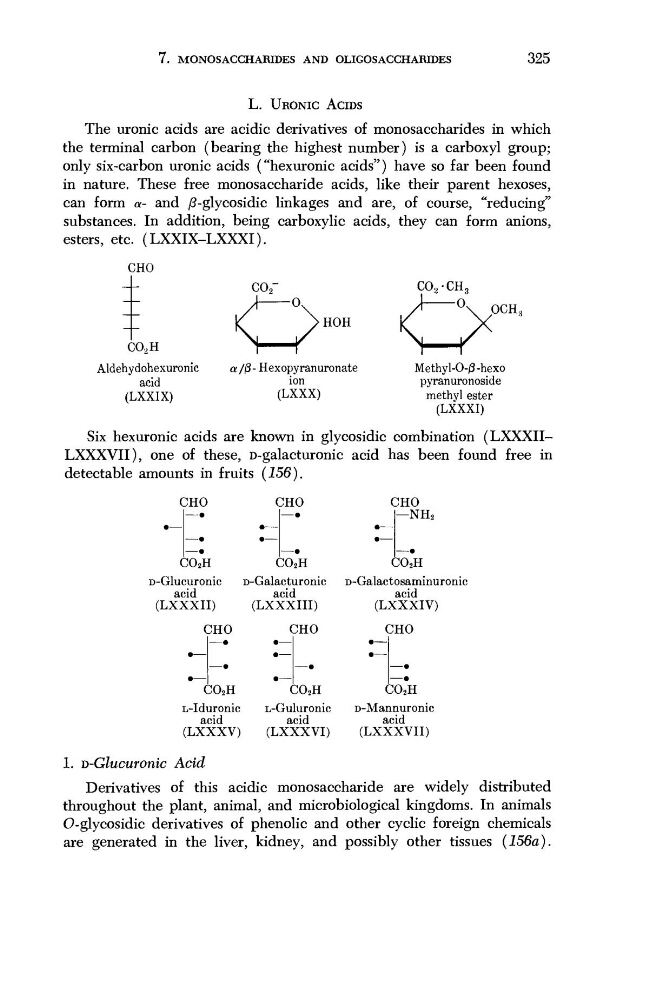
The uronic acids are acidic derivatives of monosaccharides in which
the terminal carbon (bearing the highest number) is a carboxyl group;
only six-carbon uronic acids ("hexuronic acids") have so far been found
in nature. These free monosaccharide acids, like their parent hexoses,
can form a- and ß-glycosidic linkages and are, of course, "reducing"
substances. In addition, being carboxylic acids, they can form anions,
esters, etc. (LXXIX-LXXXI).
CHO
C0 2 H
C0 9 -CH
Aldehydohexuronic
acid
(LXXIX)
HOH
a/ß- Hexopyranuronate
ion
(LXXX)
OCH 3
Methyl-O-0-hexo
pyranuronoside
methyl ester
(LXXXI)
Six hexuronic acids are known in glycosidic combination (LXXXIILXXXVII), one of these, D-galacturonic acid has been found free in
detectable amounts in fruits (156).
(
•—
(
DHO
—·
—·
:O 2 H
(
•—
•—
(
}HO
—·
UO2H
D-Glucuronic
D-Galacturonic
acid
acid
(LXXXII)
(LXXXIII)
CHO
•—
•—
(
L-Idi
a
(LX.
—·
—·
:O 2 H
uronic
cid
XXV)
CHO
•—
•—
•—
(
L-(
(L
jrU
a
x:
—·
U0 2 H
[uronic
cid
XXVI)
•—
•—
CHO
1—NH 2
C0 2 H
D-Galactosaminuronic
acid
(LXXXIV)
CHO
•—1
•—
c
D-Man
a<
(LXX
—·
;O 2 H
nuronic
3id
XVII)
1. Ό-Glucuronic Acid
Derivatives of this acidic monosaccharide are widely distributed
throughout the plant, animal, and microbiological kingdoms. In animals
O-glycosidic derivatives of phenolic and other cyclic foreign chemicals
are generated in the liver, kidney, and possibly other tissues (156a).
325
L. URONIC ACIDS
The uronic acids are acidic derivatives of monosaccharides in which
the terminal carbon (bearing the highest number) is a carboxyl group;
only six-carbon uronic acids ("hexuronic acids") have so far been found
in nature. These free monosaccharide acids, like their parent hexoses,
can form a- and ß-glycosidic linkages and are, of course, "reducing"
substances. In addition, being carboxylic acids, they can form anions,
esters, etc. (LXXIX-LXXXI).
CHO
C0 2 H
C0 9 -CH
Aldehydohexuronic
acid
(LXXIX)
HOH
a/ß- Hexopyranuronate
ion
(LXXX)
OCH 3
Methyl-O-0-hexo
pyranuronoside
methyl ester
(LXXXI)
Six hexuronic acids are known in glycosidic combination (LXXXIILXXXVII), one of these, D-galacturonic acid has been found free in
detectable amounts in fruits (156).
(
•—
(
DHO
—·
—·
:O 2 H
(
•—
•—
(
}HO
—·
UO2H
D-Glucuronic
D-Galacturonic
acid
acid
(LXXXII)
(LXXXIII)
CHO
•—
•—
(
L-Idi
a
(LX.
—·
—·
:O 2 H
uronic
cid
XXV)
CHO
•—
•—
•—
(
L-(
(L
jrU
a
x:
—·
U0 2 H
[uronic
cid
XXVI)
•—
•—
CHO
1—NH 2
C0 2 H
D-Galactosaminuronic
acid
(LXXXIV)
CHO
•—1
•—
c
D-Man
a<
(LXX
—·
;O 2 H
nuronic
3id
XVII)
1. Ό-Glucuronic Acid
Derivatives of this acidic monosaccharide are widely distributed
throughout the plant, animal, and microbiological kingdoms. In animals
O-glycosidic derivatives of phenolic and other cyclic foreign chemicals
are generated in the liver, kidney, and possibly other tissues (156a).