

7. MONOSACCHARIDES AND OLIGOSACCHARIDES
305
The example of apiose (8), which is found only in glycosidic union,
presents considerable difficulties. Formulated in the aldehydo form the
natural isomer belongs to the D-series.
CHO
i
I
H-C-OH
2
I
4' HOH 2 C^ |
x CH 2 OH 4
OH
C-2 is the highest numbered (and only) asymmetric center; it has been
proved to have the configuration of D-glyceraldehyde. Apiose can form
only a furanose ring, as it must when in glycosidic combination. When
it forms such a ring a new asymmetric center is generated at C~3. This
new asymmetric center must, by definition, define the stereochemical
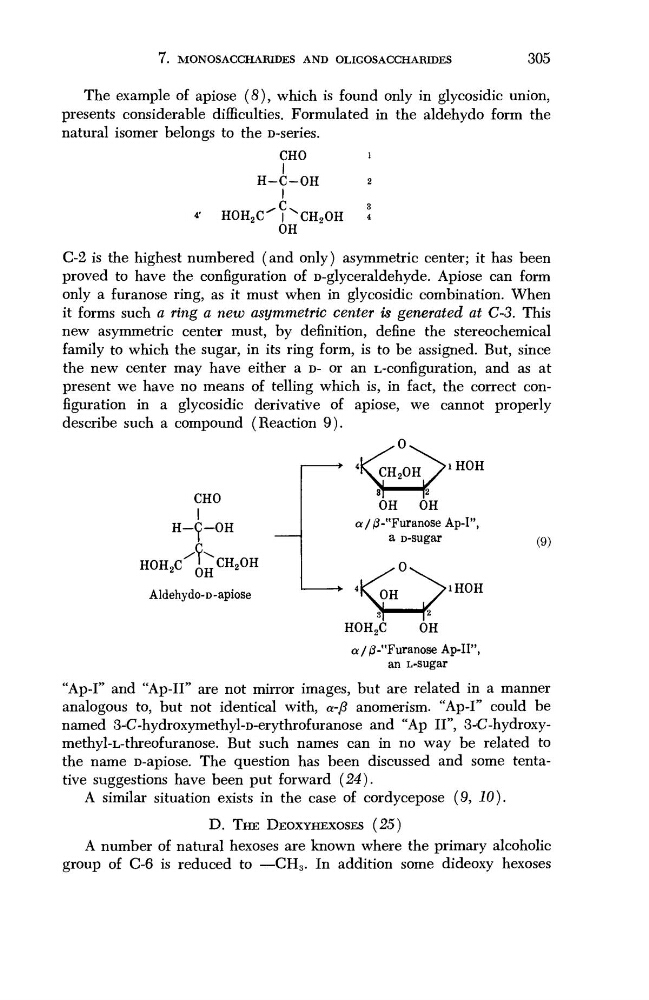
family to which the sugar, in its ring form, is to be assigned. But, since
the new center may have either a D- or an L-configuration, and as at
present we have no means of telling which is, in fact, the correct configuration in a glycosidic derivative of apiose, we cannot properly
describe such a compound (Reaction 9).
ιΗΟΗ
Αρ-Γ,
(9)
iHOH
a /ß-"Furanose Αρ-ΙΓ',
an L-sugar
"Ap-I" and "Ap-II" are not mirror images, but are related in a manner
analogous to, but not identical with, a-ß anomerism. "Ap-I" could be
named 3-C-hydroxymethyl-D-erythrofuranose and "Ap Π", 3-C-hydroxymethyl-L-threofuranose. But such names can in no way be related to
the name D-apiose. The question has been discussed and some tentative suggestions have been put forward (24).
A similar situation exists in the case of cordycepose (9, 10).
D. THE DEOXYHEXOSES
(25)
A number of natural hexoses are known where the primary alcoholic
group of C-6 is reduced to —CH 3 . In addition some dideoxy hexoses
H0H 2 C
CHO
I
H-C-OH
CH 2 OH
^
OH
Aldehydo-D-apiose
OH OH
a / ß-"Furanose .
a D-sugar
H0H 9 C
305
The example of apiose (8), which is found only in glycosidic union,
presents considerable difficulties. Formulated in the aldehydo form the
natural isomer belongs to the D-series.
CHO
i
I
H-C-OH
2
I
4' HOH 2 C^ |
x CH 2 OH 4
OH
C-2 is the highest numbered (and only) asymmetric center; it has been
proved to have the configuration of D-glyceraldehyde. Apiose can form
only a furanose ring, as it must when in glycosidic combination. When
it forms such a ring a new asymmetric center is generated at C~3. This
new asymmetric center must, by definition, define the stereochemical
family to which the sugar, in its ring form, is to be assigned. But, since
the new center may have either a D- or an L-configuration, and as at
present we have no means of telling which is, in fact, the correct configuration in a glycosidic derivative of apiose, we cannot properly
describe such a compound (Reaction 9).
ιΗΟΗ
Αρ-Γ,
(9)
iHOH
a /ß-"Furanose Αρ-ΙΓ',
an L-sugar
"Ap-I" and "Ap-II" are not mirror images, but are related in a manner
analogous to, but not identical with, a-ß anomerism. "Ap-I" could be
named 3-C-hydroxymethyl-D-erythrofuranose and "Ap Π", 3-C-hydroxymethyl-L-threofuranose. But such names can in no way be related to
the name D-apiose. The question has been discussed and some tentative suggestions have been put forward (24).
A similar situation exists in the case of cordycepose (9, 10).
D. THE DEOXYHEXOSES
(25)
A number of natural hexoses are known where the primary alcoholic
group of C-6 is reduced to —CH 3 . In addition some dideoxy hexoses
H0H 2 C
CHO
I
H-C-OH
CH 2 OH
^
OH
Aldehydo-D-apiose
OH OH
a / ß-"Furanose .
a D-sugar
H0H 9 C