

210
G. A. D. HASLEWOOD
(46) and rat (47) bile as well as in men (48) and bears. Recently,
3a,7/?,12«-trihydroxycholanic acid has been found to be formed in rat
bile in metabolic experiments (48). Coypu and guinea pig bile also contain 3a-hydroxy-7-oxocholanic acid (46, 49); other keto acids have
been isolated from various biles (4).
The well-known deoxycholic acid, 3a,12«-dihydroxycholanic acid, is
probably (48), like some of the acids mentioned above, and also lithocholic (3«-hydroxycholanic) acid, made from other bile acids by
microbial action in the intestine rather than directly by the liver itself.
An acid which was given the formula C 27 H 4G 0 6 and named "tetrahydroxynorsterocholanic acid" was isolated by Ohta in 1939 (31) from
the bile of the Japanese "Gigi" fish, Pelteobagrus nudiceps. The same
acid was later obtained from other fishes, and Yamasaki (50) found it
in chicken bile. Ohta suggested that it was a 3,6,12,24-tetrahydroxycoprostanic acid, and Isaka (51) claimed to support this structure by conversion of Ohta's acid to hyodeoxycholic and to 12-oxocholanic acids.
On infrared spectral evidence, the writer and Wootton (52) suggested
that Ohta's acid must have hydroxyl groups at 3«, 7« and 12« in a
cholane structure. When Anderson et ah were able to examine a larger
quantity of the ethyl ester of this acid, isolated from King penguin bile
(53), they concluded that the ester might well be isomeric with ethyl
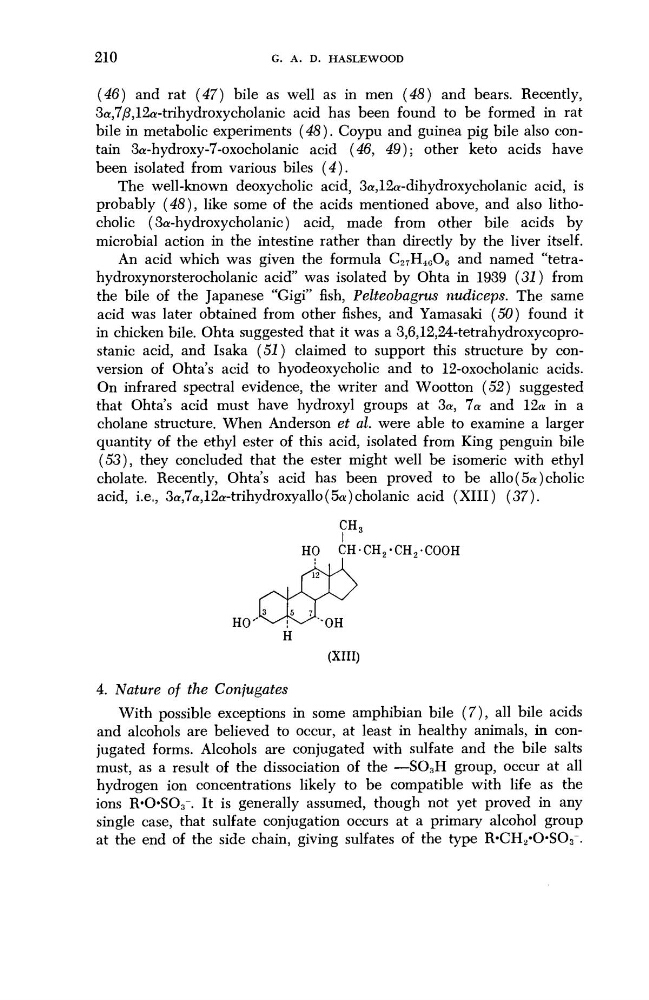
cholate. Recently, Ohta's acid has been proved to be allo(5a)cholic
acid, i.e., 3a,7a,12a-trihydroxyallo(5a)cholanic acid (XIII) (37).
CH 3
I
HO CH-CH 2 -CH 2 -COOH
U Jo 71
HO''^-^Ν^^ΟΗ
H
(ΧΠΙ)
4. Nature of the Conjugates
With possible exceptions in some amphibian bile (7), all bile acids
and alcohols are believed to occur, at least in healthy animals, in conjugated forms. Alcohols are conjugated with sulfate and the bile salts
must, as a result of the dissociation of the —S0 3 H group, occur at all
hydrogen ion concentrations likely to be compatible with life as the
ions R
# O
e S0 3 ~. It is generally assumed, though not yet proved in any
single case, that sulfate conjugation occurs at a primary alcohol group
at the end of the side chain, giving sulfates of the type R*CH 2 *0'S0 3 ~.
G. A. D. HASLEWOOD
(46) and rat (47) bile as well as in men (48) and bears. Recently,
3a,7/?,12«-trihydroxycholanic acid has been found to be formed in rat
bile in metabolic experiments (48). Coypu and guinea pig bile also contain 3a-hydroxy-7-oxocholanic acid (46, 49); other keto acids have
been isolated from various biles (4).
The well-known deoxycholic acid, 3a,12«-dihydroxycholanic acid, is
probably (48), like some of the acids mentioned above, and also lithocholic (3«-hydroxycholanic) acid, made from other bile acids by
microbial action in the intestine rather than directly by the liver itself.
An acid which was given the formula C 27 H 4G 0 6 and named "tetrahydroxynorsterocholanic acid" was isolated by Ohta in 1939 (31) from
the bile of the Japanese "Gigi" fish, Pelteobagrus nudiceps. The same
acid was later obtained from other fishes, and Yamasaki (50) found it
in chicken bile. Ohta suggested that it was a 3,6,12,24-tetrahydroxycoprostanic acid, and Isaka (51) claimed to support this structure by conversion of Ohta's acid to hyodeoxycholic and to 12-oxocholanic acids.
On infrared spectral evidence, the writer and Wootton (52) suggested
that Ohta's acid must have hydroxyl groups at 3«, 7« and 12« in a
cholane structure. When Anderson et ah were able to examine a larger
quantity of the ethyl ester of this acid, isolated from King penguin bile
(53), they concluded that the ester might well be isomeric with ethyl
cholate. Recently, Ohta's acid has been proved to be allo(5a)cholic
acid, i.e., 3a,7a,12a-trihydroxyallo(5a)cholanic acid (XIII) (37).
CH 3
I
HO CH-CH 2 -CH 2 -COOH
U Jo 71
HO''^-^Ν^^ΟΗ
H
(ΧΠΙ)
4. Nature of the Conjugates
With possible exceptions in some amphibian bile (7), all bile acids
and alcohols are believed to occur, at least in healthy animals, in conjugated forms. Alcohols are conjugated with sulfate and the bile salts
must, as a result of the dissociation of the —S0 3 H group, occur at all
hydrogen ion concentrations likely to be compatible with life as the
ions R
# O
e S0 3 ~. It is generally assumed, though not yet proved in any
single case, that sulfate conjugation occurs at a primary alcohol group
at the end of the side chain, giving sulfates of the type R*CH 2 *0'S0 3 ~.