

208
G. A. D. HASLEWOOD
these acids, 25« (4), was found in the biles of crocodiles and an alligator (26), and converted to its "stem acid," 25<*-coprostanic acid,
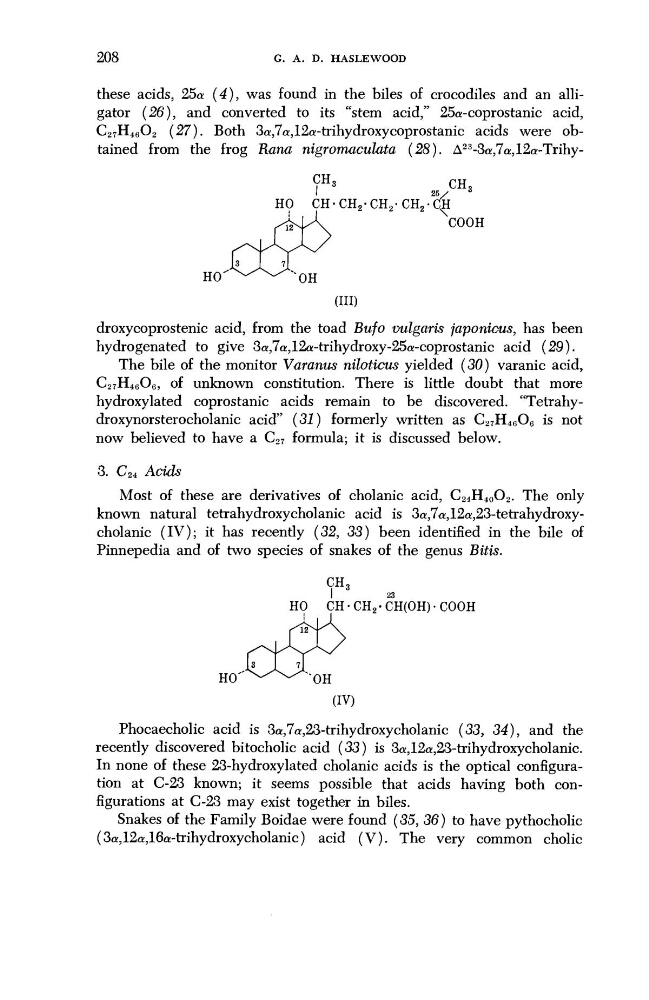
C 2 7H 46 02 (27). Both 3a,7a,12a-trihydroxycoprostanic acids were obtained from the frog Rana nigromaculata (28). A
23 -3«,7a,12«-TrihyHO"
CH,
CH · CHo· CHo· CH« •cii
COOH
(III)
droxycoprostenic acid, from the toad Bufo vulgaris japonicus, has been
hydrogenated to give 3a,7a,12a-trihydroxy-25a-coprostanic acid (29).
The bile of the monitor Vuranus niloticus yielded (30) varanic acid,
C 27 H 46 0 6 , of unknown constitution. There is little doubt that more
hydroxylated coprostanic acids remain to be discovered. "Tetrahydroxynorsterocholanic acid" (31) formerly written as C 2 7H 46 0 6 is not
now believed to have a C 27 formula; it is discussed below.
3. C 24 Acids
Most of these are derivatives of cholanic acid, C 24 H 4 o02. The only
known natural tetrahydroxycholanic acid is 3a,7a,12a,23-tetrahydroxycholanic (IV); it has recently (32, 33) been identified in the bile of
Pinnepedia and of two species of snakes of the genus Bitis.
CH,
HO CH · CH 2 · CH(OH) · COOH
OH
(IV)
Phocaecholic acid is 3a,7a,23-trihydroxycholanic (33, 34), and the
recently discovered bitocholic acid (33) is 3«, 12a,23-trihydroxy cholanic.
In none of these 23-hydroxylated cholanic acids is the optical configuration at C-23 known; it seems possible that acids having both configurations at C-23 may exist together in biles.
Snakes of the Family Boidae were found (35, 36) to have pythocholic
(3a,12a,16a-trihydroxycholanic) acid (V). The very common cholic
G. A. D. HASLEWOOD
these acids, 25« (4), was found in the biles of crocodiles and an alligator (26), and converted to its "stem acid," 25<*-coprostanic acid,
C 2 7H 46 02 (27). Both 3a,7a,12a-trihydroxycoprostanic acids were obtained from the frog Rana nigromaculata (28). A
23 -3«,7a,12«-TrihyHO"
CH,
CH · CHo· CHo· CH« •cii
COOH
(III)
droxycoprostenic acid, from the toad Bufo vulgaris japonicus, has been
hydrogenated to give 3a,7a,12a-trihydroxy-25a-coprostanic acid (29).
The bile of the monitor Vuranus niloticus yielded (30) varanic acid,
C 27 H 46 0 6 , of unknown constitution. There is little doubt that more
hydroxylated coprostanic acids remain to be discovered. "Tetrahydroxynorsterocholanic acid" (31) formerly written as C 2 7H 46 0 6 is not
now believed to have a C 27 formula; it is discussed below.
3. C 24 Acids
Most of these are derivatives of cholanic acid, C 24 H 4 o02. The only
known natural tetrahydroxycholanic acid is 3a,7a,12a,23-tetrahydroxycholanic (IV); it has recently (32, 33) been identified in the bile of
Pinnepedia and of two species of snakes of the genus Bitis.
CH,
HO CH · CH 2 · CH(OH) · COOH
OH
(IV)
Phocaecholic acid is 3a,7a,23-trihydroxycholanic (33, 34), and the
recently discovered bitocholic acid (33) is 3«, 12a,23-trihydroxy cholanic.
In none of these 23-hydroxylated cholanic acids is the optical configuration at C-23 known; it seems possible that acids having both configurations at C-23 may exist together in biles.
Snakes of the Family Boidae were found (35, 36) to have pythocholic
(3a,12a,16a-trihydroxycholanic) acid (V). The very common cholic