

1. FATTY ACID OCCURRENCE AND DISTRIBUTION
9
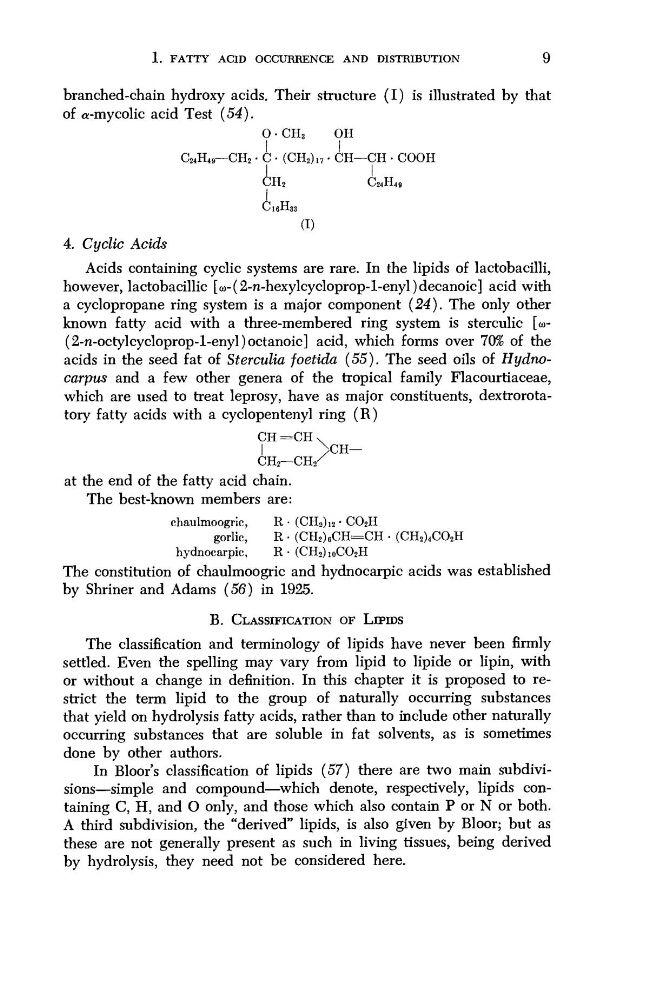
branched-chain hydroxy acids. Their structure (I) is illustrated by that
of α-mycolic acid Test (54).
0 · CH 3
OH
I
I
C24H49—CH 2 . C · (CH 2 )i 7 · CH—CH . COOH
C H 2
C24H49
1
C16H33
(I)
4. Cyclic Acids
Acids containing cyclic systems are rare. In the lipids of lactobacilli,
however, lactobacillic [a)-(2-n-hexylcycloprop-l-enyl)decanoic] acid with
a cyclopropane ring system is a major component (24). The only other
known fatty acid with a three-membered ring system is sterculic [ω(2-n-octylcycloprop-l-enyl)octanoic] acid, which forms over 70% of the
acids in the seed fat of Sterculia foetida (55). The seed oils of Hydnocarpus and a few other genera of the tropical family Flacourtiaceae,
which are used to treat leprosy, have as major constituents, dextrorotatory fatty acids with a cyclopentenyl ring (R)
CH =CH v
1
>CHCH 2 —CH/
at the end of the fatty acid chain.
The best-known members are:
chaulmoogric,
R · (CH 2 )i 2 · C0 2 H
gorlic,
R · (CH 2 ) 6 CH=CH · (CH 2 ) 4 C0 2 H
hydnocarpic,
R · (CH 2 ) 10 CO 2 H
The constitution of chaulmoogric and hydnocarpic acids was established
by Shriner and Adams (56) in 1925.
B. CLASSIFICATION OF LIPIDS
The classification and terminology of lipids have never been firmly
settled. Even the spelling may vary from lipid to lipide or lipin, with
or without a change in definition. In this chapter it is proposed to restrict the term lipid to the group of naturally occurring substances
that yield on hydrolysis fatty acids, rather than to include other naturally
occurring substances that are soluble in fat solvents, as is sometimes
done by other authors.
In Bloor's classification of lipids (57) there are two main subdivisions—simple and compound—which denote, respectively, lipids containing C, H, and O only, and those which also contain P or N or both.
A third subdivision, the "derived" lipids, is also given by Bloor; but as
these are not generally present as such in living tissues, being derived
by hydrolysis, they need not be considered here.
9
branched-chain hydroxy acids. Their structure (I) is illustrated by that
of α-mycolic acid Test (54).
0 · CH 3
OH
I
I
C24H49—CH 2 . C · (CH 2 )i 7 · CH—CH . COOH
C H 2
C24H49
1
C16H33
(I)
4. Cyclic Acids
Acids containing cyclic systems are rare. In the lipids of lactobacilli,
however, lactobacillic [a)-(2-n-hexylcycloprop-l-enyl)decanoic] acid with
a cyclopropane ring system is a major component (24). The only other
known fatty acid with a three-membered ring system is sterculic [ω(2-n-octylcycloprop-l-enyl)octanoic] acid, which forms over 70% of the
acids in the seed fat of Sterculia foetida (55). The seed oils of Hydnocarpus and a few other genera of the tropical family Flacourtiaceae,
which are used to treat leprosy, have as major constituents, dextrorotatory fatty acids with a cyclopentenyl ring (R)
CH =CH v
1
>CHCH 2 —CH/
at the end of the fatty acid chain.
The best-known members are:
chaulmoogric,
R · (CH 2 )i 2 · C0 2 H
gorlic,
R · (CH 2 ) 6 CH=CH · (CH 2 ) 4 C0 2 H
hydnocarpic,
R · (CH 2 ) 10 CO 2 H
The constitution of chaulmoogric and hydnocarpic acids was established
by Shriner and Adams (56) in 1925.
B. CLASSIFICATION OF LIPIDS
The classification and terminology of lipids have never been firmly
settled. Even the spelling may vary from lipid to lipide or lipin, with
or without a change in definition. In this chapter it is proposed to restrict the term lipid to the group of naturally occurring substances
that yield on hydrolysis fatty acids, rather than to include other naturally
occurring substances that are soluble in fat solvents, as is sometimes
done by other authors.
In Bloor's classification of lipids (57) there are two main subdivisions—simple and compound—which denote, respectively, lipids containing C, H, and O only, and those which also contain P or N or both.
A third subdivision, the "derived" lipids, is also given by Bloor; but as
these are not generally present as such in living tissues, being derived
by hydrolysis, they need not be considered here.