

188
JAMES K. GRANT
20
21
22
23
24
25
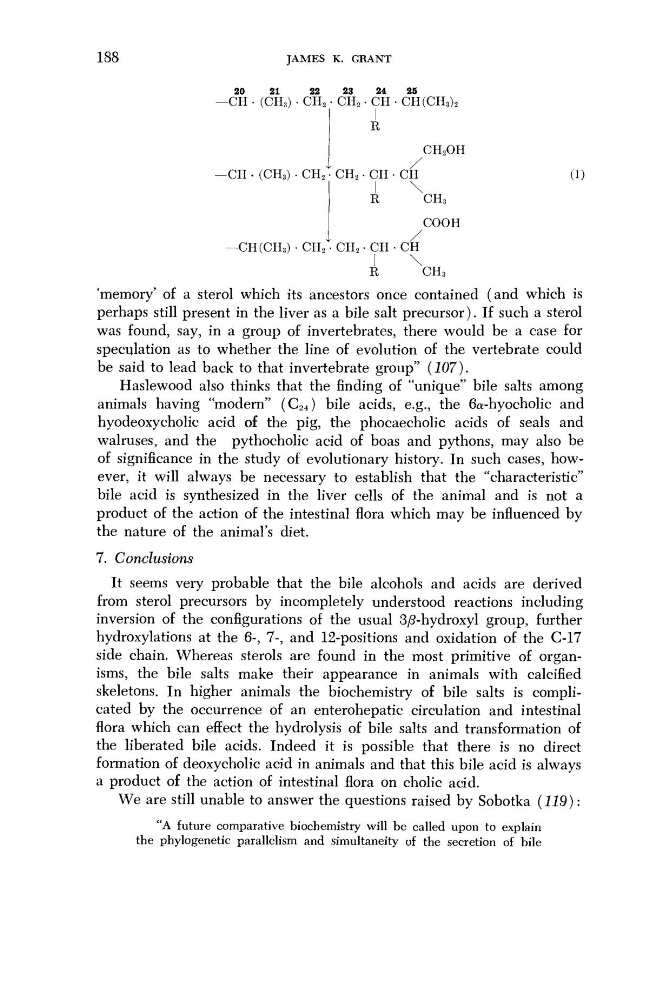
—CH · (CH 3 ) · CH 2 · CH 2 · CH · CH(CH 8 ) 2
I
I
I
R
|
CH 2 OH
—CH · (CH 3 ) · CH 2 · CH 2 · CH · CH
(1)
I
I
\
R
CH 3
COOH
I
/
—CH(CH 3 ) · CH 2 · CH 2 · CH · CH
I
\
R
CH 3
'memory' of a sterol which its ancestors once contained (and which is
perhaps still present in the liver as a bile salt precursor). If such a sterol
was found, say, in a group of invertebrates, there would be a case for
speculation as to whether the line of evolution of the vertebrate could
be said to lead back to that invertebrate group" (107).
Haslewood also thinks that the finding of "unique" bile salts among
animals having "modern" (C 24 ) bile acids, e.g., the 6a-hyocholic and
hyodeoxycholic acid of the pig, the phocaecholic acids of seals and
walruses, and the pythocholic acid of boas and pythons, may also be
of significance in the study of evolutionary history. In such cases, however, it will always be necessary to establish that the "characteristic"
bile acid is synthesized in the liver cells of the animal and is not a
product of the action of the intestinal flora which may be influenced by
the nature of the animal's diet.
7. Conclusions
It seems very probable that the bile alcohols and acids are derived
from sterol precursors by incompletely understood reactions including
inversion of the configurations of the usual 3/?-hydroxyl group, further
hydroxylations at the 6-, 7-, and 12-positions and oxidation of the C-17
side chain. Whereas sterols are found in the most primitive of organisms, the bile salts make their appearance in animals with calcified
skeletons. In higher animals the biochemistry of bile salts is complicated by the occurrence of an enterohepatic circulation and intestinal
flora which can effect the hydrolysis of bile salts and transformation of
the liberated bile acids. Indeed it is possible that there is no direct
formation of deoxycholic acid in animals and that this bile acid is always
a product of the action of intestinal flora on cholic acid.
We are still unable to answer the questions raised by Sobotka (119):
"A future comparative biochemistry will be called upon to explain
the phylogenetic parallelism and simultaneity of the secretion of bile
JAMES K. GRANT
20
21
22
23
24
25
—CH · (CH 3 ) · CH 2 · CH 2 · CH · CH(CH 8 ) 2
I
I
I
R
|
CH 2 OH
—CH · (CH 3 ) · CH 2 · CH 2 · CH · CH
(1)
I
I
\
R
CH 3
COOH
I
/
—CH(CH 3 ) · CH 2 · CH 2 · CH · CH
I
\
R
CH 3
'memory' of a sterol which its ancestors once contained (and which is
perhaps still present in the liver as a bile salt precursor). If such a sterol
was found, say, in a group of invertebrates, there would be a case for
speculation as to whether the line of evolution of the vertebrate could
be said to lead back to that invertebrate group" (107).
Haslewood also thinks that the finding of "unique" bile salts among
animals having "modern" (C 24 ) bile acids, e.g., the 6a-hyocholic and
hyodeoxycholic acid of the pig, the phocaecholic acids of seals and
walruses, and the pythocholic acid of boas and pythons, may also be
of significance in the study of evolutionary history. In such cases, however, it will always be necessary to establish that the "characteristic"
bile acid is synthesized in the liver cells of the animal and is not a
product of the action of the intestinal flora which may be influenced by
the nature of the animal's diet.
7. Conclusions
It seems very probable that the bile alcohols and acids are derived
from sterol precursors by incompletely understood reactions including
inversion of the configurations of the usual 3/?-hydroxyl group, further
hydroxylations at the 6-, 7-, and 12-positions and oxidation of the C-17
side chain. Whereas sterols are found in the most primitive of organisms, the bile salts make their appearance in animals with calcified
skeletons. In higher animals the biochemistry of bile salts is complicated by the occurrence of an enterohepatic circulation and intestinal
flora which can effect the hydrolysis of bile salts and transformation of
the liberated bile acids. Indeed it is possible that there is no direct
formation of deoxycholic acid in animals and that this bile acid is always
a product of the action of intestinal flora on cholic acid.
We are still unable to answer the questions raised by Sobotka (119):
"A future comparative biochemistry will be called upon to explain
the phylogenetic parallelism and simultaneity of the secretion of bile