

184
JAMES K. GRANT
4. Conclusions
Biosynthesis of the steroid hormones in the adrenal cortex has been
most intensively studied. Available evidence indicates that in higher
animals the adrenocortical steroids may be derived from acetate or
cholesterol by reactions which do not differ significantly in the different species studied. The failure of a few small rodents to secrete hydrocortisone is unexplained. The production of adrenocortical hormones in
classes of animals other than the Eutheria is not well established. The
investigation of this matter in animals obliged to conserve their body
water and in fishes moving from fresh to salt water should prove an interesting and fruitful field of study.
The state of knowledge of estrogen biosynthesis in any animal is
particularly unsatisfactory. A search for C-16 oxygen-substituted estrogens in species other than man and for the B-ring unsaturated compounds in species other than the horse would be timely.
C. BIOSYNTHESIS AND TRANSFORMATION OF THE BILE SALTS
1. Introduction
Bile salts are either the sulfate esters of steroid alcohols having 27
to 29 carbon atoms, or more commonly hydroxy steroid carboxylic acids
having 24, 27, 28, and possibly 29 carbon atoms conjugated with
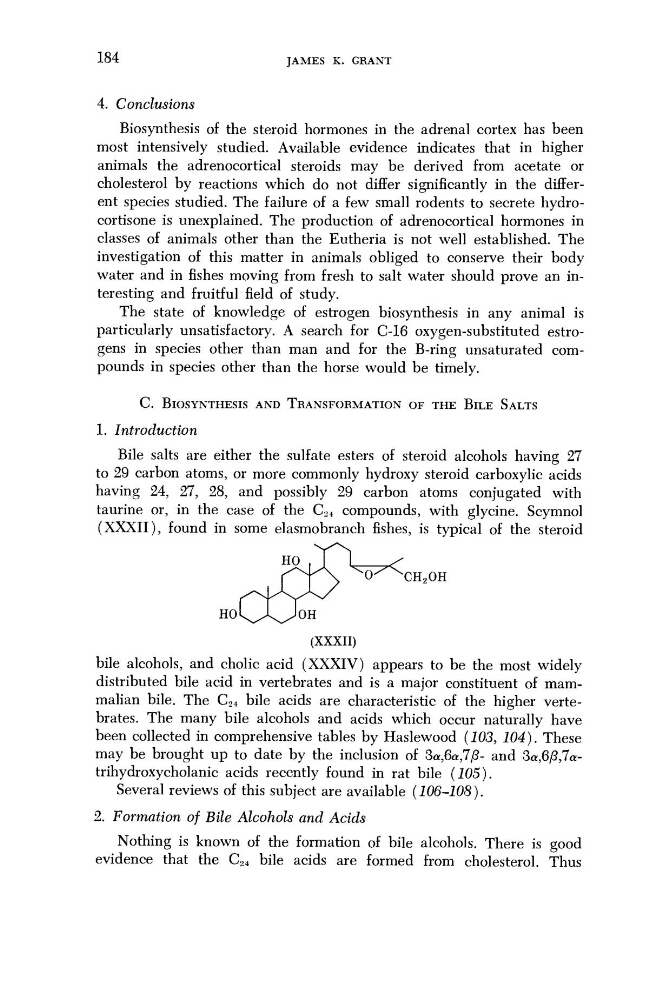
taurine or, in the case of the C 24 compounds, with glycine. Scymnol
(XXXII), found in some elasmobranch fishes, is typical of the steroid
^ΡχΉ 2 ΟΗ
(XXXII)
bile alcohols, and cholic acid (XXXIV) appears to be the most widely
distributed bile acid in vertebrates and is a major constituent of mammalian bile. The C 24 bile acids are characteristic of the higher vertebrates. The many bile alcohols and acids which occur naturally have
been collected in comprehensive tables by Haslewood (103, 104). These
may be brought up to date by the inclusion of 3afia,7ß- and Saßßjatrihydroxycholanic acids recently found in rat bile (105).
Several reviews of this subject are available (106-108).
2. Formation of Bile Alcohols and Acids
Nothing is known of the formation of bile alcohols. There is good
evidence that the C 24 bile acids are formed from cholesterol. Thus
JAMES K. GRANT
4. Conclusions
Biosynthesis of the steroid hormones in the adrenal cortex has been
most intensively studied. Available evidence indicates that in higher
animals the adrenocortical steroids may be derived from acetate or
cholesterol by reactions which do not differ significantly in the different species studied. The failure of a few small rodents to secrete hydrocortisone is unexplained. The production of adrenocortical hormones in
classes of animals other than the Eutheria is not well established. The
investigation of this matter in animals obliged to conserve their body
water and in fishes moving from fresh to salt water should prove an interesting and fruitful field of study.
The state of knowledge of estrogen biosynthesis in any animal is
particularly unsatisfactory. A search for C-16 oxygen-substituted estrogens in species other than man and for the B-ring unsaturated compounds in species other than the horse would be timely.
C. BIOSYNTHESIS AND TRANSFORMATION OF THE BILE SALTS
1. Introduction
Bile salts are either the sulfate esters of steroid alcohols having 27
to 29 carbon atoms, or more commonly hydroxy steroid carboxylic acids
having 24, 27, 28, and possibly 29 carbon atoms conjugated with
taurine or, in the case of the C 24 compounds, with glycine. Scymnol
(XXXII), found in some elasmobranch fishes, is typical of the steroid
^ΡχΉ 2 ΟΗ
(XXXII)
bile alcohols, and cholic acid (XXXIV) appears to be the most widely
distributed bile acid in vertebrates and is a major constituent of mammalian bile. The C 24 bile acids are characteristic of the higher vertebrates. The many bile alcohols and acids which occur naturally have
been collected in comprehensive tables by Haslewood (103, 104). These
may be brought up to date by the inclusion of 3afia,7ß- and Saßßjatrihydroxycholanic acids recently found in rat bile (105).
Several reviews of this subject are available (106-108).
2. Formation of Bile Alcohols and Acids
Nothing is known of the formation of bile alcohols. There is good
evidence that the C 24 bile acids are formed from cholesterol. Thus