

170
HO
JAMES K. GRANT
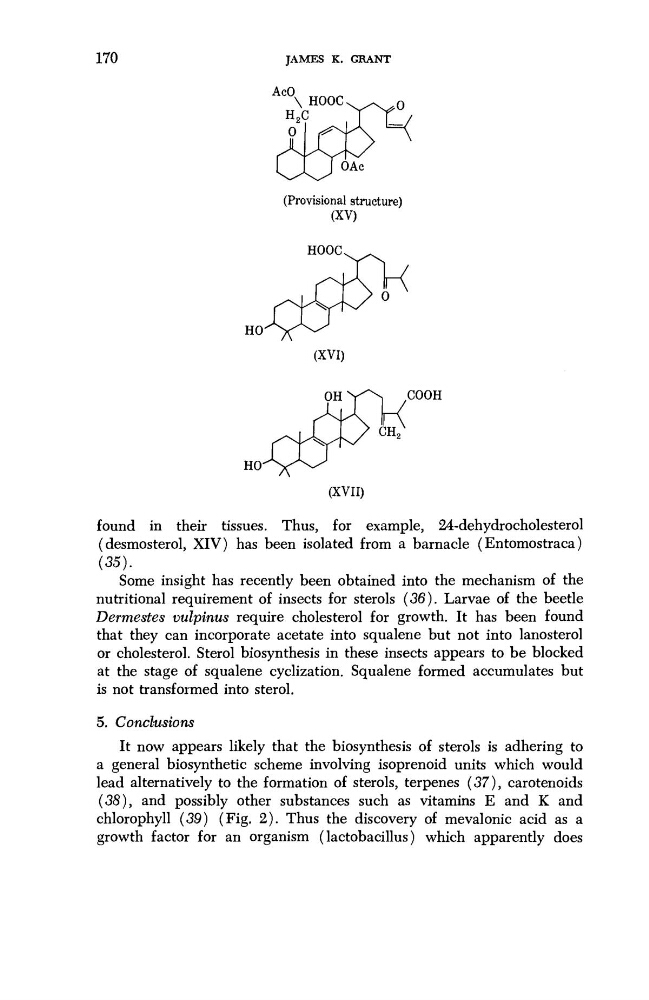
(Provisional structure)
(XV)
(XVI)
HO
(XVII)
COOH
found in their tissues. Thus, for example, 24-dehydrocholesterol
(desmosterol, XIV) has been isolated from a barnacle (Entomostraca)
(35).
Some insight has recently been obtained into the mechanism of the
nutritional requirement of insects for sterols (36). Larvae of the beetle
Dermestes vulpinus require cholesterol for growth. It has been found
that they can incorporate acetate into squalene but not into lanosterol
or cholesterol. Sterol biosynthesis in these insects appears to be blocked
at the stage of squalene cyclization. Squalene formed accumulates but
is not transformed into sterol.
5. ,Conclusions
It now appears likely that the biosynthesis of sterols is adhering to
a general biosynthetic scheme involving isoprenoid units which would
lead alternatively to the formation of sterols, terpenes (37), carotenoids
(38), and possibly other substances such as vitamins E and K and
chlorophyll (39) (Fig. 2). Thus the discovery of mevalonic acid as a
growth factor for an organism (lactobacillus) which apparently does
HO
JAMES K. GRANT
(Provisional structure)
(XV)
(XVI)
HO
(XVII)
COOH
found in their tissues. Thus, for example, 24-dehydrocholesterol
(desmosterol, XIV) has been isolated from a barnacle (Entomostraca)
(35).
Some insight has recently been obtained into the mechanism of the
nutritional requirement of insects for sterols (36). Larvae of the beetle
Dermestes vulpinus require cholesterol for growth. It has been found
that they can incorporate acetate into squalene but not into lanosterol
or cholesterol. Sterol biosynthesis in these insects appears to be blocked
at the stage of squalene cyclization. Squalene formed accumulates but
is not transformed into sterol.
5. ,Conclusions
It now appears likely that the biosynthesis of sterols is adhering to
a general biosynthetic scheme involving isoprenoid units which would
lead alternatively to the formation of sterols, terpenes (37), carotenoids
(38), and possibly other substances such as vitamins E and K and
chlorophyll (39) (Fig. 2). Thus the discovery of mevalonic acid as a
growth factor for an organism (lactobacillus) which apparently does