

164
JAMES K. GRANT
M
JYL
M
\
M
/
M—C
CT TT \
\
M
I
C
M
Μ^ _ ^Μ^^Μ M-Methyl carbon
n
C-Carboxyl carbon
(Π)
ΗΟ^ ^c^"^σ
(III)
appear to follow pathways similar to that of cholesterol, deviating only
at a relatively late stage. It is thus fortunate that present knowledge of
cholesterol biogenesis, based on investigations with animal tissues,
plants, yeasts, and molds, is extensive and gaps in this knowledge are
being filled in rapidly.
2. Biosynthesis of Cholesterol
The biosynthesis of cholesterol will not be considered in detail here
since comprehensive reviews are available elsewhere (3a,b,c). The
following account emphasizes the general nature of reactions involved.
Figures la and lb are intended to summarize the present state of
knowledge.
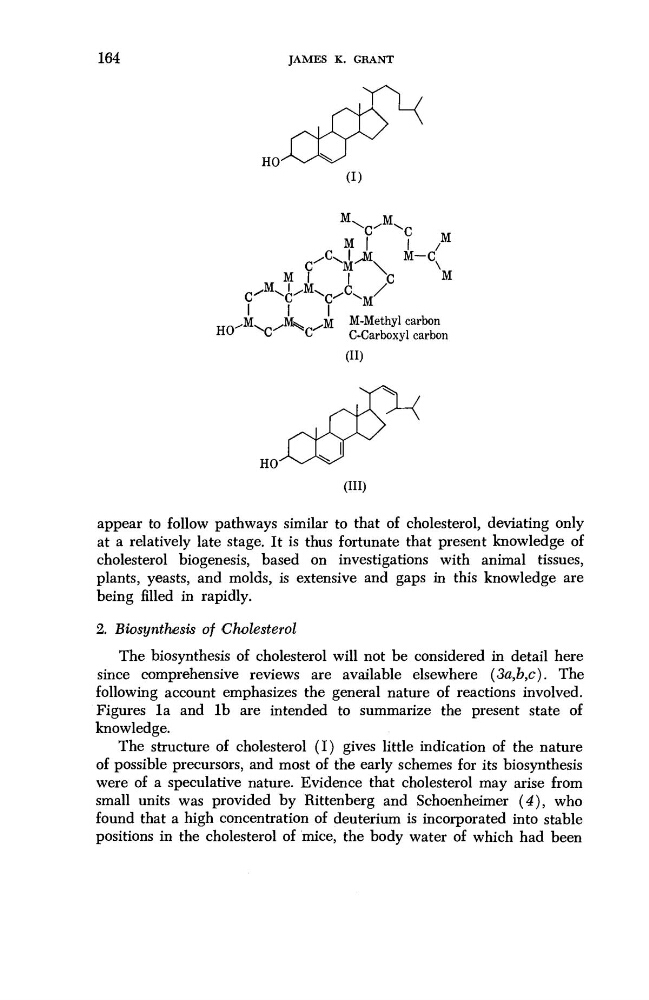
The structure of cholesterol (I) gives little indication of the nature
of possible precursors, and most of the early schemes for its biosynthesis
were of a speculative nature. Evidence that cholesterol may arise from
small units was provided by Rittenberg and Schoenheimer (4), who
found that a high concentration of deuterium is incorporated into stable
positions in the cholesterol of mice, the body water of which had been
JAMES K. GRANT
M
JYL
M
\
M
/
M—C
CT TT \
\
M
I
C
M
Μ^ _ ^Μ^^Μ M-Methyl carbon
n
C-Carboxyl carbon
(Π)
ΗΟ^ ^c^"^σ
(III)
appear to follow pathways similar to that of cholesterol, deviating only
at a relatively late stage. It is thus fortunate that present knowledge of
cholesterol biogenesis, based on investigations with animal tissues,
plants, yeasts, and molds, is extensive and gaps in this knowledge are
being filled in rapidly.
2. Biosynthesis of Cholesterol
The biosynthesis of cholesterol will not be considered in detail here
since comprehensive reviews are available elsewhere (3a,b,c). The
following account emphasizes the general nature of reactions involved.
Figures la and lb are intended to summarize the present state of
knowledge.
The structure of cholesterol (I) gives little indication of the nature
of possible precursors, and most of the early schemes for its biosynthesis
were of a speculative nature. Evidence that cholesterol may arise from
small units was provided by Rittenberg and Schoenheimer (4), who
found that a high concentration of deuterium is incorporated into stable
positions in the cholesterol of mice, the body water of which had been