

2. STEROLS: STRUCTURE AND DISTRIBUTION
149
ences in sterol content reflect some phylogenetic relationship among
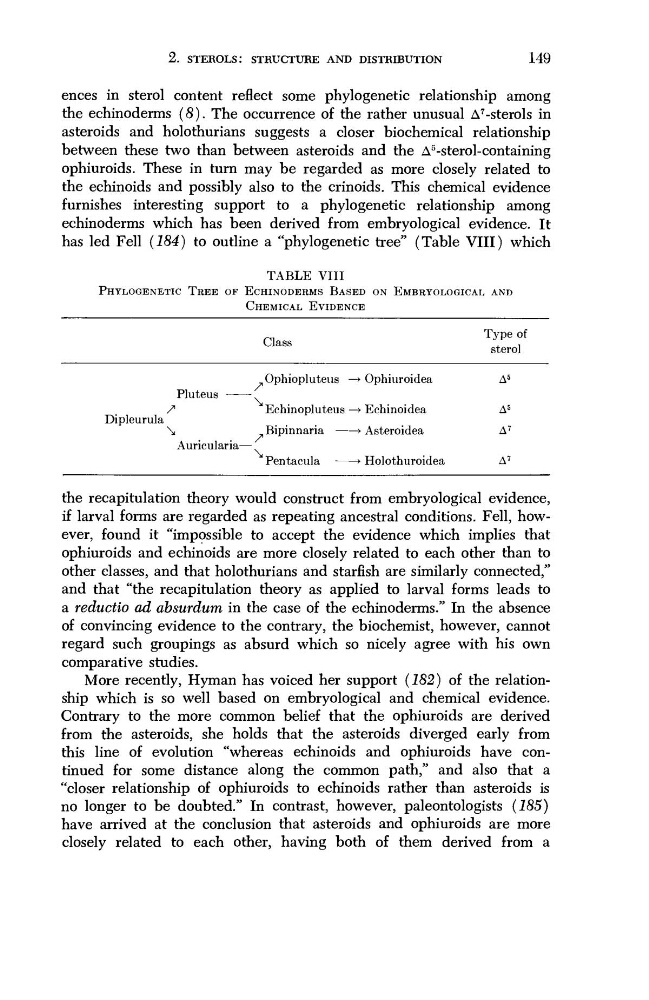
the echinoderms (8). The occurrence of the rather unusual A
7 -sterols in
asteroids and holothurians suggests a closer biochemical relationship
between these two than between asteroids and the A
5 -sterol-containing
ophiuroids. These in turn may be regarded as more closely related to
the echinoids and possibly also to the crinoids. This chemical evidence
furnishes interesting support to a phylogenetic relationship among
echinoderms which has been derived from embryological evidence. It
has led Fell (184) to outline a "phylogenetic tree" (Table VIII) which
TABLE VIII
PHYLOGENETIC TREE OF ECHINODERMS BASED ON EMBRYOLOGICAL AND
CHEMICAL EVIDENCE
01
Type of
Class
sterol
Pluteus
S
Dipleurula \
AuriculariaOphiopluteus —> Ophiuroidea
Echinopluteus —* Echinoidea
Bipinnaria
> Asteroidea
Pentacula
> Holothuroidea
Δ
5
Δ
5
Δ
7
Δ
7
the recapitulation theory would construct from embryological evidence,
if larval forms are regarded as repeating ancestral conditions. Fell, however, found it "impossible to accept the evidence which implies that
ophiuroids and echinoids are more closely related to each other than to
other classes, and that holothurians and starfish are similarly connected,"
and that "the recapitulation theory as applied to larval forms leads to
a reductio ad absurdum in the case of the echinoderms." In the absence
of convincing evidence to the contrary, the biochemist, however, cannot
regard such groupings as absurd which so nicely agree with his own
comparative studies.
More recently, Hyman has voiced her support (182) of the relationship which is so well based on embryological and chemical evidence.
Contrary to the more common belief that the ophiuroids are derived
from the asteroids, she holds that the asteroids diverged early from
this line of evolution "whereas echinoids and ophiuroids have continued for some distance along the common path," and also that a
"closer relationship of ophiuroids to echinoids rather than asteroids is
no longer to be doubted." In contrast, however, paleontologists (185)
have arrived at the conclusion that asteroids and ophiuroids are more
closely related to each other, having both of them derived from a
149
ences in sterol content reflect some phylogenetic relationship among
the echinoderms (8). The occurrence of the rather unusual A
7 -sterols in
asteroids and holothurians suggests a closer biochemical relationship
between these two than between asteroids and the A
5 -sterol-containing
ophiuroids. These in turn may be regarded as more closely related to
the echinoids and possibly also to the crinoids. This chemical evidence
furnishes interesting support to a phylogenetic relationship among
echinoderms which has been derived from embryological evidence. It
has led Fell (184) to outline a "phylogenetic tree" (Table VIII) which
TABLE VIII
PHYLOGENETIC TREE OF ECHINODERMS BASED ON EMBRYOLOGICAL AND
CHEMICAL EVIDENCE
01
Type of
Class
sterol
Pluteus
S
Dipleurula \
AuriculariaOphiopluteus —> Ophiuroidea
Echinopluteus —* Echinoidea
Bipinnaria
> Asteroidea
Pentacula
> Holothuroidea
Δ
5
Δ
5
Δ
7
Δ
7
the recapitulation theory would construct from embryological evidence,
if larval forms are regarded as repeating ancestral conditions. Fell, however, found it "impossible to accept the evidence which implies that
ophiuroids and echinoids are more closely related to each other than to
other classes, and that holothurians and starfish are similarly connected,"
and that "the recapitulation theory as applied to larval forms leads to
a reductio ad absurdum in the case of the echinoderms." In the absence
of convincing evidence to the contrary, the biochemist, however, cannot
regard such groupings as absurd which so nicely agree with his own
comparative studies.
More recently, Hyman has voiced her support (182) of the relationship which is so well based on embryological and chemical evidence.
Contrary to the more common belief that the ophiuroids are derived
from the asteroids, she holds that the asteroids diverged early from
this line of evolution "whereas echinoids and ophiuroids have continued for some distance along the common path," and also that a
"closer relationship of ophiuroids to echinoids rather than asteroids is
no longer to be doubted." In contrast, however, paleontologists (185)
have arrived at the conclusion that asteroids and ophiuroids are more
closely related to each other, having both of them derived from a