

140
WERNER BERGMANN
pected of being identical with corbisterol (153). From a comparison of
the sizes of the side chains and vitamin D activities the conclusion has
been drawn that corbisterol is of the order C 28 rather than C 29 (153).
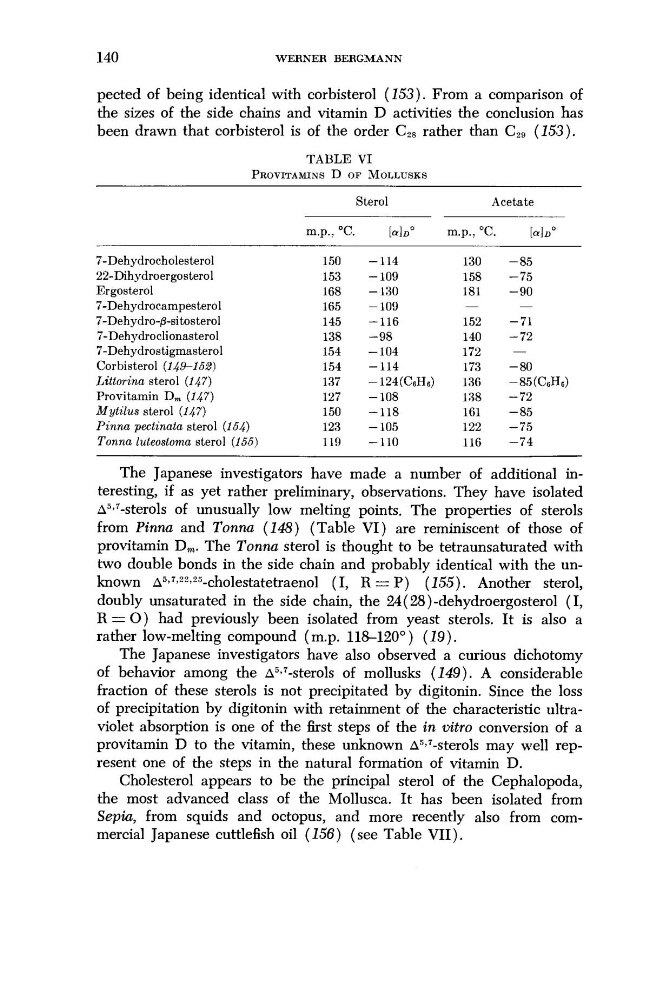
TABLE VI
PROVITAMINS D OF MOLLUSKS
Sterol
Acetate
7-Dehydrocholesterol
22-Dihydroergosterol
Ergo sterol
7-Dehydrocampesterol
7-Dehydro-/3-sitosterol
7-Dehydroclionasterol
7-Dehydrostigmasterol
Corbisterol (149-152)
Littorina sterol (147)
Provitamin D m (147)
Mytilus sterol (147)
Pinna pectinata sterol (154)
Tonna luteostoma sterol (155)
m.p., °C.
150
153
168
165
145
138
154
154
137
127
150
123
119
[<*\D°
-114
-109
-130
-109
-116
-98
-104
-114
-124(C6H6)
-108
-118
-105
-110
m.p., °C.
130
158
181
—
152
140
172
173
136
138
161
122
116
MD°
-85
-75
-90
—
-71
-72
—
-80
-85(C 6 H C )
-72
-85
-75
-74
The Japanese investigators have made a number of additional interesting, if as yet rather preliminary, observations. They have isolated
A
57 -sterols of unusually low melting points. The properties of sterols
from Pinna and Tonna (148) (Table VI) are reminiscent of those of
provitamin D m . The Tonna sterol is thought to be tetraunsaturated with
two double bonds in the side chain and probably identical with the unknown A
5 '
7 '
22 '
25 -cholestatetraenol (I, R = P) (155). Another sterol,
doubly unsaturated in the side chain, the 24(28)-dehydroergosterol (I,
R = O) had previously been isolated from yeast sterols. It is also a
rather low-melting compound (m.p. 118-120°) (19).
The Japanese investigators have also observed a curious dichotomy
of behavior among the A
5 '
7 -sterols of mollusks (149). A considerable
fraction of these sterols is not precipitated by digitonin. Since the loss
of precipitation by digitonin with retainment of the characteristic ultraviolet absorption is one of the first steps of the in vitro conversion of a
provitamin D to the vitamin, these unknown A
57 -sterols may well represent one of the steps in the natural formation of vitamin D.
Cholesterol appears to be the principal sterol of the Cephalopoda,
the most advanced class of the Mollusca. It has been isolated from
Sepia, from squids and octopus, and more recently also from commercial Japanese cuttlefish oil (156) (see Table VII).
WERNER BERGMANN
pected of being identical with corbisterol (153). From a comparison of
the sizes of the side chains and vitamin D activities the conclusion has
been drawn that corbisterol is of the order C 28 rather than C 29 (153).
TABLE VI
PROVITAMINS D OF MOLLUSKS
Sterol
Acetate
7-Dehydrocholesterol
22-Dihydroergosterol
Ergo sterol
7-Dehydrocampesterol
7-Dehydro-/3-sitosterol
7-Dehydroclionasterol
7-Dehydrostigmasterol
Corbisterol (149-152)
Littorina sterol (147)
Provitamin D m (147)
Mytilus sterol (147)
Pinna pectinata sterol (154)
Tonna luteostoma sterol (155)
m.p., °C.
150
153
168
165
145
138
154
154
137
127
150
123
119
[<*\D°
-114
-109
-130
-109
-116
-98
-104
-114
-124(C6H6)
-108
-118
-105
-110
m.p., °C.
130
158
181
—
152
140
172
173
136
138
161
122
116
MD°
-85
-75
-90
—
-71
-72
—
-80
-85(C 6 H C )
-72
-85
-75
-74
The Japanese investigators have made a number of additional interesting, if as yet rather preliminary, observations. They have isolated
A
57 -sterols of unusually low melting points. The properties of sterols
from Pinna and Tonna (148) (Table VI) are reminiscent of those of
provitamin D m . The Tonna sterol is thought to be tetraunsaturated with
two double bonds in the side chain and probably identical with the unknown A
5 '
7 '
22 '
25 -cholestatetraenol (I, R = P) (155). Another sterol,
doubly unsaturated in the side chain, the 24(28)-dehydroergosterol (I,
R = O) had previously been isolated from yeast sterols. It is also a
rather low-melting compound (m.p. 118-120°) (19).
The Japanese investigators have also observed a curious dichotomy
of behavior among the A
5 '
7 -sterols of mollusks (149). A considerable
fraction of these sterols is not precipitated by digitonin. Since the loss
of precipitation by digitonin with retainment of the characteristic ultraviolet absorption is one of the first steps of the in vitro conversion of a
provitamin D to the vitamin, these unknown A
57 -sterols may well represent one of the steps in the natural formation of vitamin D.
Cholesterol appears to be the principal sterol of the Cephalopoda,
the most advanced class of the Mollusca. It has been isolated from
Sepia, from squids and octopus, and more recently also from commercial Japanese cuttlefish oil (156) (see Table VII).