

2. STEROLS: STRUCTURE AND DISTRIBUTION
131
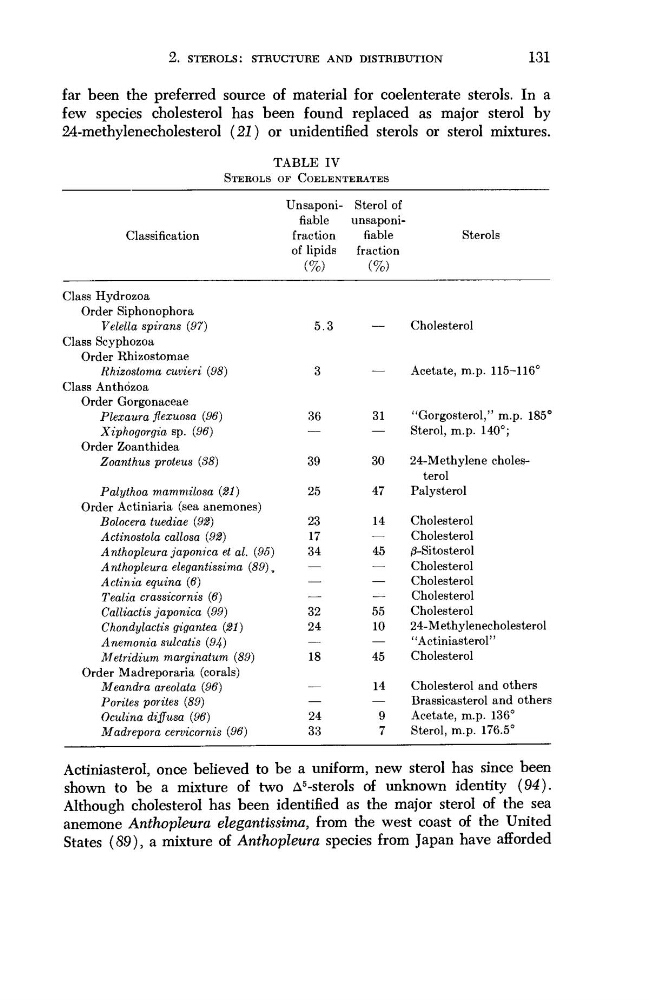
far been the preferred source of material for coelenterate sterols. In a
few species cholesterol has been found replaced as major sterol by
24-methylenecholesterol (21) or unidentified sterols or sterol mixtures.
TABLE IV
STEROLS OF COELENTERATES
Classification
Class Hydrozoa
Order Siphonophora
Velella spirans (97)
Class Scyphozoa
Order Rhizostomae
Rhizostoma cuvieri (98)
Class Anthozoa
Order Gorgonaceae
Plexaura flexuosa (96)
Xiphogorgia sp. (96)
Order Zoanthidea
Zoanthus proteus (38)
Palythoa mammilosa (21)
Order Actiniaria (sea anemones)
Bolocera tuediae (92)
Actinostola callosa (92)
Anthopleura japonica et cd. (95)
Anthopleura elegantissima (89),
Actinia equina (6)
Tealia crassicornis (6)
Calliactis japonica (99)
Chondylactis gigantea (21)
Anemonia sulcatis (94)
Metridium marginatum (89)
Order Madreporaria (corals)
Meandra areolata (96)
Porites porites (89)
Oculina diffusa (96)
Madrepora cervicornis (96)
Unsaponifiable
fraction
of lipids
(%)
5.3
3
36
—
39
25
23
17
34
—
—
—
32
24
—
18
—
—
24
33
Sterol of
unsaponifiable
fraction
(%)
—
—
31
—
30
47
14
—
45
—
—
—
55
10
—
45
14
—
9
7
Sterols
Cholesterol
Acetate, m.p. 115-116°
"Gorgosterol," m.p. 185°
Sterol, m.p. 140°;
24-Methylene cholesterol
Palysterol
Cholesterol
Cholesterol
ß-Sitosterol
Cholesterol
Cholesterol
Cholesterol
Cholesterol
24-Methylenecholesterol
" Actiniasterol''
Cholesterol
Cholesterol and others
Brassicasterol and others
Acetate, m.p. 136°
Sterol, m.p. 176.5°
Actiniasterol, once believed to be a uniform, new sterol has since been
shown to be a mixture of two A
5 -sterols of unknown identity (94).
Although cholesterol has been identified as the major sterol of the sea
anemone Anthopleura elegantissima, from the west coast of the United
States (89), a mixture of Anthopleura species from Japan have afforded
131
far been the preferred source of material for coelenterate sterols. In a
few species cholesterol has been found replaced as major sterol by
24-methylenecholesterol (21) or unidentified sterols or sterol mixtures.
TABLE IV
STEROLS OF COELENTERATES
Classification
Class Hydrozoa
Order Siphonophora
Velella spirans (97)
Class Scyphozoa
Order Rhizostomae
Rhizostoma cuvieri (98)
Class Anthozoa
Order Gorgonaceae
Plexaura flexuosa (96)
Xiphogorgia sp. (96)
Order Zoanthidea
Zoanthus proteus (38)
Palythoa mammilosa (21)
Order Actiniaria (sea anemones)
Bolocera tuediae (92)
Actinostola callosa (92)
Anthopleura japonica et cd. (95)
Anthopleura elegantissima (89),
Actinia equina (6)
Tealia crassicornis (6)
Calliactis japonica (99)
Chondylactis gigantea (21)
Anemonia sulcatis (94)
Metridium marginatum (89)
Order Madreporaria (corals)
Meandra areolata (96)
Porites porites (89)
Oculina diffusa (96)
Madrepora cervicornis (96)
Unsaponifiable
fraction
of lipids
(%)
5.3
3
36
—
39
25
23
17
34
—
—
—
32
24
—
18
—
—
24
33
Sterol of
unsaponifiable
fraction
(%)
—
—
31
—
30
47
14
—
45
—
—
—
55
10
—
45
14
—
9
7
Sterols
Cholesterol
Acetate, m.p. 115-116°
"Gorgosterol," m.p. 185°
Sterol, m.p. 140°;
24-Methylene cholesterol
Palysterol
Cholesterol
Cholesterol
ß-Sitosterol
Cholesterol
Cholesterol
Cholesterol
Cholesterol
24-Methylenecholesterol
" Actiniasterol''
Cholesterol
Cholesterol and others
Brassicasterol and others
Acetate, m.p. 136°
Sterol, m.p. 176.5°
Actiniasterol, once believed to be a uniform, new sterol has since been
shown to be a mixture of two A
5 -sterols of unknown identity (94).
Although cholesterol has been identified as the major sterol of the sea
anemone Anthopleura elegantissima, from the west coast of the United
States (89), a mixture of Anthopleura species from Japan have afforded