

2. STEROLS: STRUCTURE AND DISTRIBUTION
123
TABLE
Classification
Paramecium aurelia (74)
Tetrahymena geleii (70,
79-81)
Order Hypotrichidae
Stylonychia pustulata (75)
Total
lipid
(%)
17*
II (Continued)
Unsaponinable
Sterol °
f
ul
fraction
unsaponifiable
of lipid
fr ^\
on
(%)
(%)
25
40, m.p. 312°
c
Sterols
Promoting
growth
Brassicasterol,
fucosterol,
/3-sitosterol,
but not cholesterol
None required
Stigmasterol,
/3-sitosterol, but
not cholesterol
a Based on dry weight.
b Sterols inhibit growth.
c An unlikely melting point for a sterol.
require dietary sterols for their normal growth. The sterol requirements
differ, even among species of the same genus. Thus sterols are required
for the growth of LabyrinthuL· vitellina {71) but not for Labyrinthula
minuta, a cholesterol-producing organism. Although two amebas, species
of the genus Entamoeba, require cholesterol {72), the growth of a third
is inhibited by the addition of sterols to its culture medium {73).
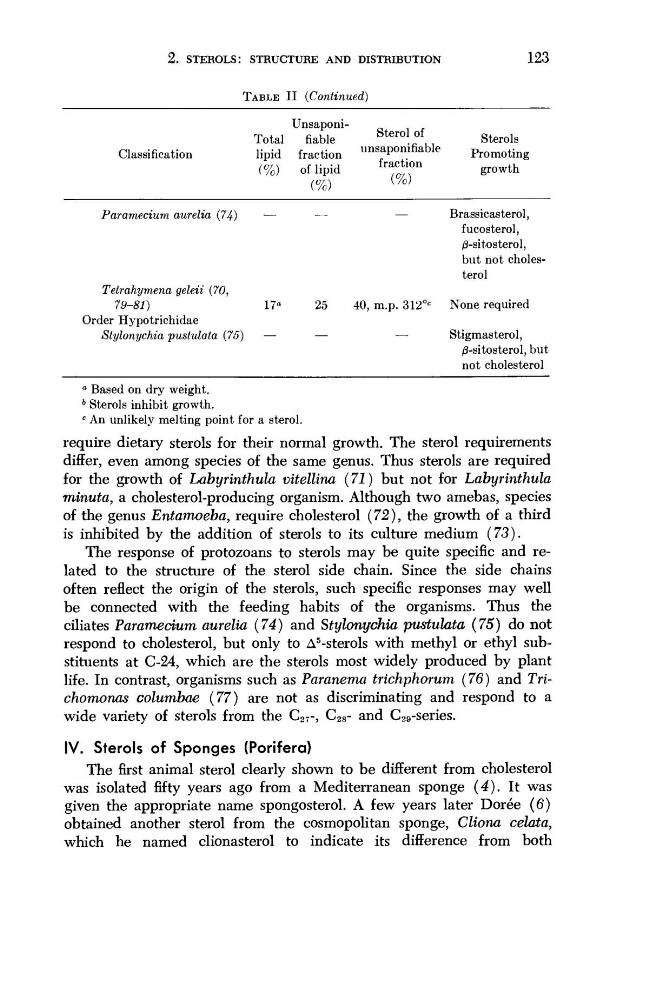
The response of protozoans to sterols may be quite specific and related to the structure of the sterol side chain. Since the side chains
often reflect the origin of the sterols, such specific responses may well
be connected with the feeding habits of the organisms. Thus the
ciliates Paramecium aurelia {74) and Stylonychia pustulata {75) do not
respond to cholesterol, but only to A
5 -sterols with methyl or ethyl substituents at C-24, which are the sterols most widely produced by plant
life. In contrast, organisms such as Paranema trichphorum {76) and Trichomonas columbae {77) are not as discriminating and respond to a
wide variety of sterols from the C 27 -, C 28 - and C 29-senes.
IV. Sterols of Sponges (Porifera)
The first animal sterol clearly shown to be different from cholesterol
was isolated fifty years ago from a Mediterranean sponge {4). It was
given the appropriate name spongosterol. A few years later Doree (6)
obtained another sterol from the cosmopolitan sponge, Cliona celata,
which he named clionasterol to indicate its difference from both
123
TABLE
Classification
Paramecium aurelia (74)
Tetrahymena geleii (70,
79-81)
Order Hypotrichidae
Stylonychia pustulata (75)
Total
lipid
(%)
17*
II (Continued)
Unsaponinable
Sterol °
f
ul
fraction
unsaponifiable
of lipid
fr ^\
on
(%)
(%)
25
40, m.p. 312°
c
Sterols
Promoting
growth
Brassicasterol,
fucosterol,
/3-sitosterol,
but not cholesterol
None required
Stigmasterol,
/3-sitosterol, but
not cholesterol
a Based on dry weight.
b Sterols inhibit growth.
c An unlikely melting point for a sterol.
require dietary sterols for their normal growth. The sterol requirements
differ, even among species of the same genus. Thus sterols are required
for the growth of LabyrinthuL· vitellina {71) but not for Labyrinthula
minuta, a cholesterol-producing organism. Although two amebas, species
of the genus Entamoeba, require cholesterol {72), the growth of a third
is inhibited by the addition of sterols to its culture medium {73).
The response of protozoans to sterols may be quite specific and related to the structure of the sterol side chain. Since the side chains
often reflect the origin of the sterols, such specific responses may well
be connected with the feeding habits of the organisms. Thus the
ciliates Paramecium aurelia {74) and Stylonychia pustulata {75) do not
respond to cholesterol, but only to A
5 -sterols with methyl or ethyl substituents at C-24, which are the sterols most widely produced by plant
life. In contrast, organisms such as Paranema trichphorum {76) and Trichomonas columbae {77) are not as discriminating and respond to a
wide variety of sterols from the C 27 -, C 28 - and C 29-senes.
IV. Sterols of Sponges (Porifera)
The first animal sterol clearly shown to be different from cholesterol
was isolated fifty years ago from a Mediterranean sponge {4). It was
given the appropriate name spongosterol. A few years later Doree (6)
obtained another sterol from the cosmopolitan sponge, Cliona celata,
which he named clionasterol to indicate its difference from both