

2. STEROLS: STRUCTURE AND DISTRIBUTION
119
perimentations on the final steps of the biosynthesis of cholesterol
(VIII-XIII). It may be converted by rat liver homogenates into cholesterol (51) and it is believed to be present in trace amounts in pig liver
(52).
24-Methylene-A
8 (
9 >-cholestenol (fecosterol) (V, R —D), C 28 H 56 0,
m.p. 162°, [a] D +42°; acetate, m.p. 159-161°, [a] D +20°. The structure
of this minor yeast sterol is based on some experimental evidence (47)
and on molecular rotation differences (31). It needs verification by synthesis before it can finally be accepted.
6. Group VI (Structures VI and VII): Trimethyhterols with Specific
Rotations in Excess of [a] D +50°
These compounds, which contain six isoprene units joined in accordance with the isoprene rule, are of the class of triterpenoids. Their inclusion among the sterols is based on good chemical and biological evidence. They possess the typical sterol ring structure and a side chain
common to other sterols, and differ from them only in the presence of
three additional methyl groups. Cholesterol has been converted by
chemical means into lanosterol, the best known of the trimethylsterols
(53). The reverse has been carried out biologically in liver homogenates
(54). In the biosynthesis of cholesterol (VIII-XIII), lanosterol (IX)
has been shown to occupy a pivotal position (46) as the final product of
the cyclization of squalene (VIII).
Trimethylsterols may be readily differentiated from other sterols by
the molecular rotation differences between the sterols and their acetates.
In contrast to those of the unmethylated sterols they are of positive
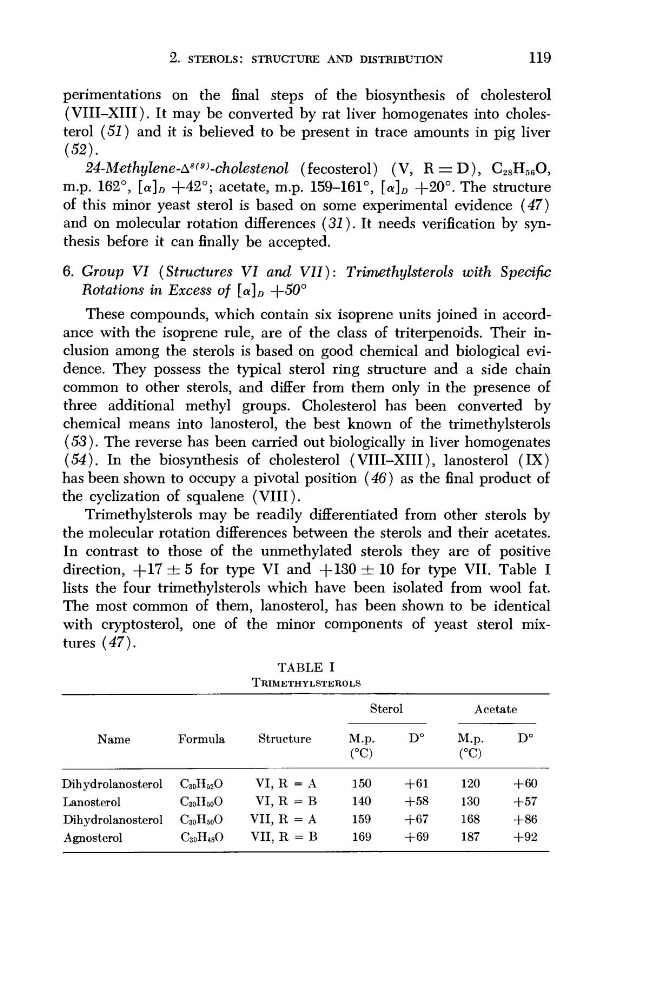
direction, +17 ± 5 for type VI and +130 ± 10 for type VII. Table I
lists the four trimethylsterols which have been isolated from wool fat.
The most common of them, lanosterol, has been shown to be identical
with cryptosterol, one of the minor components of yeast sterol mixtures (47).
Sterol
Name
Formula
Structure
M.p.
(°C)
Dihydrolanosterol
C30H52O
Lanosterol
C30H50O
Dihydrolanosterol
C30H50O
Agnosterol
C3oH 48 0
TABLE I
TRIMETHYLSTEROLS
VI, R = A
150
VI, R = B
140
VII, R = A
159
VII, R = B
169
Acetate
D°
M.p.
D°
(°C)
+61
120
+60
+58
130
+57
+67
168
+86
+69
187
+92
119
perimentations on the final steps of the biosynthesis of cholesterol
(VIII-XIII). It may be converted by rat liver homogenates into cholesterol (51) and it is believed to be present in trace amounts in pig liver
(52).
24-Methylene-A
8 (
9 >-cholestenol (fecosterol) (V, R —D), C 28 H 56 0,
m.p. 162°, [a] D +42°; acetate, m.p. 159-161°, [a] D +20°. The structure
of this minor yeast sterol is based on some experimental evidence (47)
and on molecular rotation differences (31). It needs verification by synthesis before it can finally be accepted.
6. Group VI (Structures VI and VII): Trimethyhterols with Specific
Rotations in Excess of [a] D +50°
These compounds, which contain six isoprene units joined in accordance with the isoprene rule, are of the class of triterpenoids. Their inclusion among the sterols is based on good chemical and biological evidence. They possess the typical sterol ring structure and a side chain
common to other sterols, and differ from them only in the presence of
three additional methyl groups. Cholesterol has been converted by
chemical means into lanosterol, the best known of the trimethylsterols
(53). The reverse has been carried out biologically in liver homogenates
(54). In the biosynthesis of cholesterol (VIII-XIII), lanosterol (IX)
has been shown to occupy a pivotal position (46) as the final product of
the cyclization of squalene (VIII).
Trimethylsterols may be readily differentiated from other sterols by
the molecular rotation differences between the sterols and their acetates.
In contrast to those of the unmethylated sterols they are of positive
direction, +17 ± 5 for type VI and +130 ± 10 for type VII. Table I
lists the four trimethylsterols which have been isolated from wool fat.
The most common of them, lanosterol, has been shown to be identical
with cryptosterol, one of the minor components of yeast sterol mixtures (47).
Sterol
Name
Formula
Structure
M.p.
(°C)
Dihydrolanosterol
C30H52O
Lanosterol
C30H50O
Dihydrolanosterol
C30H50O
Agnosterol
C3oH 48 0
TABLE I
TRIMETHYLSTEROLS
VI, R = A
150
VI, R = B
140
VII, R = A
159
VII, R = B
169
Acetate
D°
M.p.
D°
(°C)
+61
120
+60
+58
130
+57
+67
168
+86
+69
187
+92