

1. FATTY ACID OCCURRENCE AND DISTRIBUTION
89
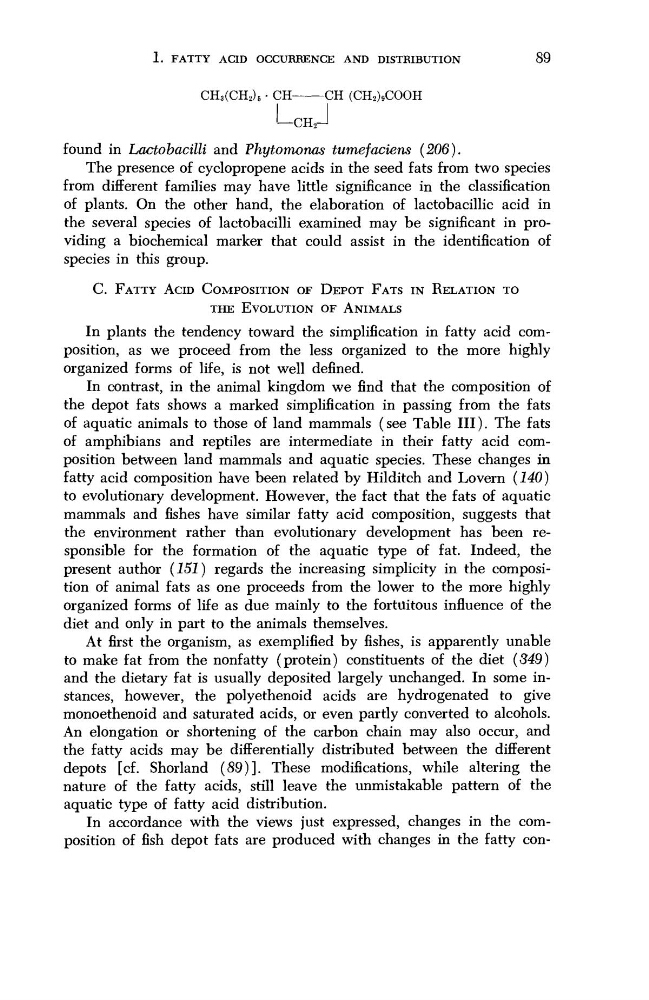
CH 3 (CH 2 ) 5 · CH
CH (CH 2 ) 9 COOH
'—CH 2 J
found in Lactobacilli and Phytomonas tumefaciens
(206).
The presence of cyclopropene acids in the seed fats from two species
from different families may have little significance in the classification
of plants. On the other hand, the elaboration of lactobacillic acid in
the several species of lactobacilli examined may be significant in providing a biochemical marker that could assist in the identification of
species in this group.
C. FATTY ACID COMPOSITION OF DEPOT FATS IN RELATION TO
THE EVOLUTION OF ANIMALS
In plants the tendency toward the simplification in fatty acid composition, as we proceed from the less organized to the more highly
organized forms of life, is not well defined.
In contrast, in the animal kingdom we find that the composition of
the depot fats shows a marked simplification in passing from the fats
of aquatic animals to those of land mammals (see Table III). The fats
of amphibians and reptiles are intermediate in their fatty acid composition between land mammals and aquatic species. These changes in
fatty acid composition have been related by Hilditch and Lovern (140)
to evolutionary development. However, the fact that the fats of aquatic
mammals and fishes have similar fatty acid composition, suggests that
the environment rather than evolutionary development has been responsible for the formation of the aquatic type of fat. Indeed, the
present author (151) regards the increasing simplicity in the composition of animal fats as one proceeds from the lower to the more highly
organized forms of life as due mainly to the fortuitous influence of the
diet and only in part to the animals themselves.
At first the organism, as exemplified by fishes, is apparently unable
to make fat from the nonfatty (protein) constituents of the diet (S49)
and the dietary fat is usually deposited largely unchanged. In some instances, however, the polyethenoid acids are hydrogenated to give
monoethenoid and saturated acids, or even partly converted to alcohols.
An elongation or shortening of the carbon chain may also occur, and
the fatty acids may be differentially distributed between the different
depots [cf. Shorland (89)]. These modifications, while altering the
nature of the fatty acids, still leave the unmistakable pattern of the
aquatic type of fatty acid distribution.
In accordance with the views just expressed, changes in the composition of fish depot fats are produced with changes in the fatty con-
89
CH 3 (CH 2 ) 5 · CH
CH (CH 2 ) 9 COOH
'—CH 2 J
found in Lactobacilli and Phytomonas tumefaciens
(206).
The presence of cyclopropene acids in the seed fats from two species
from different families may have little significance in the classification
of plants. On the other hand, the elaboration of lactobacillic acid in
the several species of lactobacilli examined may be significant in providing a biochemical marker that could assist in the identification of
species in this group.
C. FATTY ACID COMPOSITION OF DEPOT FATS IN RELATION TO
THE EVOLUTION OF ANIMALS
In plants the tendency toward the simplification in fatty acid composition, as we proceed from the less organized to the more highly
organized forms of life, is not well defined.
In contrast, in the animal kingdom we find that the composition of
the depot fats shows a marked simplification in passing from the fats
of aquatic animals to those of land mammals (see Table III). The fats
of amphibians and reptiles are intermediate in their fatty acid composition between land mammals and aquatic species. These changes in
fatty acid composition have been related by Hilditch and Lovern (140)
to evolutionary development. However, the fact that the fats of aquatic
mammals and fishes have similar fatty acid composition, suggests that
the environment rather than evolutionary development has been responsible for the formation of the aquatic type of fat. Indeed, the
present author (151) regards the increasing simplicity in the composition of animal fats as one proceeds from the lower to the more highly
organized forms of life as due mainly to the fortuitous influence of the
diet and only in part to the animals themselves.
At first the organism, as exemplified by fishes, is apparently unable
to make fat from the nonfatty (protein) constituents of the diet (S49)
and the dietary fat is usually deposited largely unchanged. In some instances, however, the polyethenoid acids are hydrogenated to give
monoethenoid and saturated acids, or even partly converted to alcohols.
An elongation or shortening of the carbon chain may also occur, and
the fatty acids may be differentially distributed between the different
depots [cf. Shorland (89)]. These modifications, while altering the
nature of the fatty acids, still leave the unmistakable pattern of the
aquatic type of fatty acid distribution.
In accordance with the views just expressed, changes in the composition of fish depot fats are produced with changes in the fatty con-