

78
P. K. STUMPF AND G. A. BARBER
Fatty acids
COA-SH\ATP
-CH 2 -CH 2 -CH 2 -CO-S-CoA
^H^(FAD^rFADH2 Oxidation )
Acyl-dehydrogenase
CH3-CO-S-CoA
0-Ketoacyl-thiolase
HS-CoA
-CH2CO-CH2-CO-S-CoA^
/3-hydroxylCH2-CH = CH-CO-S-CoA
■^v
E
zssr
-CH2-CH-CH2-CO-S-CoA
HO.
^^(DPN
+ ^DPNH + H
+ Oxidation)
+ dh
(TPNH^:TPN+H
+ Synthesis)
acyl-dehydrogenase
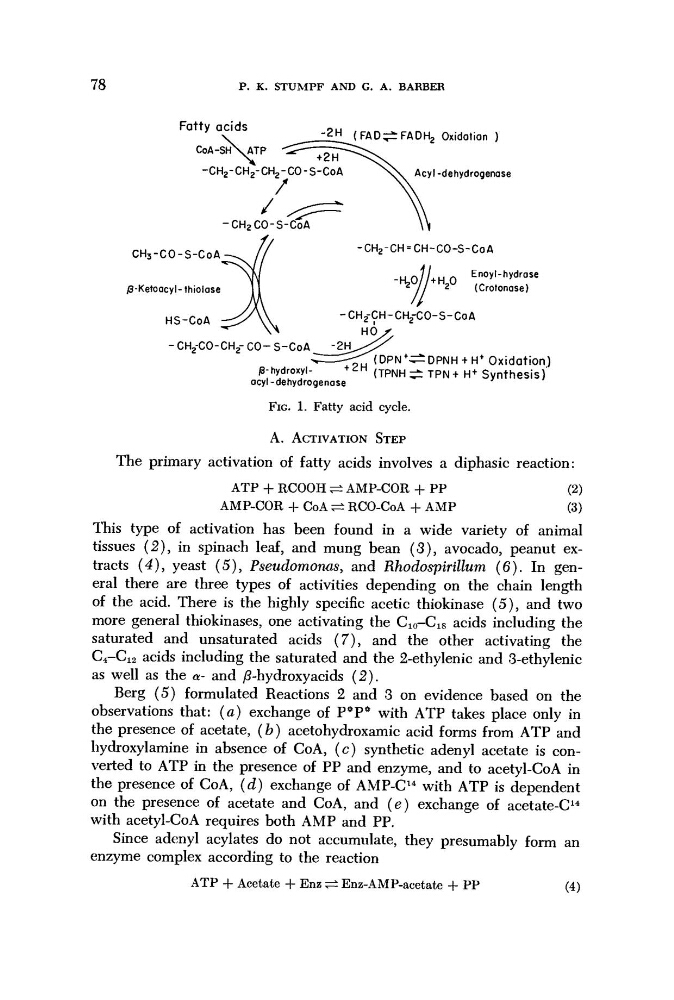
FIG. 1. Fatty acid cycle.
A. ACTIVATION STEP
The primary activation of fatty acids involves a diphasic reaction:
ATP + RCOOH ^± AMP-COR + PP
(2)
AMP-COR + CoA ^ RCO-CoA + AMP
(3)
This type of activation has been found in a wide variety of animal
tissues (2), in spinach leaf, and mung bean (3), avocado, peanut extracts (4), yeast (5), Fseudomonas, and Rhodospirillum (6). In general there are three types of activities depending on the chain length
of the acid. There is the highly specific acetic thiokinase (5), and two
more general thiokinases, one activating the Ci 0 -Ci 8 acids including the
saturated and unsaturated acids (7), and the other activating the
C 4 -Ci 2 acids including the saturated and the 2-ethylenic and 3-ethylenic
as well as the a- and /?-hydroxyacids (2).
Berg (5) formulated Reactions 2 and 3 on evidence based on the
observations that: (a) exchange of P*P* with ATP takes place only in
the presence of acetate, (b) acetohydroxamic acid forms from ATP and
hydroxylamine in absence of CoA, (c) synthetic adenyl acetate is converted to ATP in the presence of PP and enzyme, and to acetyl-CoA in
the presence of CoA, (d) exchange of AMP-C
14 with ATP is dependent
on the presence of acetate and CoA, and (e) exchange of acetate-C
14
with acetyl-CoA requires both AMP and PP.
Since adenyl acylates do not accumulate, they presumably form an
enzyme complex according to the reaction
ATP + Acetate + Enz ^± Enz-AMP-acetate + PP
(4)
P. K. STUMPF AND G. A. BARBER
Fatty acids
COA-SH\ATP
-CH 2 -CH 2 -CH 2 -CO-S-CoA
^H^(FAD^rFADH2 Oxidation )
Acyl-dehydrogenase
CH3-CO-S-CoA
0-Ketoacyl-thiolase
HS-CoA
-CH2CO-CH2-CO-S-CoA^
/3-hydroxylCH2-CH = CH-CO-S-CoA
■^v
E
zssr
-CH2-CH-CH2-CO-S-CoA
HO.
^^(DPN
+ ^DPNH + H
+ Oxidation)
+ dh
(TPNH^:TPN+H
+ Synthesis)
acyl-dehydrogenase
FIG. 1. Fatty acid cycle.
A. ACTIVATION STEP
The primary activation of fatty acids involves a diphasic reaction:
ATP + RCOOH ^± AMP-COR + PP
(2)
AMP-COR + CoA ^ RCO-CoA + AMP
(3)
This type of activation has been found in a wide variety of animal
tissues (2), in spinach leaf, and mung bean (3), avocado, peanut extracts (4), yeast (5), Fseudomonas, and Rhodospirillum (6). In general there are three types of activities depending on the chain length
of the acid. There is the highly specific acetic thiokinase (5), and two
more general thiokinases, one activating the Ci 0 -Ci 8 acids including the
saturated and unsaturated acids (7), and the other activating the
C 4 -Ci 2 acids including the saturated and the 2-ethylenic and 3-ethylenic
as well as the a- and /?-hydroxyacids (2).
Berg (5) formulated Reactions 2 and 3 on evidence based on the
observations that: (a) exchange of P*P* with ATP takes place only in
the presence of acetate, (b) acetohydroxamic acid forms from ATP and
hydroxylamine in absence of CoA, (c) synthetic adenyl acetate is converted to ATP in the presence of PP and enzyme, and to acetyl-CoA in
the presence of CoA, (d) exchange of AMP-C
14 with ATP is dependent
on the presence of acetate and CoA, and (e) exchange of acetate-C
14
with acetyl-CoA requires both AMP and PP.
Since adenyl acylates do not accumulate, they presumably form an
enzyme complex according to the reaction
ATP + Acetate + Enz ^± Enz-AMP-acetate + PP
(4)