

76
P. K. STUMPF AND G. A. BARBER
I. Energetics of Fatty Acid Oxidation
Since fatty acids are stored mostly as triglycerides, they must first
be converted to coenzyme A esters before they can be further utilized.
In the hydrolysis of triglycerides to free fatty acids about 2500 cal. of
free energy of hydrolysis are liberated in the form of heat, since there
is no known mechanism for its conservation. If, however, the ester
bonds in triglycerides could be cleaved by a thiolytic split, then the
total conservation of the ester linkage would be possible. Since this
means the formation of a thioester bond of approximately 8500 cal. of
free energy of hydrolysis, it would imply that the equilibrium would be
greatly in favor of the synthesis of the ester bond rather than of the
thioester linkage. Regardless of the mode of triglyceride cleavage, each
fatty acid, free or otherwise, must eventually enter the classic ß-oxidative cycle as an acyl CoA derivative. A unique feature of ß-oxidation
is that a fatty acid must undergo only one initial activation to the energy level of an acyl CoA derivative; thereafter it remains at that energy level as a CoA derivative throughout the complete conversion of
the molecule to acetyl-CoA.
It is therefore instructive to examine in detail the energy potential
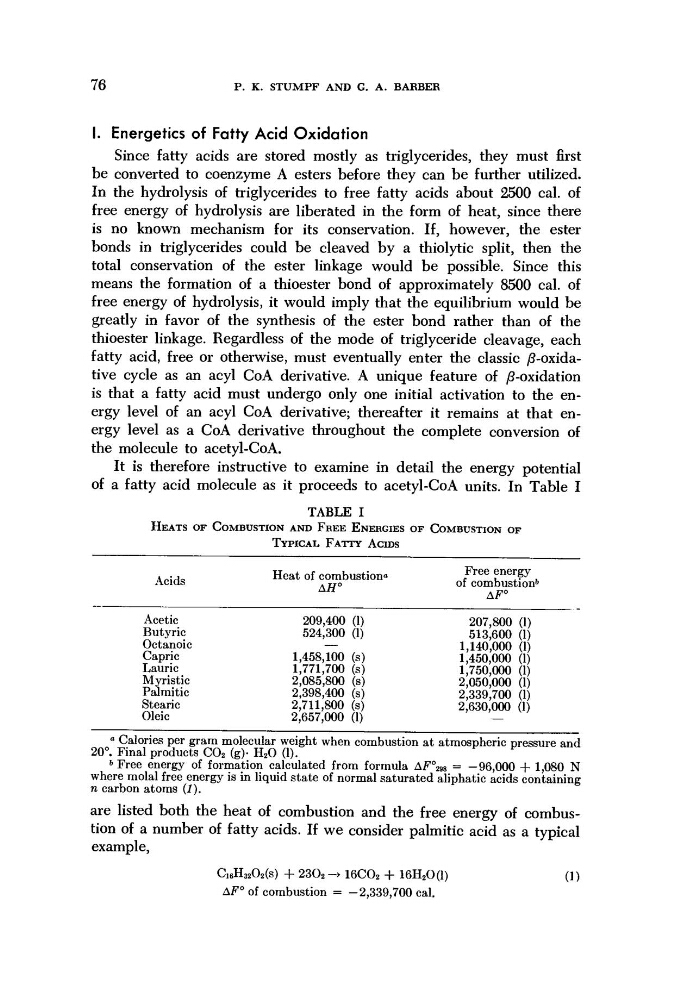
of a fatty acid molecule as it proceeds to acetyl-CoA units. In Table I
TABLE I
HEATS OF COMBUSTION AND FREE ENERGIES OF COMBUSTION OF
TYPICAL FATTY ACIDS
Acids
Heat
°
f
—
i0
-
o f t S
AH
AF°
Acetic
Butyric
Octanoic
Capric
Laurie
Myristic
Palmitic
Stearic
Oleic
209,400 (1)
524,300 (1)
—
1,458,100 (s)
1,771,700 (s)
2,085,800 (s)
2,398,400 (s)
2,711,800 (s)
2,657,000 (1)
207,800 (1)
513,600 (1)
1,140,000 (1)
1,450,000 (1)
1,750,000 (1)
2,050,000 (1)
2,339,700 (1)
2,630,000 (1)
—
° Calories per gram molecular weight when combustion at atmospheric pressure and
20°. Final products C0 2 (g)· H 2 0 (1).
h Free energy of formation calculated from formula AF°2 9 s = —96,000 + 1,080 N
where molal free energy is in liquid state of normal saturated aliphatic acids containing
n carbon atoms (1).
are listed both the heat of combustion and the free energy of combustion of a number of fatty acids. If we consider palmitic acid as a typical
example,
Ci 6 H 32 0 2 (s) + 230 2 -> 16C0 2 + 16H 2 0(l)
(1)
AF° of combustion = -2,339,700 cal.
P. K. STUMPF AND G. A. BARBER
I. Energetics of Fatty Acid Oxidation
Since fatty acids are stored mostly as triglycerides, they must first
be converted to coenzyme A esters before they can be further utilized.
In the hydrolysis of triglycerides to free fatty acids about 2500 cal. of
free energy of hydrolysis are liberated in the form of heat, since there
is no known mechanism for its conservation. If, however, the ester
bonds in triglycerides could be cleaved by a thiolytic split, then the
total conservation of the ester linkage would be possible. Since this
means the formation of a thioester bond of approximately 8500 cal. of
free energy of hydrolysis, it would imply that the equilibrium would be
greatly in favor of the synthesis of the ester bond rather than of the
thioester linkage. Regardless of the mode of triglyceride cleavage, each
fatty acid, free or otherwise, must eventually enter the classic ß-oxidative cycle as an acyl CoA derivative. A unique feature of ß-oxidation
is that a fatty acid must undergo only one initial activation to the energy level of an acyl CoA derivative; thereafter it remains at that energy level as a CoA derivative throughout the complete conversion of
the molecule to acetyl-CoA.
It is therefore instructive to examine in detail the energy potential
of a fatty acid molecule as it proceeds to acetyl-CoA units. In Table I
TABLE I
HEATS OF COMBUSTION AND FREE ENERGIES OF COMBUSTION OF
TYPICAL FATTY ACIDS
Acids
Heat
°
f
—
i0
-
o f t S
AH
AF°
Acetic
Butyric
Octanoic
Capric
Laurie
Myristic
Palmitic
Stearic
Oleic
209,400 (1)
524,300 (1)
—
1,458,100 (s)
1,771,700 (s)
2,085,800 (s)
2,398,400 (s)
2,711,800 (s)
2,657,000 (1)
207,800 (1)
513,600 (1)
1,140,000 (1)
1,450,000 (1)
1,750,000 (1)
2,050,000 (1)
2,339,700 (1)
2,630,000 (1)
—
° Calories per gram molecular weight when combustion at atmospheric pressure and
20°. Final products C0 2 (g)· H 2 0 (1).
h Free energy of formation calculated from formula AF°2 9 s = —96,000 + 1,080 N
where molal free energy is in liquid state of normal saturated aliphatic acids containing
n carbon atoms (1).
are listed both the heat of combustion and the free energy of combustion of a number of fatty acids. If we consider palmitic acid as a typical
example,
Ci 6 H 32 0 2 (s) + 230 2 -> 16C0 2 + 16H 2 0(l)
(1)
AF° of combustion = -2,339,700 cal.