

2. THERMODYNAMICS OF LIVING SYSTEMS
69
EXTERNAL FORCE if)
+.
ACTIVATED STATE
WITHOUT
EXTERNAL
FORCE
INITIAL
STATE
\*}' /SÄTE
REACTION COORDINATE
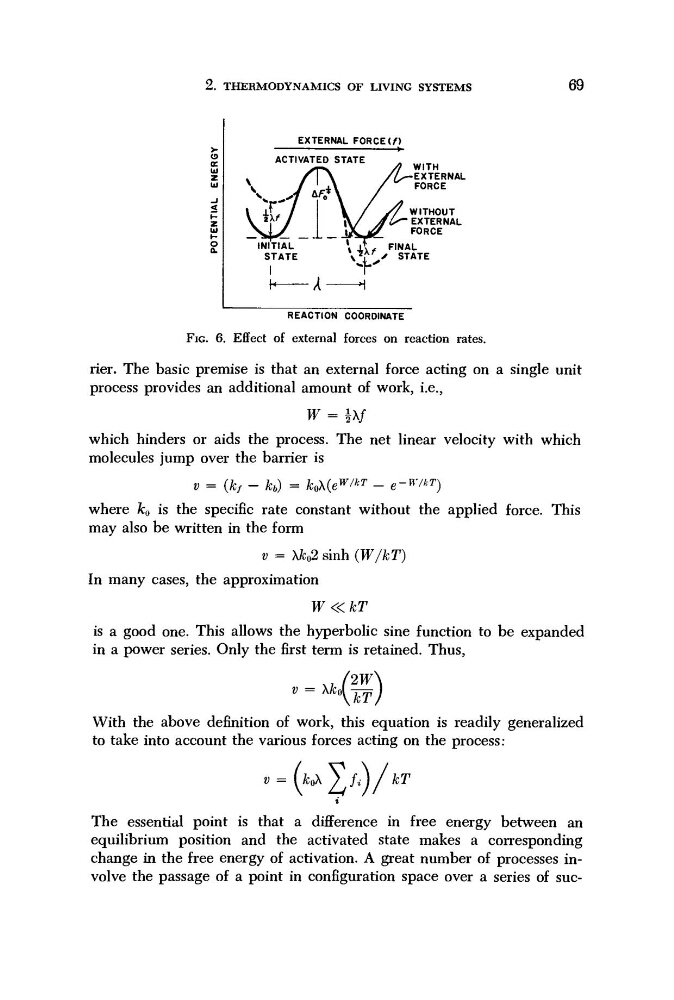
FIG. 6. Effect of external forces on reaction rates.
rier. The basic premise is that an external force acting on a single unit
process provides an additional amount of work, i.e.,
w = w
which hinders or aids the process. The net linear velocity with which
molecules jump over the barrier is
v = (k f - k b ) = k 0 \(e
w '
kT
-
ew '
kT )
where k 0 is the specific rate constant without the applied force. This
may also be written in the form
v = \k 0 2 sinh (W/kT)
In many cases, the approximation
W«kT
is a good one. This allows the hyperbolic sine function to be expanded
in a power series. Only the first term is retained. Thus,
v = Xfco(^)
With the above definition of work, this equation is readily generalized
to take into account the various forces acting on the process:
v = UoX YM/M
7
The essential point is that a difference in free energy between an
equilibrium position and the activated state makes a corresponding
change in the free energy of activation. A great number of processes involve the passage of a point in configuration space over a series of sue-
69
EXTERNAL FORCE if)
+.
ACTIVATED STATE
WITHOUT
EXTERNAL
FORCE
INITIAL
STATE
\*}' /SÄTE
REACTION COORDINATE
FIG. 6. Effect of external forces on reaction rates.
rier. The basic premise is that an external force acting on a single unit
process provides an additional amount of work, i.e.,
w = w
which hinders or aids the process. The net linear velocity with which
molecules jump over the barrier is
v = (k f - k b ) = k 0 \(e
w '
kT
-
ew '
kT )
where k 0 is the specific rate constant without the applied force. This
may also be written in the form
v = \k 0 2 sinh (W/kT)
In many cases, the approximation
W«kT
is a good one. This allows the hyperbolic sine function to be expanded
in a power series. Only the first term is retained. Thus,
v = Xfco(^)
With the above definition of work, this equation is readily generalized
to take into account the various forces acting on the process:
v = UoX YM/M
7
The essential point is that a difference in free energy between an
equilibrium position and the activated state makes a corresponding
change in the free energy of activation. A great number of processes involve the passage of a point in configuration space over a series of sue-