

2. THERMODYNAMICS OF LIVING SYSTEMS
67
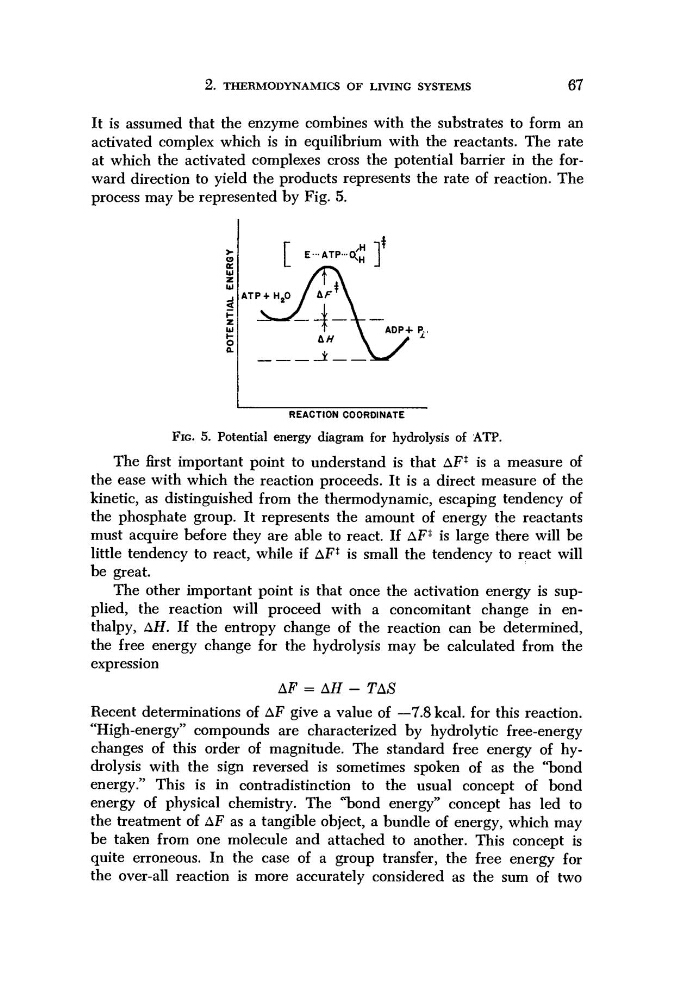
It is assumed that the enzyme combines with the substrates to form an
activated complex which is in equilibrium with the reactants. The rate
at which the activated complexes cross the potential barrier in the forward direction to yield the products represents the rate of reaction. The
process may be represented by Fig. 5.
ADP+ P.,
REACTION COORDINATE
FIG. 5. Potential energy diagram for hydrolysis of ATP.
The first important point to understand is that AF* is a measure of
the ease with which the reaction proceeds. It is a direct measure of the
kinetic, as distinguished from the thermodynamic, escaping tendency of
the phosphate group. It represents the amount of energy the reactants
must acquire before they are able to react. If AF* is large there will be
little tendency to react, while if AF* is small the tendency to react will
be great.
The other important point is that once the activation energy is supplied, the reaction will proceed with a concomitant change in enthalpy, AH. If the entropy change of the reaction can be determined,
the free energy change for the hydrolysis may be calculated from the
expression
AF = AH - TAS
Recent determinations of AF give a value of —7.8 kcal, for this reaction.
"High-energy" compounds are characterized by hydrolytic free-energy
changes of this order of magnitude. The standard free energy of hydrolysis with the sign reversed is sometimes spoken of as the "bond
energy." This is in contradistinction to the usual concept of bond
energy of physical chemistry. The "bond energy" concept has led to
the treatment of AF as a tangible object, a bundle of energy, which may
be taken from one molecule and attached to another. This concept is
quite erroneous. In the case of a group transfer, the free energy for
the over-all reaction is more accurately considered as the sum of two
67
It is assumed that the enzyme combines with the substrates to form an
activated complex which is in equilibrium with the reactants. The rate
at which the activated complexes cross the potential barrier in the forward direction to yield the products represents the rate of reaction. The
process may be represented by Fig. 5.
ADP+ P.,
REACTION COORDINATE
FIG. 5. Potential energy diagram for hydrolysis of ATP.
The first important point to understand is that AF* is a measure of
the ease with which the reaction proceeds. It is a direct measure of the
kinetic, as distinguished from the thermodynamic, escaping tendency of
the phosphate group. It represents the amount of energy the reactants
must acquire before they are able to react. If AF* is large there will be
little tendency to react, while if AF* is small the tendency to react will
be great.
The other important point is that once the activation energy is supplied, the reaction will proceed with a concomitant change in enthalpy, AH. If the entropy change of the reaction can be determined,
the free energy change for the hydrolysis may be calculated from the
expression
AF = AH - TAS
Recent determinations of AF give a value of —7.8 kcal, for this reaction.
"High-energy" compounds are characterized by hydrolytic free-energy
changes of this order of magnitude. The standard free energy of hydrolysis with the sign reversed is sometimes spoken of as the "bond
energy." This is in contradistinction to the usual concept of bond
energy of physical chemistry. The "bond energy" concept has led to
the treatment of AF as a tangible object, a bundle of energy, which may
be taken from one molecule and attached to another. This concept is
quite erroneous. In the case of a group transfer, the free energy for
the over-all reaction is more accurately considered as the sum of two