

2. THERMODYNAMICS OF LIVING SYSTEMS
51
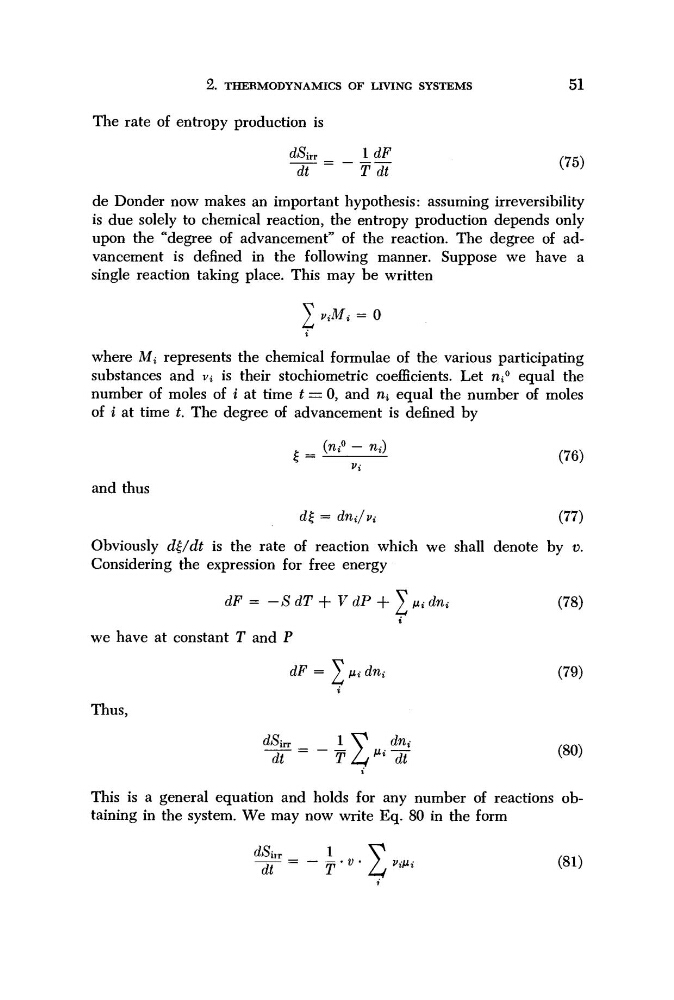
The rate of entropy production is
dSi T r _
1 dF
, 7Κλ
de Donder now makes an important hypothesis: assuming irreversibility
is due solely to chemical reaction, the entropy production depends only
upon the "degree of advancement" of the reaction. The degree of advancement is defined in the following manner. Suppose we have a
single reaction taking place. This may be written
^ vMi = 0
where M* represents the chemical formulae of the various participating
substances and VJ is their stochiometric coefficients. Let n*
0 equal the
number of moles of i at time t = 0, and n\ equal the number of moles
of i at time t. The degree of advancement is defined by
£ =
(n *° "
Ui)
(76)
and thus
d£ = drii/vi
(77)
Obviously άξ/dt is the rate of reaction which we shall denote by v.
Considering the expression for free energy
dF = -SdT+VdP + ^ ßi drii
(78)
we have at constant T and P
dF = ^ μ< drii
(79)
i
Thus,
dSj„
1_ Y* dni
~W~
T Li
ßi
~dt
(80)
This is a general equation and holds for any number of reactions obtaining in the system. We may now write Eq. 80 in the form
*S* = -i,. v .
y vm
(si)
51
The rate of entropy production is
dSi T r _
1 dF
, 7Κλ
de Donder now makes an important hypothesis: assuming irreversibility
is due solely to chemical reaction, the entropy production depends only
upon the "degree of advancement" of the reaction. The degree of advancement is defined in the following manner. Suppose we have a
single reaction taking place. This may be written
^ vMi = 0
where M* represents the chemical formulae of the various participating
substances and VJ is their stochiometric coefficients. Let n*
0 equal the
number of moles of i at time t = 0, and n\ equal the number of moles
of i at time t. The degree of advancement is defined by
£ =
(n *° "
Ui)
(76)
and thus
d£ = drii/vi
(77)
Obviously άξ/dt is the rate of reaction which we shall denote by v.
Considering the expression for free energy
dF = -SdT+VdP + ^ ßi drii
(78)
we have at constant T and P
dF = ^ μ< drii
(79)
i
Thus,
dSj„
1_ Y* dni
~W~
T Li
ßi
~dt
(80)
This is a general equation and holds for any number of reactions obtaining in the system. We may now write Eq. 80 in the form
*S* = -i,. v .
y vm
(si)