

2. THERMODYNAMICS OF LIVING SYSTEMS
35
position of life with respect to the Second Law? The Second Law means
"death by confinement." This is what is meant by "left to itself" in the
formal statement given in Section ΙΙ,ί,Ι.* Living systems avoid this
death sentence since they are open systems and thus not confined.
Stated in another way, all processes in nature show an inexorable increase in entropy on the over-all balance sheet. In the case of life, the
approach towards maximum entropy, i.e., death, can only be postponed,
not prevented, for exactly the length of a life time by continually consuming from the environment "negative entropy."
4. Free Energy
The idea of the drift towards maximum randomness provides a most
fundamental way of viewing the Second Law, but there is also another measure which may be applied to living organisms which compares thermodynamically to chemical reactions carried out at constant
temperature and pressure. In such a system, heat may flow to and from
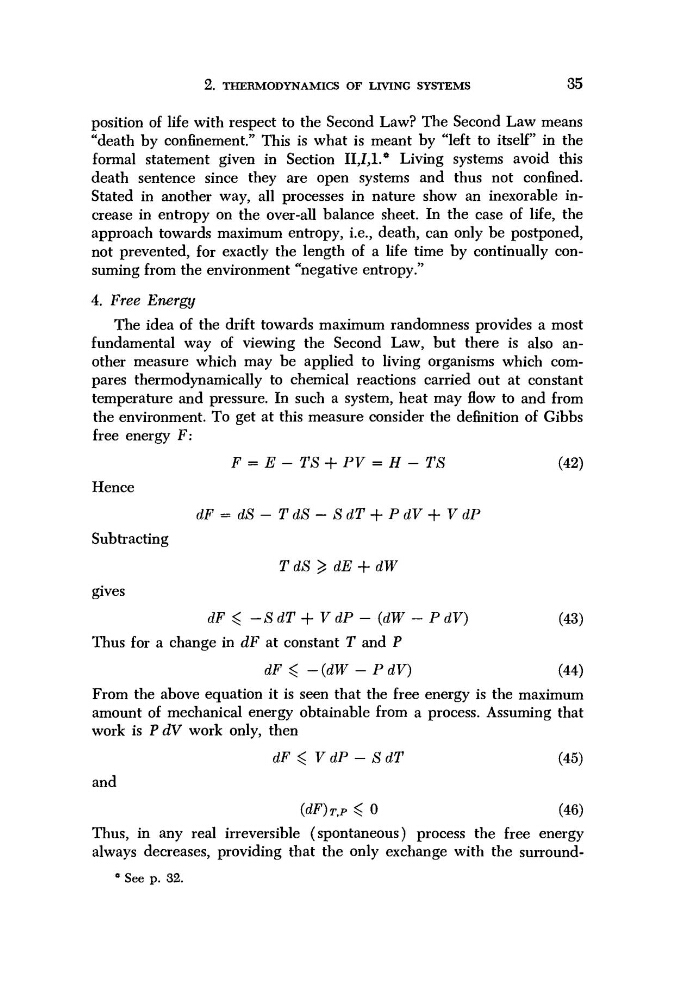
the environment. To get at this measure consider the definition of Gibbs
free energy F:
F = E - TS + PV = H - TS
(42)
Hence
dF = dS - T dS - 8 dT + P dV + V dP
Subtracting
Td8^dE
+ dW
gives
dF ^ -SdT + VdP - (dW - P dV)
(43)
Thus for a change in dF at constant T and P
dF ζ -{dW - PdV)
(44)
From the above equation it is seen that the free energy is the maximum
amount of mechanical energy obtainable from a process. Assuming that
work is PdV work only, then
dF ^ VdP - SdT
(45)
and
(dF) T .p ζ 0
(46)
Thus, in any real irreversible (spontaneous) process the free energy
always decreases, providing that the only exchange with the surround* See p. 32.
35
position of life with respect to the Second Law? The Second Law means
"death by confinement." This is what is meant by "left to itself" in the
formal statement given in Section ΙΙ,ί,Ι.* Living systems avoid this
death sentence since they are open systems and thus not confined.
Stated in another way, all processes in nature show an inexorable increase in entropy on the over-all balance sheet. In the case of life, the
approach towards maximum entropy, i.e., death, can only be postponed,
not prevented, for exactly the length of a life time by continually consuming from the environment "negative entropy."
4. Free Energy
The idea of the drift towards maximum randomness provides a most
fundamental way of viewing the Second Law, but there is also another measure which may be applied to living organisms which compares thermodynamically to chemical reactions carried out at constant
temperature and pressure. In such a system, heat may flow to and from
the environment. To get at this measure consider the definition of Gibbs
free energy F:
F = E - TS + PV = H - TS
(42)
Hence
dF = dS - T dS - 8 dT + P dV + V dP
Subtracting
Td8^dE
+ dW
gives
dF ^ -SdT + VdP - (dW - P dV)
(43)
Thus for a change in dF at constant T and P
dF ζ -{dW - PdV)
(44)
From the above equation it is seen that the free energy is the maximum
amount of mechanical energy obtainable from a process. Assuming that
work is PdV work only, then
dF ^ VdP - SdT
(45)
and
(dF) T .p ζ 0
(46)
Thus, in any real irreversible (spontaneous) process the free energy
always decreases, providing that the only exchange with the surround* See p. 32.