

506
MARY BELLE ALLEN
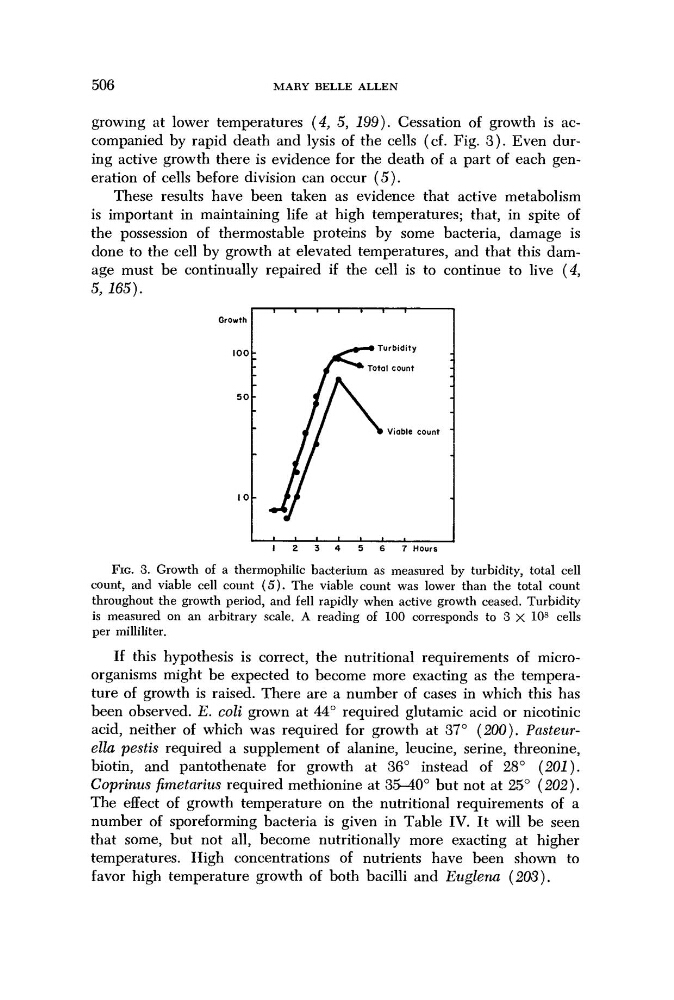
growing at lower temperatures (4, 5, 199). Cessation of growth is accompanied by rapid death and lysis of the cells (cf. Fig. 3). Even during active growth there is evidence for the death of a part of each generation of cells before division can occur (5).
These results have been taken as evidence that active metabolism
is important in maintaining life at high temperatures; that, in spite of
the possession of thermostable proteins by some bacteria, damage is
done to the cell by growth at elevated temperatures, and that this damage must be continually repaired if the cell is to continue to live (4,
5,165).
Growth
100
50
10
12
3
4
5
6
7 Hours
FIG. 3. Growth of a thermophilic bacterium as measured by turbidity, total cell
count, and viable cell count (5). The viable count was lower than the total count
throughout the growth period, and fell rapidly when active growth ceased. Turbidity
is measured on an arbitrary scale. A reading of 100 corresponds to 3 X 10
8 cells
per milliliter.
If this hypothesis is correct, the nutritional requirements of microorganisms might be expected to become more exacting as the temperature of growth is raised. There are a number of cases in which this has
been observed. E. coli grown at 44° required glutamic acid or nicotinic
acid, neither of which was required for growth at 37° (200). Pasteurella pestis required a supplement of alanine, leucine, serine, threonine,
biotin, and pantothenate for growth at 36° instead of 28° (201).
Coprinus fimetarius required methionine at 35-40° but not at 25° (202).
The effect of growth temperature on the nutritional requirements of a
number of sporeforming bacteria is given in Table IV. It will be seen
that some, but not all, become nutritionally more exacting at higher
temperatures. High concentrations of nutrients have been shown to
favor high temperature growth of both bacilli and Euglena (203).
Viable count
_l
I
I
l_
MARY BELLE ALLEN
growing at lower temperatures (4, 5, 199). Cessation of growth is accompanied by rapid death and lysis of the cells (cf. Fig. 3). Even during active growth there is evidence for the death of a part of each generation of cells before division can occur (5).
These results have been taken as evidence that active metabolism
is important in maintaining life at high temperatures; that, in spite of
the possession of thermostable proteins by some bacteria, damage is
done to the cell by growth at elevated temperatures, and that this damage must be continually repaired if the cell is to continue to live (4,
5,165).
Growth
100
50
10
12
3
4
5
6
7 Hours
FIG. 3. Growth of a thermophilic bacterium as measured by turbidity, total cell
count, and viable cell count (5). The viable count was lower than the total count
throughout the growth period, and fell rapidly when active growth ceased. Turbidity
is measured on an arbitrary scale. A reading of 100 corresponds to 3 X 10
8 cells
per milliliter.
If this hypothesis is correct, the nutritional requirements of microorganisms might be expected to become more exacting as the temperature of growth is raised. There are a number of cases in which this has
been observed. E. coli grown at 44° required glutamic acid or nicotinic
acid, neither of which was required for growth at 37° (200). Pasteurella pestis required a supplement of alanine, leucine, serine, threonine,
biotin, and pantothenate for growth at 36° instead of 28° (201).
Coprinus fimetarius required methionine at 35-40° but not at 25° (202).
The effect of growth temperature on the nutritional requirements of a
number of sporeforming bacteria is given in Table IV. It will be seen
that some, but not all, become nutritionally more exacting at higher
temperatures. High concentrations of nutrients have been shown to
favor high temperature growth of both bacilli and Euglena (203).
Viable count
_l
I
I
l_