

11. ORGANISMS AND THERMAL ENERGY
503
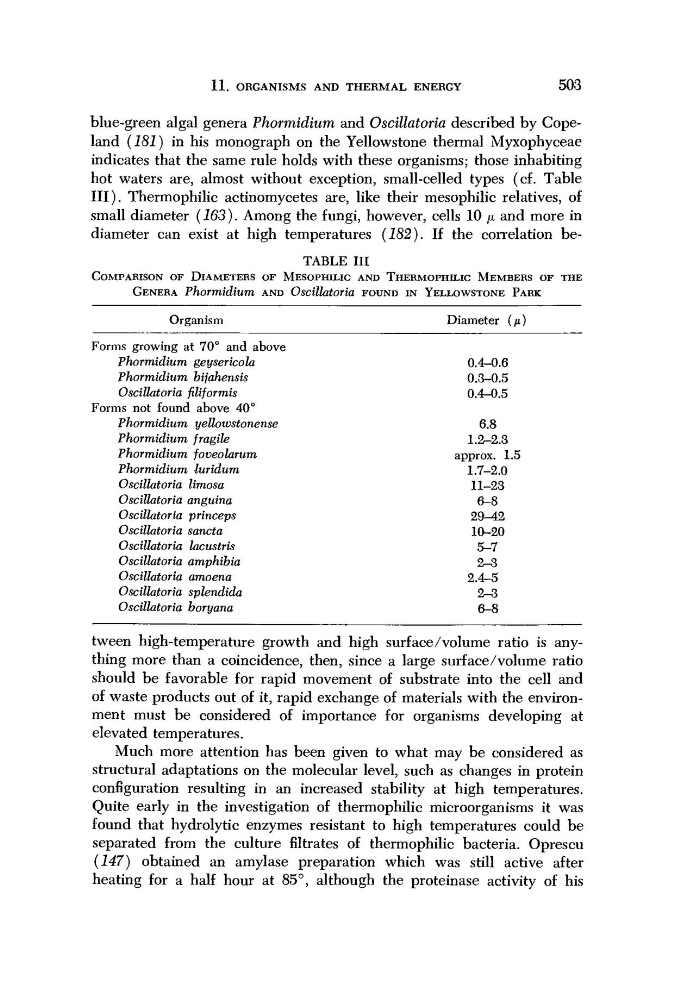
blue-green algal genera Phormidium and Oscillatoria described by Copeland (181) in his monograph on the Yellowstone thermal Myxophyceae
indicates that the same rule holds with these organisms; those inhabiting
hot waters are, almost without exception, small-celled types (cf. Table
III). Thermophilic actinomycetes are, like their mesophilic relatives, of
small diameter (163). Among the fungi, however, cells 10 μ and more in
diameter can exist at high temperatures (182). If the correlation beTABLE III
COMPARISON OF DIAMETERS OF MESOPHILIC AND THERMOPHILIC MEMBERS OF THE
GENERA Phormidium
AND Oscillatoria FOUND IN YELLOWSTONE PARK
Organism
Diameter (μ)
Forms growing at 70° and above
Phormidium geysericoh
Phormidium bijahensis
Oscillatoria filiformis
Forms not found above 40°
Phormidium yellowstonense
Phormidium fragile
Phormidium foveohrum
Phormidium luridum
Oscillatoria limosa
Oscillatoria anguina
OsciUatoria princeps
Oscillatoria sancta
Oscillatoria lacustris
Oscillatoria amphibia
Oscillatoria amoena
Oscillatoria splendida
Oscillatoria boryana
0.4-0.6
0.3-0.5
0.4-0.5
6.8
1.2-2.3
approx. 1.5
1.7-2.0
11-23
6-8
29-42
10-20
5-7
2^3
2.4-5
2-3
6-8
tween high-temperature growth and high surface/volume ratio is anything more than a coincidence, then, since a large surface/volume ratio
should be favorable for rapid movement of substrate into the cell and
of waste products out of it, rapid exchange of materials with the environment must be considered of importance for organisms developing at
elevated temperatures.
Much more attention has been given to what may be considered as
structural adaptations on the molecular level, such as changes in protein
configuration resulting in an increased stability at high temperatures.
Quite early in the investigation of thermophilic microorganisms it was
found that hydrolytic enzymes resistant to high temperatures could be
separated from the culture filtrates of thermophilic bacteria. Oprescu
(147) obtained an amylase preparation which was still active after
heating for a half hour at 85°, although the proteinase activity of his
503
blue-green algal genera Phormidium and Oscillatoria described by Copeland (181) in his monograph on the Yellowstone thermal Myxophyceae
indicates that the same rule holds with these organisms; those inhabiting
hot waters are, almost without exception, small-celled types (cf. Table
III). Thermophilic actinomycetes are, like their mesophilic relatives, of
small diameter (163). Among the fungi, however, cells 10 μ and more in
diameter can exist at high temperatures (182). If the correlation beTABLE III
COMPARISON OF DIAMETERS OF MESOPHILIC AND THERMOPHILIC MEMBERS OF THE
GENERA Phormidium
AND Oscillatoria FOUND IN YELLOWSTONE PARK
Organism
Diameter (μ)
Forms growing at 70° and above
Phormidium geysericoh
Phormidium bijahensis
Oscillatoria filiformis
Forms not found above 40°
Phormidium yellowstonense
Phormidium fragile
Phormidium foveohrum
Phormidium luridum
Oscillatoria limosa
Oscillatoria anguina
OsciUatoria princeps
Oscillatoria sancta
Oscillatoria lacustris
Oscillatoria amphibia
Oscillatoria amoena
Oscillatoria splendida
Oscillatoria boryana
0.4-0.6
0.3-0.5
0.4-0.5
6.8
1.2-2.3
approx. 1.5
1.7-2.0
11-23
6-8
29-42
10-20
5-7
2^3
2.4-5
2-3
6-8
tween high-temperature growth and high surface/volume ratio is anything more than a coincidence, then, since a large surface/volume ratio
should be favorable for rapid movement of substrate into the cell and
of waste products out of it, rapid exchange of materials with the environment must be considered of importance for organisms developing at
elevated temperatures.
Much more attention has been given to what may be considered as
structural adaptations on the molecular level, such as changes in protein
configuration resulting in an increased stability at high temperatures.
Quite early in the investigation of thermophilic microorganisms it was
found that hydrolytic enzymes resistant to high temperatures could be
separated from the culture filtrates of thermophilic bacteria. Oprescu
(147) obtained an amylase preparation which was still active after
heating for a half hour at 85°, although the proteinase activity of his