

11. ORGANISMS AND THERMAL ENERGY
489
even though the individual reactions taking place in the organism are
governed by the same rules which control them in vitro. These rules,
however, remain of importance when a molecular explanation of biochemical events is sought.
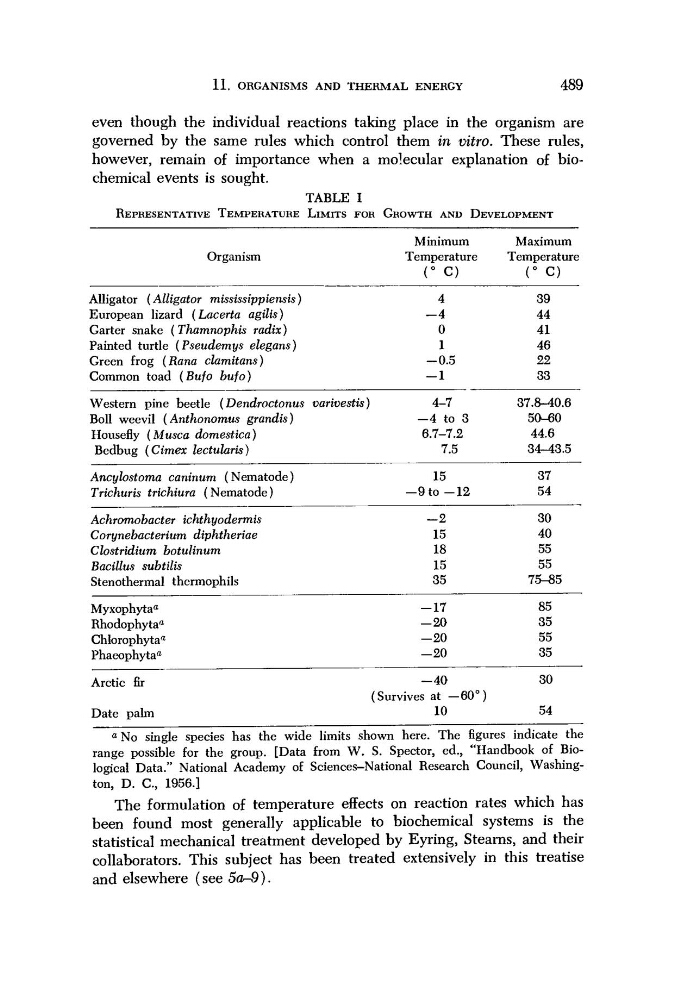
TABLE I
REPRESENTATIVE TEMPERATURE LIMITS FOR GROWTH AND DEVELOPMENT
Organism
Minimum
Temperature
r c)
Maximum
Temperature
r o
Alligator (Alligator
mississippiensis)
European lizard (Lacerta
agilis)
Garter snake (Thamnophis
radix)
Painted turtle (Pseudemys
elegans)
Green frog (Rana
clamitans)
Common toad (Bufo
bufo)
Western pine beetle (Dendroctonus
varivestis)
Boll weevil (Anthonomus grandis)
Housefly (Musca
domestica)
Bedbug (Cimex lectularis)
4
-4
0
1
-0.5
-1
4-7
—4 to 3
6.7-7.2
7.5
39
44
41
46
22
33
37.&-40.6
50-60
44.6
34-43.5
Ancylostoma caninum (Nematode)
Trichuris trichiura (Nematode)
15
-9 to-12
37
54
Achromobacter
ichthyodermis
Corynebacterium
diphtheriae
Clostridium
botulinum
Bacillus subtilis
Stenothermal thermophils
-2
15
18
15
35
-17
-20
-20
-20
30
40
55
55
75-85
85
35
55
35
Myxophyta
a
Rhodophyta
a
Chlorophyta
a
Phaeophyta
a
Arctic fir
Date palm
-40
30
(Survives at —60°)
10
54
a No single species has the wide limits shown here. The figures indicate the
range possible for the group. [Data from W. S. Spector, ed., "Handbook of Biological Data." National Academy of Sciences-National Research Council, Washington, D. C, 1956.]
The formulation of temperature effects on reaction rates which has
been found most generally applicable to biochemical systems is the
statistical mechanical treatment developed by Eyring, Stearns, and their
collaborators. This subject has been treated extensively in this treatise
and elsewhere (see 5a-9).
489
even though the individual reactions taking place in the organism are
governed by the same rules which control them in vitro. These rules,
however, remain of importance when a molecular explanation of biochemical events is sought.
TABLE I
REPRESENTATIVE TEMPERATURE LIMITS FOR GROWTH AND DEVELOPMENT
Organism
Minimum
Temperature
r c)
Maximum
Temperature
r o
Alligator (Alligator
mississippiensis)
European lizard (Lacerta
agilis)
Garter snake (Thamnophis
radix)
Painted turtle (Pseudemys
elegans)
Green frog (Rana
clamitans)
Common toad (Bufo
bufo)
Western pine beetle (Dendroctonus
varivestis)
Boll weevil (Anthonomus grandis)
Housefly (Musca
domestica)
Bedbug (Cimex lectularis)
4
-4
0
1
-0.5
-1
4-7
—4 to 3
6.7-7.2
7.5
39
44
41
46
22
33
37.&-40.6
50-60
44.6
34-43.5
Ancylostoma caninum (Nematode)
Trichuris trichiura (Nematode)
15
-9 to-12
37
54
Achromobacter
ichthyodermis
Corynebacterium
diphtheriae
Clostridium
botulinum
Bacillus subtilis
Stenothermal thermophils
-2
15
18
15
35
-17
-20
-20
-20
30
40
55
55
75-85
85
35
55
35
Myxophyta
a
Rhodophyta
a
Chlorophyta
a
Phaeophyta
a
Arctic fir
Date palm
-40
30
(Survives at —60°)
10
54
a No single species has the wide limits shown here. The figures indicate the
range possible for the group. [Data from W. S. Spector, ed., "Handbook of Biological Data." National Academy of Sciences-National Research Council, Washington, D. C, 1956.]
The formulation of temperature effects on reaction rates which has
been found most generally applicable to biochemical systems is the
statistical mechanical treatment developed by Eyring, Stearns, and their
collaborators. This subject has been treated extensively in this treatise
and elsewhere (see 5a-9).