

464
ERIC E. CONN
phosphorylation when added to mitochondria is of considerable importance (158). This observation implies that DPNH formed in extramitochondrial reactions catalyzed by soluble dehydrogenases can in
turn be oxidized by the respiratory chain of the mitochondria to support
phosphorylation. If this is possible, then the oxidation of substrates by
pyridine-nucleotide-specific soluble enzymes outside the mitochondria
may provide additional energy sources for the cell. The most important
single example of an extramitochondrial enzyme which might function
in this manner is the glyceraldehyde-3-phosphate dehydrogenase.
It should be emphasized that, in earlier studies, it was necessary to
subject mitochondria to hypotonic treatment or.to add cytochrome c
(158) before the oxidation of external DPNH would support oxidative
phosphorylation. However, Maley (160) has recently reported the oxidation of DPNH by rat liver mitochondria in experiments in which P/O
ratios in excess of 2.0 were obtained.
Experiments of the sort just described are not comparable to conditions existing within the cell, for in the latter case DPNH would be generated in low concentration and immediately reoxidized by the respiratory chain. Lehninger suggested that the concentration of DPNH may
determine whether phosphorylation will occur. He attempted to reproduce conditions in the cell by coupling the reduction of DPN
+ by
crystalline alcohol dehydrogenase (159) to reoxidation by rat liver
mitochondria. Essentially no phosphorylation was observed. However,
in other experiments in which triosephosphate dehydrogenase was utilized as the DPNH-generating system, phosphorylation over and above
that due to the substrate phosphorylation by the dehydrogenase did
occur (159). The difference in the phosphorylating ability of the two
coupled dehydrogenase systems was explained by the differences in
equilibrium of the two systems. With triosephosphate dehydrogenase,
approximately 90% of the total DPN was in the reduced form. In the case
of alcohol dehydrogenase, less than 2% of the coenzyme was reduced.
These experiments and their significance in the general economy of the
cell have been extensively discussed (137, 159).
Although the oxidation of DPNH will support the formation of 3
high-energy phosphate bonds, there is little evidence to indicate that
TPNH can function in the same way. Instead, Kaplan et al. (161) have
provided data indicating that the oxidation of TPNH through the electron transport system of rat liver mitochondria does not lead to oxidative
phosphorylation. Only when the oxidation of TPNH is mediated through
the enzyme transhydrogenase (162) and DPN
+ is there evidence for
phosphorylation, the oxidation of DPNH formed in the transhydrogenase
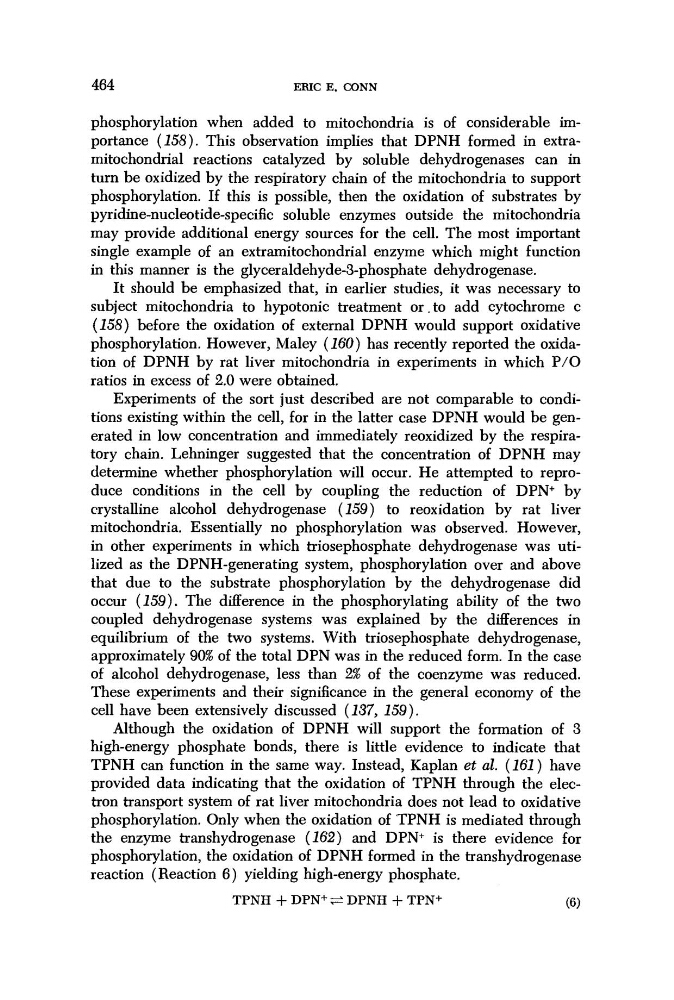
reaction (Reaction 6) yielding high-energy phosphate.
TPNH + DPN+ Ξ± DPNH + TPN+
(6)
ERIC E. CONN
phosphorylation when added to mitochondria is of considerable importance (158). This observation implies that DPNH formed in extramitochondrial reactions catalyzed by soluble dehydrogenases can in
turn be oxidized by the respiratory chain of the mitochondria to support
phosphorylation. If this is possible, then the oxidation of substrates by
pyridine-nucleotide-specific soluble enzymes outside the mitochondria
may provide additional energy sources for the cell. The most important
single example of an extramitochondrial enzyme which might function
in this manner is the glyceraldehyde-3-phosphate dehydrogenase.
It should be emphasized that, in earlier studies, it was necessary to
subject mitochondria to hypotonic treatment or.to add cytochrome c
(158) before the oxidation of external DPNH would support oxidative
phosphorylation. However, Maley (160) has recently reported the oxidation of DPNH by rat liver mitochondria in experiments in which P/O
ratios in excess of 2.0 were obtained.
Experiments of the sort just described are not comparable to conditions existing within the cell, for in the latter case DPNH would be generated in low concentration and immediately reoxidized by the respiratory chain. Lehninger suggested that the concentration of DPNH may
determine whether phosphorylation will occur. He attempted to reproduce conditions in the cell by coupling the reduction of DPN
+ by
crystalline alcohol dehydrogenase (159) to reoxidation by rat liver
mitochondria. Essentially no phosphorylation was observed. However,
in other experiments in which triosephosphate dehydrogenase was utilized as the DPNH-generating system, phosphorylation over and above
that due to the substrate phosphorylation by the dehydrogenase did
occur (159). The difference in the phosphorylating ability of the two
coupled dehydrogenase systems was explained by the differences in
equilibrium of the two systems. With triosephosphate dehydrogenase,
approximately 90% of the total DPN was in the reduced form. In the case
of alcohol dehydrogenase, less than 2% of the coenzyme was reduced.
These experiments and their significance in the general economy of the
cell have been extensively discussed (137, 159).
Although the oxidation of DPNH will support the formation of 3
high-energy phosphate bonds, there is little evidence to indicate that
TPNH can function in the same way. Instead, Kaplan et al. (161) have
provided data indicating that the oxidation of TPNH through the electron transport system of rat liver mitochondria does not lead to oxidative
phosphorylation. Only when the oxidation of TPNH is mediated through
the enzyme transhydrogenase (162) and DPN
+ is there evidence for
phosphorylation, the oxidation of DPNH formed in the transhydrogenase
reaction (Reaction 6) yielding high-energy phosphate.
TPNH + DPN+ Ξ± DPNH + TPN+
(6)