

10. ELECTRON TRANSPORT AND OXIDATIVE PHOSPHORYLATION
459
tion of DPNH. The oxidation of DPNH resulted in large oxygen uptake,
but there was no phosphorylation. For a more detailed discussion of the
older work in oxidative phosphorylation, the reader is referred to the
reviews by Hunter (136) and by Lehninger (137).
B. ENERGY RELATIONSHIPS
Belitzer (134) observed that the difference in oxidation-reduction
potential between substrates and 0 2 was sufficient to permit the
esterification of several moles of inorganic phosphate for each oxidation
equivalent. Moreover, in 1939 the cytochrome pathway was known in
some detail and it was recognized that the electron transfer passed
through a series of carriers in stepwise manner. Thus Belitzer proposed
that each of those steps in which DPNH, flavoprotein or cytochrome
was oxidized in turn by the next carrier represented an energy-releasing
step which could be linked to phosphorylation. Although these relationships have been thoroughly discussed elsewhere (13, 137, 137a)
they will be reviewed briefly again.
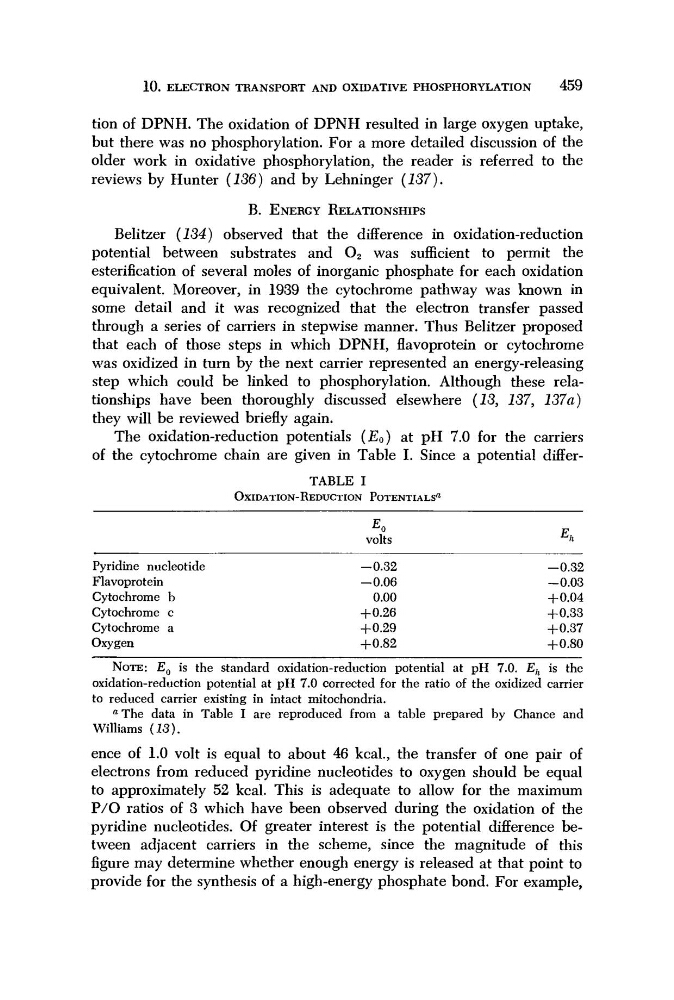
The oxidation-reduction potentials (E 0 ) at pH 7.0 for the carriers
of the cytochrome chain are given in Table I. Since a potential differTABLE I
OXIDATION-REDUCTION POTENTIALS
01
-
—
volts
^
Pyridine nucleotide
—0.32
—0.32
Flavoprotein
—0.06
—0.03
Cytochrome b
0.00
+0.04
Cytochrome c
+0.26
+0.33
Cytochrome a
+0.29
+0.37
Oxygen
+0.82
+0.80
NOTE: E 0 is the standard oxidation-reduction potential at pH 7.O. E h is the
oxidation-reduction potential at pH 7.0 corrected for the ratio of the oxidized carrier
to reduced carrier existing in intact mitochondria.
a The data in Table I are reproduced from a table prepared by Chance and
Williams (13).
ence of 1.0 volt is equal to about 46 kcal., the transfer of one pair of
electrons from reduced pyridine nucleotides to oxygen should be equal
to approximately 52 kcal. This is adequate to allow for the maximum
P/O ratios of 3 which have been observed during the oxidation of the
pyridine nucleotides. Of greater interest is the potential difference between adjacent carriers in the scheme, since the magnitude of this
figure may determine whether enough energy is released at that point to
provide for the synthesis of a high-energy phosphate bond. For example,
459
tion of DPNH. The oxidation of DPNH resulted in large oxygen uptake,
but there was no phosphorylation. For a more detailed discussion of the
older work in oxidative phosphorylation, the reader is referred to the
reviews by Hunter (136) and by Lehninger (137).
B. ENERGY RELATIONSHIPS
Belitzer (134) observed that the difference in oxidation-reduction
potential between substrates and 0 2 was sufficient to permit the
esterification of several moles of inorganic phosphate for each oxidation
equivalent. Moreover, in 1939 the cytochrome pathway was known in
some detail and it was recognized that the electron transfer passed
through a series of carriers in stepwise manner. Thus Belitzer proposed
that each of those steps in which DPNH, flavoprotein or cytochrome
was oxidized in turn by the next carrier represented an energy-releasing
step which could be linked to phosphorylation. Although these relationships have been thoroughly discussed elsewhere (13, 137, 137a)
they will be reviewed briefly again.
The oxidation-reduction potentials (E 0 ) at pH 7.0 for the carriers
of the cytochrome chain are given in Table I. Since a potential differTABLE I
OXIDATION-REDUCTION POTENTIALS
01
-
—
volts
^
Pyridine nucleotide
—0.32
—0.32
Flavoprotein
—0.06
—0.03
Cytochrome b
0.00
+0.04
Cytochrome c
+0.26
+0.33
Cytochrome a
+0.29
+0.37
Oxygen
+0.82
+0.80
NOTE: E 0 is the standard oxidation-reduction potential at pH 7.O. E h is the
oxidation-reduction potential at pH 7.0 corrected for the ratio of the oxidized carrier
to reduced carrier existing in intact mitochondria.
a The data in Table I are reproduced from a table prepared by Chance and
Williams (13).
ence of 1.0 volt is equal to about 46 kcal., the transfer of one pair of
electrons from reduced pyridine nucleotides to oxygen should be equal
to approximately 52 kcal. This is adequate to allow for the maximum
P/O ratios of 3 which have been observed during the oxidation of the
pyridine nucleotides. Of greater interest is the potential difference between adjacent carriers in the scheme, since the magnitude of this
figure may determine whether enough energy is released at that point to
provide for the synthesis of a high-energy phosphate bond. For example,