

28
HENRY EYRING, RICHABD P. BOYCE AND JOHN D. SPIKES
which is the same value as obtained experimentally from the burning
of glucose in a calorimeter.
Another technique, which is used in many cases where the AH for
a reaction is difficult to measure directly, involves adding or subtracting
an appropriate series of reactions, each of which has a known AH. For
example, it is difficult to measure directly the AH for the burning of
carbon in oxygen with the formation of carbon monoxide. It is fairly
simple, however, to measure AH for the oxidation of carbon to carbon
dioxide and the AH for the oxidation of carbon monoxide to carbon
dioxide. These latter reactions can be subtracted algebraically to give
the first reaction as follows:
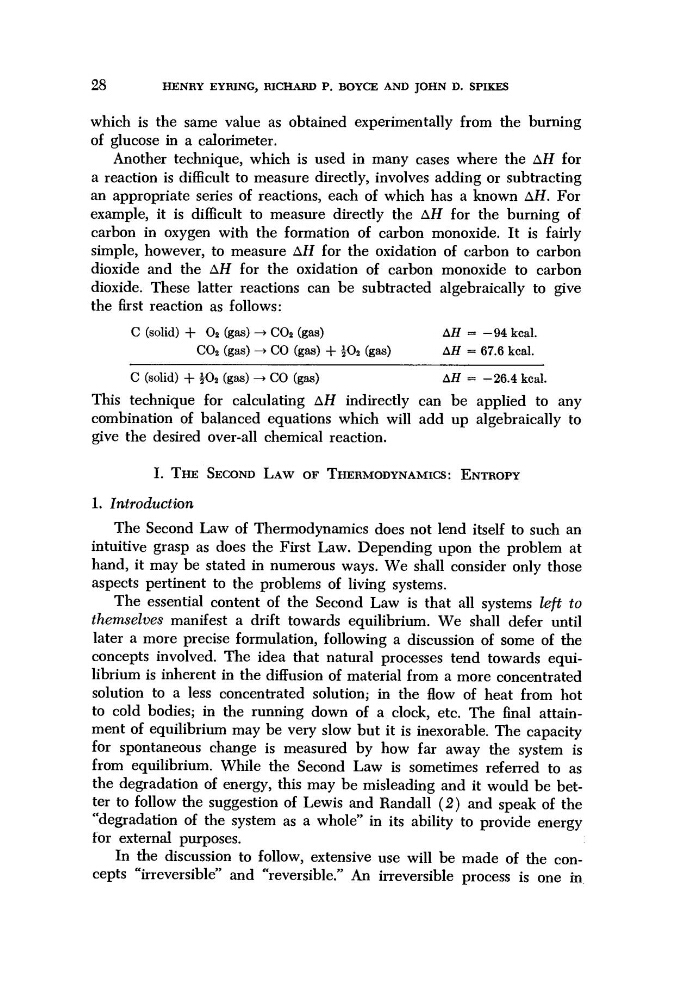
C (solid) + 0 2 (gas) -> C0 2 (gas)
AH = -94 kcal.
C0 2 (gas) -> CO (gas) + £0 2 (gas)
AH = 67.6 kcal.
C (solid) + J0 2 (gas) -► CO (gas)
AH = -26.4 kcal.
This technique for calculating AH indirectly can be applied to any
combination of balanced equations which will add up algebraically to
give the desired over-all chemical reaction.
I. THE SECOND LAW OF THERMODYNAMICS: ENTROPY
1. Introduction
The Second Law of Thermodynamics does not lend itself to such an
intuitive grasp as does the First Law. Depending upon the problem at
hand, it may be stated in numerous ways. We shall consider only those
aspects pertinent to the problems of living systems.
The essential content of the Second Law is that all systems left to
themselves manifest a drift towards equilibrium. We shall defer until
later a more precise formulation, following a discussion of some of the
concepts involved. The idea that natural processes tend towards equilibrium is inherent in the diffusion of material from a more concentrated
solution to a less concentrated solution; in the flow of heat from hot
to cold bodies; in the running down of a clock, etc. The final attainment of equilibrium may be very slow but it is inexorable. The capacity
for spontaneous change is measured by how far away the system is
from equilibrium. While the Second Law is sometimes referred to as
the degradation of energy, this may be misleading and it would be better to follow the suggestion of Lewis and Randall (2) and speak of the
"degradation of the system as a whole" in its ability to provide energy
for external purposes.
In the discussion to follow, extensive use will be made of the concepts "irreversible" and "reversible." An irreversible process is one in
HENRY EYRING, RICHABD P. BOYCE AND JOHN D. SPIKES
which is the same value as obtained experimentally from the burning
of glucose in a calorimeter.
Another technique, which is used in many cases where the AH for
a reaction is difficult to measure directly, involves adding or subtracting
an appropriate series of reactions, each of which has a known AH. For
example, it is difficult to measure directly the AH for the burning of
carbon in oxygen with the formation of carbon monoxide. It is fairly
simple, however, to measure AH for the oxidation of carbon to carbon
dioxide and the AH for the oxidation of carbon monoxide to carbon
dioxide. These latter reactions can be subtracted algebraically to give
the first reaction as follows:
C (solid) + 0 2 (gas) -> C0 2 (gas)
AH = -94 kcal.
C0 2 (gas) -> CO (gas) + £0 2 (gas)
AH = 67.6 kcal.
C (solid) + J0 2 (gas) -► CO (gas)
AH = -26.4 kcal.
This technique for calculating AH indirectly can be applied to any
combination of balanced equations which will add up algebraically to
give the desired over-all chemical reaction.
I. THE SECOND LAW OF THERMODYNAMICS: ENTROPY
1. Introduction
The Second Law of Thermodynamics does not lend itself to such an
intuitive grasp as does the First Law. Depending upon the problem at
hand, it may be stated in numerous ways. We shall consider only those
aspects pertinent to the problems of living systems.
The essential content of the Second Law is that all systems left to
themselves manifest a drift towards equilibrium. We shall defer until
later a more precise formulation, following a discussion of some of the
concepts involved. The idea that natural processes tend towards equilibrium is inherent in the diffusion of material from a more concentrated
solution to a less concentrated solution; in the flow of heat from hot
to cold bodies; in the running down of a clock, etc. The final attainment of equilibrium may be very slow but it is inexorable. The capacity
for spontaneous change is measured by how far away the system is
from equilibrium. While the Second Law is sometimes referred to as
the degradation of energy, this may be misleading and it would be better to follow the suggestion of Lewis and Randall (2) and speak of the
"degradation of the system as a whole" in its ability to provide energy
for external purposes.
In the discussion to follow, extensive use will be made of the concepts "irreversible" and "reversible." An irreversible process is one in