

10. ELECTRON TRANSPORT AND OXIDATIVE PHOSPHORYLATION
449
hand, BAL (41, 42), the antibiotic antimycin A (43), Amytal (44), and
certain quinones (45) interfere with electron transfer at points between
cytochrome c and succinate or DPNH. Although the mode of action of
this latter group of inhibitors is not at all clear (46), the site of action
has been specified (47). However, since there is not complete agreement
on the sequence of carriers in the region where these inhibitors are believed to function, the site of action of the inhibitors may not be known
with absolute certainty.
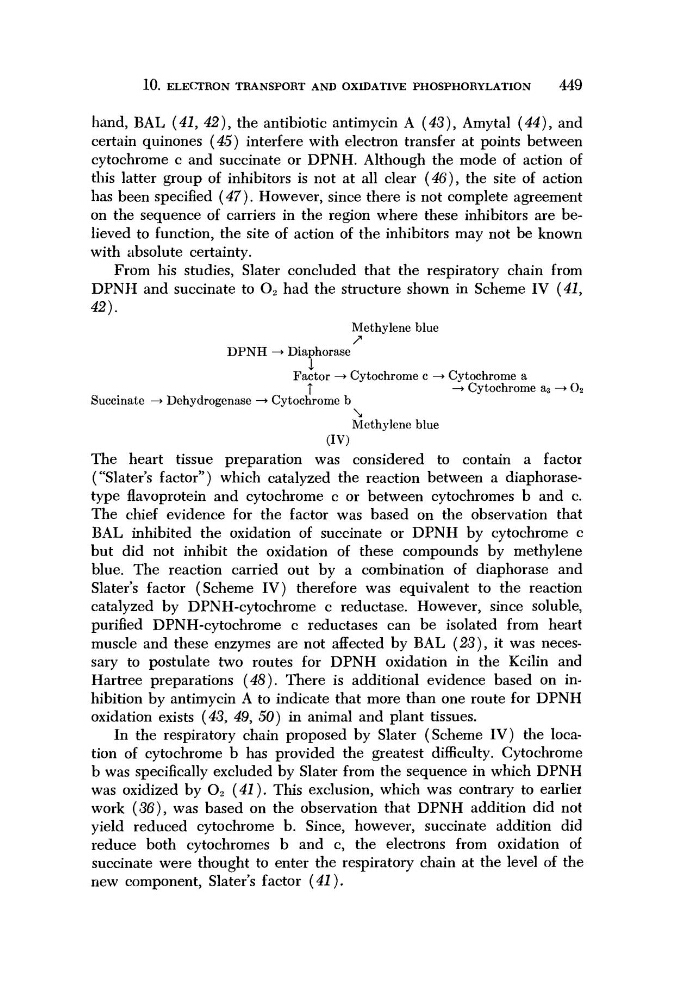
From his studies, Slater concluded that the respiratory chain from
DPNH and succinate to 0 2 had the structure shown in Scheme IV (41,
42).
Methylene blue
S
DPNH -> Diaphorase
i
Factor —> Cytochrome c —> Cytochrome a
|
—* Cytochrome a 3 —> O2
Succinate —> Dehydrogenase —> Cytochrome b
\
Methylene blue
(IV)
The heart tissue preparation was considered to contain a factor
("Slater's factor") which catalyzed the reaction between a diaphorasetype flavoprotein and cytochrome c or between cytochromes b and c.
The chief evidence for the factor was based on the observation that
BAL inhibited the oxidation of succinate or DPNH by cytochrome c
but did not inhibit the oxidation of these compounds by methylene
blue. The reaction carried out by a combination of diaphorase and
Slater's factor (Scheme IV) therefore was equivalent to the reaction
catalyzed by DPNH-cytochrome c reductase. However, since soluble,
purified DPNH-cytochrome c reductases can be isolated from heart
muscle and these enzymes are not affected by BAL (23), it was necessary to postulate two routes for DPNH oxidation in the Keilin and
Hartree preparations (48). There is additional evidence based on inhibition by antimycin A to indicate that more than one route for DPNH
oxidation exists (43, 49, 50) in animal and plant tissues.
In the respiratory chain proposed by Slater (Scheme IV) the location of cytochrome b has provided the greatest difficulty. Cytochrome
b was specifically excluded by Slater from the sequence in which DPNH
was oxidized by 0 2 (41). This exclusion, which was contrary to earlier
work (36), was based on the observation that DPNH addition did not
yield reduced cytochrome b. Since, however, succinate addition did
reduce both cytochromes b and c, the electrons from oxidation of
succinate were thought to enter the respiratory chain at the level of the
new component, Slater's factor (41).
449
hand, BAL (41, 42), the antibiotic antimycin A (43), Amytal (44), and
certain quinones (45) interfere with electron transfer at points between
cytochrome c and succinate or DPNH. Although the mode of action of
this latter group of inhibitors is not at all clear (46), the site of action
has been specified (47). However, since there is not complete agreement
on the sequence of carriers in the region where these inhibitors are believed to function, the site of action of the inhibitors may not be known
with absolute certainty.
From his studies, Slater concluded that the respiratory chain from
DPNH and succinate to 0 2 had the structure shown in Scheme IV (41,
42).
Methylene blue
S
DPNH -> Diaphorase
i
Factor —> Cytochrome c —> Cytochrome a
|
—* Cytochrome a 3 —> O2
Succinate —> Dehydrogenase —> Cytochrome b
\
Methylene blue
(IV)
The heart tissue preparation was considered to contain a factor
("Slater's factor") which catalyzed the reaction between a diaphorasetype flavoprotein and cytochrome c or between cytochromes b and c.
The chief evidence for the factor was based on the observation that
BAL inhibited the oxidation of succinate or DPNH by cytochrome c
but did not inhibit the oxidation of these compounds by methylene
blue. The reaction carried out by a combination of diaphorase and
Slater's factor (Scheme IV) therefore was equivalent to the reaction
catalyzed by DPNH-cytochrome c reductase. However, since soluble,
purified DPNH-cytochrome c reductases can be isolated from heart
muscle and these enzymes are not affected by BAL (23), it was necessary to postulate two routes for DPNH oxidation in the Keilin and
Hartree preparations (48). There is additional evidence based on inhibition by antimycin A to indicate that more than one route for DPNH
oxidation exists (43, 49, 50) in animal and plant tissues.
In the respiratory chain proposed by Slater (Scheme IV) the location of cytochrome b has provided the greatest difficulty. Cytochrome
b was specifically excluded by Slater from the sequence in which DPNH
was oxidized by 0 2 (41). This exclusion, which was contrary to earlier
work (36), was based on the observation that DPNH addition did not
yield reduced cytochrome b. Since, however, succinate addition did
reduce both cytochromes b and c, the electrons from oxidation of
succinate were thought to enter the respiratory chain at the level of the
new component, Slater's factor (41).