

420
ERNEST BUEDING AND EMMANUEL FÄRBER
completely, and that under anaerobic conditions oxidation of 1 mole of
glyceraldehyde-3-phosphate is coupled with the reduction of another
mole of this compound to the glycerophosphate.
Glyceraldehyde-3-phosphate + P; + DPN+ -► 1,3-Diphosphoglycerate + DPNH
(1)
Glyceraldehyde-3-phosphate + DPNH -> Glycerophosphate + DPN+
(2)
Hydrolysis of glycerophosphate by the action of a phosphatase would
give rise to one mole of glycerol per mole of pyruvate formed from 1,3diphosphoglycerate. If aerobically DPNH were reoxidized by an electron
transport system present in these trypanosomes, reduction of glyceraldehyde-3-phosphate could not occur, resulting in the formation of two
moles of pyruvate from one mole of glucose.
TABLE II
METABOLIC CHARACTERISTICS OF TRYPANOSOMES
Group
A
B
C
Species
of
Trypanosoma
T. equiperdum
T. evansi
T. rhodesiense
T. gambiense
T. hippicum
T. brucei
T. equinum
T. congolense
T. lewisi
T. cruzi
Glucose
utilization
(milligrams per
100 million per
hour)
0.8-2.8
0.8-2.8
0.8-2.8
0.8-2.8
0.8-2.8
0.8-2.8
0.8-2.8
0.53
0.1-0.2
0.1-0.2
Respiratory
quotient
0.00-0.11
0.00-0.11
0.00-0.11
0.0O-0.11
0.00-0.11
0.00-0.11
0.00-0.11
1.0
0.9-1.05
0.9-1.05
Inhibition
of 0 2 uptake
by cyanide,
0.001 M (in
per cent)
0
0
0
0
0
0
0
59
83-100
83-100
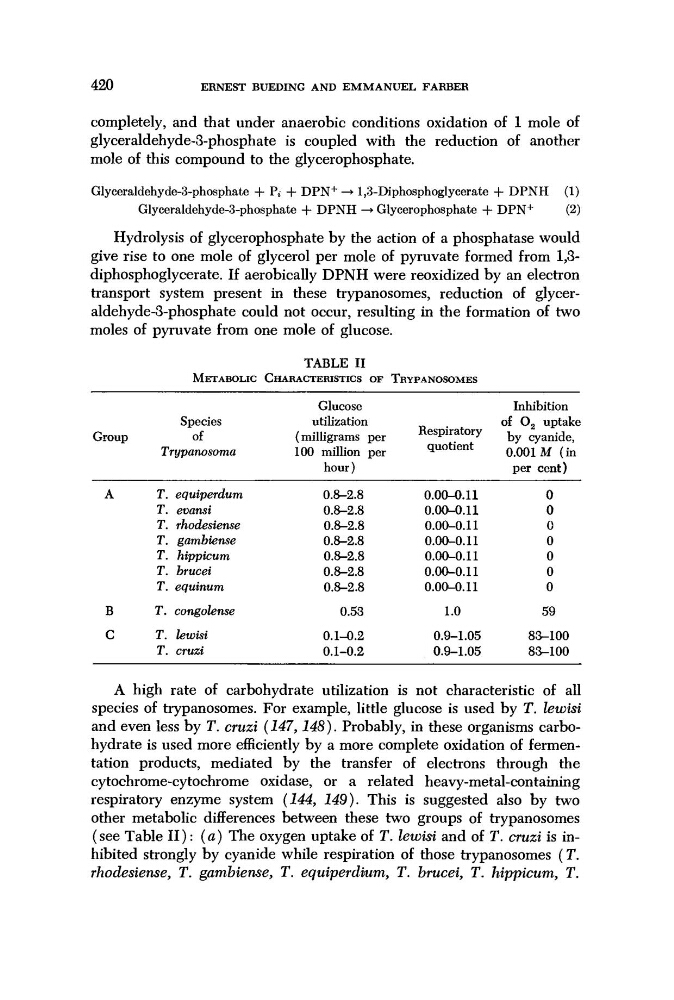
A high rate of carbohydrate utilization is not characteristic of all
species of trypanosomes. For example, little glucose is used by T. lewisi
and even less by T. cruzi (147,148). Probably, in these organisms carbohydrate is used more efficiently by a more complete oxidation of fermentation products, mediated by the transfer of electrons through the
cytochrome-cytochrome oxidase, or a related heavy-metal-containing
respiratory enzyme system (144, 149). This is suggested also by two
other metabolic differences between these two groups of trypanosomes
(see Table II): (a) The oxygen uptake of T. lewisi and of Γ. cruzi is inhibited strongly by cyanide while respiration of those trypanosomes (T.
rhodesiense, T. gambiense, T. equiperdium, T. brucei, T. hippicum, T.
ERNEST BUEDING AND EMMANUEL FÄRBER
completely, and that under anaerobic conditions oxidation of 1 mole of
glyceraldehyde-3-phosphate is coupled with the reduction of another
mole of this compound to the glycerophosphate.
Glyceraldehyde-3-phosphate + P; + DPN+ -► 1,3-Diphosphoglycerate + DPNH
(1)
Glyceraldehyde-3-phosphate + DPNH -> Glycerophosphate + DPN+
(2)
Hydrolysis of glycerophosphate by the action of a phosphatase would
give rise to one mole of glycerol per mole of pyruvate formed from 1,3diphosphoglycerate. If aerobically DPNH were reoxidized by an electron
transport system present in these trypanosomes, reduction of glyceraldehyde-3-phosphate could not occur, resulting in the formation of two
moles of pyruvate from one mole of glucose.
TABLE II
METABOLIC CHARACTERISTICS OF TRYPANOSOMES
Group
A
B
C
Species
of
Trypanosoma
T. equiperdum
T. evansi
T. rhodesiense
T. gambiense
T. hippicum
T. brucei
T. equinum
T. congolense
T. lewisi
T. cruzi
Glucose
utilization
(milligrams per
100 million per
hour)
0.8-2.8
0.8-2.8
0.8-2.8
0.8-2.8
0.8-2.8
0.8-2.8
0.8-2.8
0.53
0.1-0.2
0.1-0.2
Respiratory
quotient
0.00-0.11
0.00-0.11
0.00-0.11
0.0O-0.11
0.00-0.11
0.00-0.11
0.00-0.11
1.0
0.9-1.05
0.9-1.05
Inhibition
of 0 2 uptake
by cyanide,
0.001 M (in
per cent)
0
0
0
0
0
0
0
59
83-100
83-100
A high rate of carbohydrate utilization is not characteristic of all
species of trypanosomes. For example, little glucose is used by T. lewisi
and even less by T. cruzi (147,148). Probably, in these organisms carbohydrate is used more efficiently by a more complete oxidation of fermentation products, mediated by the transfer of electrons through the
cytochrome-cytochrome oxidase, or a related heavy-metal-containing
respiratory enzyme system (144, 149). This is suggested also by two
other metabolic differences between these two groups of trypanosomes
(see Table II): (a) The oxygen uptake of T. lewisi and of Γ. cruzi is inhibited strongly by cyanide while respiration of those trypanosomes (T.
rhodesiense, T. gambiense, T. equiperdium, T. brucei, T. hippicum, T.