

24
HENRY EYRING, RICHARD P. BOYCE AND JOHN D. SPIKES
body with respect to one another; similarly, the chemical potential is
determined solely by the thermodynamic state of the phase in question
as characterized by its temperature, pressure, and composition. The
symbol assigned to denote the chemical potential is μ.
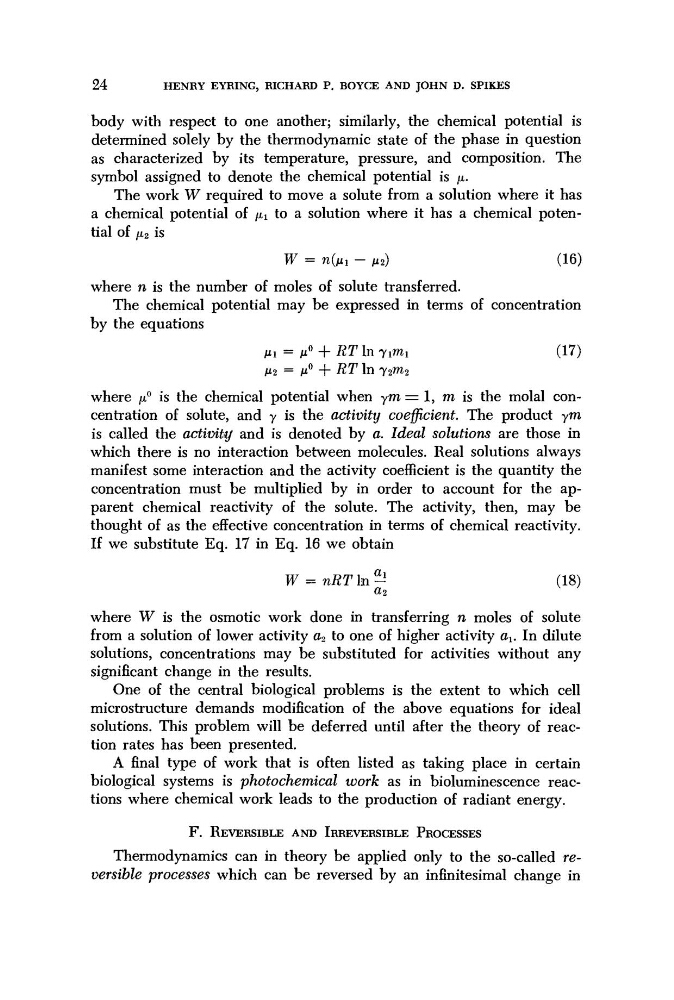
The work W required to move a solute from a solution where it has
a chemical potential of μ λ to a solution where it has a chemical potential of μ 2 is
W = η( μι - μ 2 )
(16)
where n is the number of moles of solute transferred.
The chemical potential may be expressed in terms of concentration
by the equations
μι = μ° + RT In 7iWi
(17)
M2 = M° + RT In 7 2 m 2
where μ° is the chemical potential when γπι = 1, m is the molal concentration of solute, and γ is the activity coefficient. The product γτη
is called the activity and is denoted by a. Ideal solutions are those in
which there is no interaction between molecules. Real solutions always
manifest some interaction and the activity coefficient is the quantity the
concentration must be multiplied by in order to account for the apparent chemical reactivity of the solute. The activity, then, may be
thought of as the effective concentration in terms of chemical reactivity.
If we substitute Eq. 17 in Eq. 16 we obtain
W = nRT In -
1
(18)
where W is the osmotic work done in transferring n moles of solute
from a solution of lower activity a 2 to one of higher activity a lt In dilute
solutions, concentrations may be substituted for activities without any
significant change in the results.
One of the central biological problems is the extent to which cell
microstructure demands modification of the above equations for ideal
solutions. This problem will be deferred until after the theory of reaction rates has been presented.
A final type of work that is often listed as taking place in certain
biological systems is photochemical work as in bioluminescence reactions where chemical work leads to the production of radiant energy.
F. REVERSIBLE AND IRREVERSIBLE PROCESSES
Thermodynamics can in theory be applied only to the so-called reversible processes which can be reversed by an infinitesimal change in
HENRY EYRING, RICHARD P. BOYCE AND JOHN D. SPIKES
body with respect to one another; similarly, the chemical potential is
determined solely by the thermodynamic state of the phase in question
as characterized by its temperature, pressure, and composition. The
symbol assigned to denote the chemical potential is μ.
The work W required to move a solute from a solution where it has
a chemical potential of μ λ to a solution where it has a chemical potential of μ 2 is
W = η( μι - μ 2 )
(16)
where n is the number of moles of solute transferred.
The chemical potential may be expressed in terms of concentration
by the equations
μι = μ° + RT In 7iWi
(17)
M2 = M° + RT In 7 2 m 2
where μ° is the chemical potential when γπι = 1, m is the molal concentration of solute, and γ is the activity coefficient. The product γτη
is called the activity and is denoted by a. Ideal solutions are those in
which there is no interaction between molecules. Real solutions always
manifest some interaction and the activity coefficient is the quantity the
concentration must be multiplied by in order to account for the apparent chemical reactivity of the solute. The activity, then, may be
thought of as the effective concentration in terms of chemical reactivity.
If we substitute Eq. 17 in Eq. 16 we obtain
W = nRT In -
1
(18)
where W is the osmotic work done in transferring n moles of solute
from a solution of lower activity a 2 to one of higher activity a lt In dilute
solutions, concentrations may be substituted for activities without any
significant change in the results.
One of the central biological problems is the extent to which cell
microstructure demands modification of the above equations for ideal
solutions. This problem will be deferred until after the theory of reaction rates has been presented.
A final type of work that is often listed as taking place in certain
biological systems is photochemical work as in bioluminescence reactions where chemical work leads to the production of radiant energy.
F. REVERSIBLE AND IRREVERSIBLE PROCESSES
Thermodynamics can in theory be applied only to the so-called reversible processes which can be reversed by an infinitesimal change in