

8. REACTIONS OF INORGANIC SUBSTANCES
399
oneUa in pure cultures on a strictly inorganic medium where the sole
energy source was iron filings; therefore, it is most likely, as Lieske
postulated, that at least this species is chemo-lithotrophic.
More recently, a new type of iron-oxidizing bacteria was discovered
by Colmer and co-workers (209) in acid drainage waters from coal
mines. These waters have a pH of about 3.0 and contain both free
sulfuric acid and ferrous sulfate which is quite rapidly oxidized with
the formation of large deposits of ferric hydroxide. Since the spontaneous oxidation of ferrous sulfate by oxygen is extremely slow at this
pH, a biological process is obviously involved. These authors isolated
from this natural medium a typical strain of Thiobacillus thiooxidans
and another microorganism which they called T. ferrooxidans. The
latter oxidizes thiosulfate and has the same morphological characteristics as the former but cannot oxidize elementary sulfur, while it
utilizes the oxidation of ferrous to ferric iron as energy source. Growth
can take place at pH 2.0-4.5, with an optimum at pH 3.5; in 3 days, the
cultures oxidize up to 200 p.p.m. of ferrous iron, an amount which could
not be oxidized spontaneously in air in less than two years. The chemolithotrophic character of T. ferrooxidans has been demonstrated (210).
The growth balance sheet conformed to the prediction of Starkey who
showed that the free energy efficiency could not rise above 3.5%. This
value is lower than that of other autotrophic bacteria; this is due, in
part, to the low energy level of iron oxidation and, in part, to the
slight solubility of the carbon source, i.e., carbon dioxide, at the pH at
which this bacterium can grow.
Leathen et al. (211) also isolated typical strains of T. thiooxidans
and a bacterium which actively oxidizes iron from the same source, i.e.,
drainage water of coal mines. But this organism, in contrast to that of
Colmer and associates (209), cannot oxidize thiosulfate or any other
form of inorganic sulfur. Therefore it was not classed in the genus
Thiobacillus but rather was called Ferrobacillus ferrooxidans.
It was first thought that the ferrous sulfate which is present in mine
waters and constitutes the substrate of the ferrobacteria is derived from
the oxidation of sulfide by sulfo-oxidizing bacteria, particularly by T.
thiooxidans or the organism of Temple and Colmer which oxidizes both
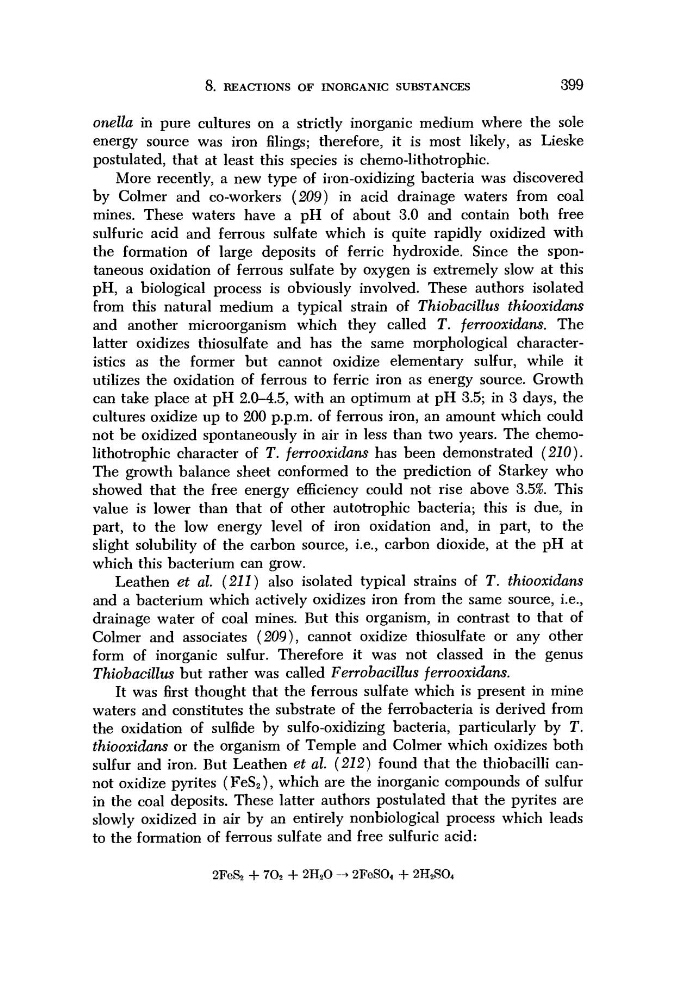
sulfur and iron. But Leathen et al. (212) found that the thiobacilli cannot oxidize pyrites (FeS 2 ), which are the inorganic compounds of sulfur
in the coal deposits. These latter authors postulated that the pyrites are
slowly oxidized in air by an entirely nonbiological process which leads
to the formation of ferrous sulfate and free sulfuric acid:
2FeS 2 + 70 2 + 2H 2 0 -+ 2FeS0 4 + 2H 2 S0 4
399
oneUa in pure cultures on a strictly inorganic medium where the sole
energy source was iron filings; therefore, it is most likely, as Lieske
postulated, that at least this species is chemo-lithotrophic.
More recently, a new type of iron-oxidizing bacteria was discovered
by Colmer and co-workers (209) in acid drainage waters from coal
mines. These waters have a pH of about 3.0 and contain both free
sulfuric acid and ferrous sulfate which is quite rapidly oxidized with
the formation of large deposits of ferric hydroxide. Since the spontaneous oxidation of ferrous sulfate by oxygen is extremely slow at this
pH, a biological process is obviously involved. These authors isolated
from this natural medium a typical strain of Thiobacillus thiooxidans
and another microorganism which they called T. ferrooxidans. The
latter oxidizes thiosulfate and has the same morphological characteristics as the former but cannot oxidize elementary sulfur, while it
utilizes the oxidation of ferrous to ferric iron as energy source. Growth
can take place at pH 2.0-4.5, with an optimum at pH 3.5; in 3 days, the
cultures oxidize up to 200 p.p.m. of ferrous iron, an amount which could
not be oxidized spontaneously in air in less than two years. The chemolithotrophic character of T. ferrooxidans has been demonstrated (210).
The growth balance sheet conformed to the prediction of Starkey who
showed that the free energy efficiency could not rise above 3.5%. This
value is lower than that of other autotrophic bacteria; this is due, in
part, to the low energy level of iron oxidation and, in part, to the
slight solubility of the carbon source, i.e., carbon dioxide, at the pH at
which this bacterium can grow.
Leathen et al. (211) also isolated typical strains of T. thiooxidans
and a bacterium which actively oxidizes iron from the same source, i.e.,
drainage water of coal mines. But this organism, in contrast to that of
Colmer and associates (209), cannot oxidize thiosulfate or any other
form of inorganic sulfur. Therefore it was not classed in the genus
Thiobacillus but rather was called Ferrobacillus ferrooxidans.
It was first thought that the ferrous sulfate which is present in mine
waters and constitutes the substrate of the ferrobacteria is derived from
the oxidation of sulfide by sulfo-oxidizing bacteria, particularly by T.
thiooxidans or the organism of Temple and Colmer which oxidizes both
sulfur and iron. But Leathen et al. (212) found that the thiobacilli cannot oxidize pyrites (FeS 2 ), which are the inorganic compounds of sulfur
in the coal deposits. These latter authors postulated that the pyrites are
slowly oxidized in air by an entirely nonbiological process which leads
to the formation of ferrous sulfate and free sulfuric acid:
2FeS 2 + 70 2 + 2H 2 0 -+ 2FeS0 4 + 2H 2 S0 4