

8. REACTIONS OF INORGANIC SUBSTANCES
397
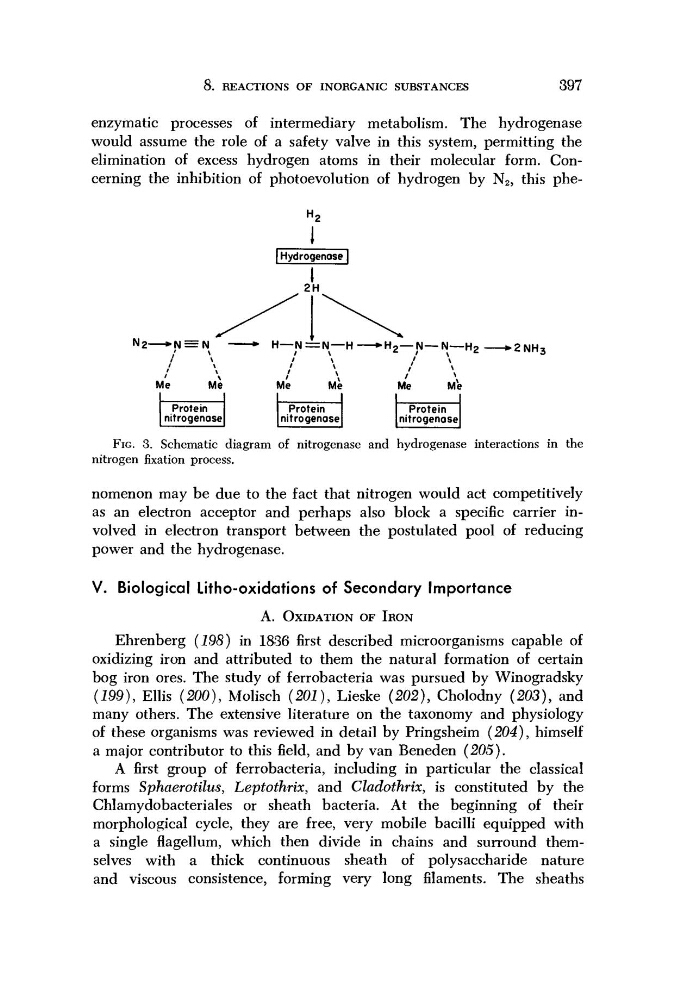
enzymatic processes of intermediary metabolism. The hydrogenase
would assume the role of a safety valve in this system, permitting the
elimination of excess hydrogen atoms in their molecular form. Concerning the inhibition of photoevolution of hydrogen by N 2 , this pheN2
>N = N
H—N=N—-H
►H2- N—N—H2
►2NH3
Me
Me
Me
Me
Me
\
Me
Protein
nitrogenose
Protein
nitrogenose
Protein
nitrogenose
FIG. 3. Schematic diagram of nitrogenase and hydrogenase interactions in the
nitrogen fixation process.
nomenon may be due to the fact that nitrogen would act competitively
as an electron acceptor and perhaps also block a specific carrier involved in electron transport between the postulated pool of reducing
power and the hydrogenase.
V. Biological Litho-oxidations of Secondary Importance
A. OXIDATION OF IRON
Ehrenberg (198) in 1836 first described microorganisms capable of
oxidizing iron and attributed to them the natural formation of certain
bog iron ores. The study of ferrobacteria was pursued by Winogradsky
(199), Ellis (200), Molisch (201), Lieske (202), Cholodny (203), and
many others. The extensive literature on the taxonomy and physiology
of these organisms was reviewed in detail by Pringsheim (204), himself
a major contributor to this field, and by van Beneden (205).
A first group of ferrobacteria, including in particular the classical
forms Sphaerotilus, Leptothrix, and Cladothrix, is constituted by the
Chlamydobacteriales or sheath bacteria. At the beginning of their
morphological cycle, they are free, very mobile bacilli equipped with
a single flagellum, which then divide in chains and surround themselves with a thick continuous sheath of polysaccharide nature
and viscous consistence, forming very long filaments. The sheaths
397
enzymatic processes of intermediary metabolism. The hydrogenase
would assume the role of a safety valve in this system, permitting the
elimination of excess hydrogen atoms in their molecular form. Concerning the inhibition of photoevolution of hydrogen by N 2 , this pheN2
>N = N
H—N=N—-H
►H2- N—N—H2
►2NH3
Me
Me
Me
Me
Me
\
Me
Protein
nitrogenose
Protein
nitrogenose
Protein
nitrogenose
FIG. 3. Schematic diagram of nitrogenase and hydrogenase interactions in the
nitrogen fixation process.
nomenon may be due to the fact that nitrogen would act competitively
as an electron acceptor and perhaps also block a specific carrier involved in electron transport between the postulated pool of reducing
power and the hydrogenase.
V. Biological Litho-oxidations of Secondary Importance
A. OXIDATION OF IRON
Ehrenberg (198) in 1836 first described microorganisms capable of
oxidizing iron and attributed to them the natural formation of certain
bog iron ores. The study of ferrobacteria was pursued by Winogradsky
(199), Ellis (200), Molisch (201), Lieske (202), Cholodny (203), and
many others. The extensive literature on the taxonomy and physiology
of these organisms was reviewed in detail by Pringsheim (204), himself
a major contributor to this field, and by van Beneden (205).
A first group of ferrobacteria, including in particular the classical
forms Sphaerotilus, Leptothrix, and Cladothrix, is constituted by the
Chlamydobacteriales or sheath bacteria. At the beginning of their
morphological cycle, they are free, very mobile bacilli equipped with
a single flagellum, which then divide in chains and surround themselves with a thick continuous sheath of polysaccharide nature
and viscous consistence, forming very long filaments. The sheaths