

8. REACTIONS OF INORGANIC SUBSTANCES
393
genase activity proper but rather in electron transport between this
enzyme and certain acceptors. This hypothesis would explain why the
nature of the metal in question may vary from one author to the next,
depending on the source of the hydrogenase and the nature of the system under investigation.
4. Mechanism of Action
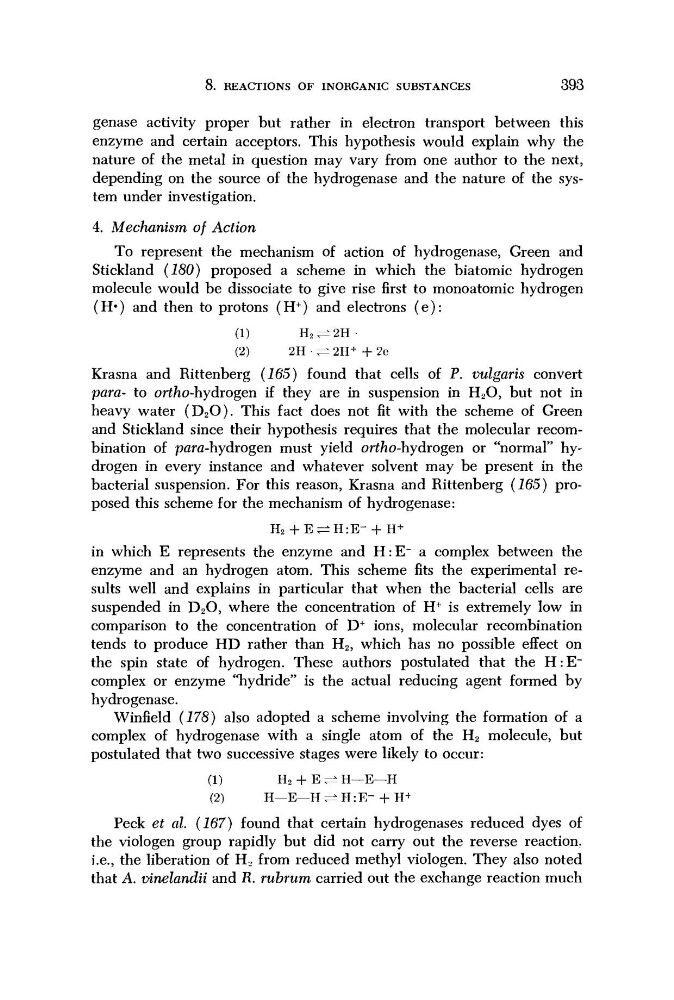
To represent the mechanism of action of hydrogenase, Green and
Stickland (180) proposed a scheme in which the biatomic hydrogen
molecule would be dissociate to give rise first to monoatomic hydrogen
(H·) and then to protons (H
+ ) and electrons (e):
(1)
H 2 ^2H·
(2)
2H · ^ 2H+ + 2e
Krasna and Rittenberg (165) found that cells of P. vulgaris convert
para- to orf/io-hydrogen if they are in suspension in H 2 0, but not in
heavy water (D 2 0). This fact does not fit with the scheme of Green
and Stickland since their hypothesis requires that the molecular recombination of para-hydrogen must yield ori/io-hydrogen or "normal" hydrogen in every instance and whatever solvent may be present in the
bacterial suspension. For this reason, Krasna and Rittenberg (165) proposed this scheme for the mechanism of hydrogenase:
H 2 + E;=±H:E- + H
+
in which E represents the enzyme and H:E" a complex between the
enzyme and an hydrogen atom. This scheme fits the experimental results well and explains in particular that when the bacterial cells are
suspended in D 2 0, where the concentration of H
+ is extremely low in
comparison to the concentration of D
+ ions, molecular recombination
tends to produce HD rather than H 2 , which has no possible effect on
the spin state of hydrogen. These authors postulated that the H:E~
complex or enzyme "hydride" is the actual reducing agent formed by
hydrogenase.
Winfield (178) also adopted a scheme involving the formation of a
complex of hydrogenase with a single atom of the H 2 molecule, but
postulated that two successive stages were likely to occur:
(1)
H 2 + E ^ H—E—H
(2)
H—E—H ^± H: E~ + H+
Peck et al. (167) found that certain hydrogenases reduced dyes of
the viologen group rapidly but did not carry out the reverse reaction,
i.e., the liberation of H_, from reduced methyl viologen. They also noted
that A. vinelandii and R. rubrum carried out the exchange reaction much
393
genase activity proper but rather in electron transport between this
enzyme and certain acceptors. This hypothesis would explain why the
nature of the metal in question may vary from one author to the next,
depending on the source of the hydrogenase and the nature of the system under investigation.
4. Mechanism of Action
To represent the mechanism of action of hydrogenase, Green and
Stickland (180) proposed a scheme in which the biatomic hydrogen
molecule would be dissociate to give rise first to monoatomic hydrogen
(H·) and then to protons (H
+ ) and electrons (e):
(1)
H 2 ^2H·
(2)
2H · ^ 2H+ + 2e
Krasna and Rittenberg (165) found that cells of P. vulgaris convert
para- to orf/io-hydrogen if they are in suspension in H 2 0, but not in
heavy water (D 2 0). This fact does not fit with the scheme of Green
and Stickland since their hypothesis requires that the molecular recombination of para-hydrogen must yield ori/io-hydrogen or "normal" hydrogen in every instance and whatever solvent may be present in the
bacterial suspension. For this reason, Krasna and Rittenberg (165) proposed this scheme for the mechanism of hydrogenase:
H 2 + E;=±H:E- + H
+
in which E represents the enzyme and H:E" a complex between the
enzyme and an hydrogen atom. This scheme fits the experimental results well and explains in particular that when the bacterial cells are
suspended in D 2 0, where the concentration of H
+ is extremely low in
comparison to the concentration of D
+ ions, molecular recombination
tends to produce HD rather than H 2 , which has no possible effect on
the spin state of hydrogen. These authors postulated that the H:E~
complex or enzyme "hydride" is the actual reducing agent formed by
hydrogenase.
Winfield (178) also adopted a scheme involving the formation of a
complex of hydrogenase with a single atom of the H 2 molecule, but
postulated that two successive stages were likely to occur:
(1)
H 2 + E ^ H—E—H
(2)
H—E—H ^± H: E~ + H+
Peck et al. (167) found that certain hydrogenases reduced dyes of
the viologen group rapidly but did not carry out the reverse reaction,
i.e., the liberation of H_, from reduced methyl viologen. They also noted
that A. vinelandii and R. rubrum carried out the exchange reaction much