

390
CLAUDE FROMAGEOT AND JACQUES C. SENEZ
inhibit certain hydrogenase preparations. According to Gest (138),
methylene blue inhibits only the soluble hydrogenases and has no effect
on particulate hydrogenases. Further, the inhibitory activity of the dye
was attributed to metallic impurities. It should be noted, however, that
the oxidation-reduction potential of methylene blue is relatively high
and that, in systems where the dye is introduced in the oxidized state,
certain hydrogenases endowed with particular sensitivity to oxidation
may be inactivated by the simple influence of the dye on the oxidoreduction potential of the medium.
In 1934, Farkas et al. (163) showed that hydrogenase catalyzes the
exchange reaction between deuterium and water:
D 2 + H 2 0 ^ HD + HDO
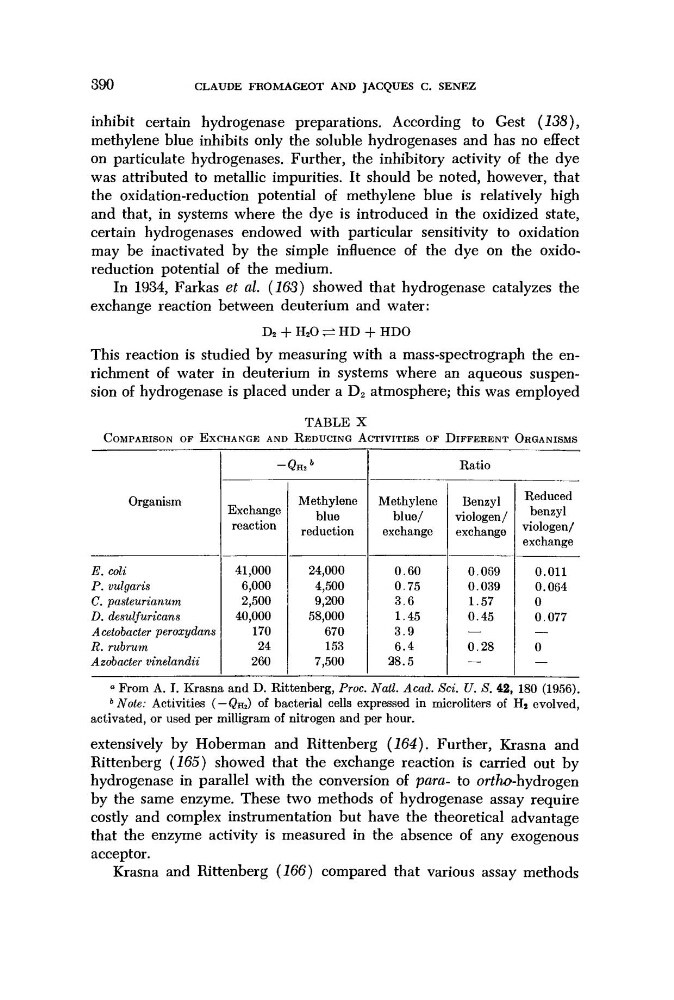
This reaction is studied by measuring with a mass-spectrograph the enrichment of water in deuterium in systems where an aqueous suspension of hydrogenase is placed under a D 2 atmosphere; this was employed
TABLE X
COMPARISON OF EXCHANGE AND REDUCING ACTIVITIES OF DIFFERENT ORGANISMS
Organism
E. coli
P. vulgaris
C. pasteurianum
D. desulfuricans
Acetobacter per oxy dans
R. rubrum
Azobacter vinelandii
-Qn,"
Exchange
reaction
41,000
6,000
2,500
40,000
170
24
260
Methylene
blue
reduction
24,000
4,500
9,200
58,000
670
153
7,500
Ratio
Methylene
blue/
exchange
0.60
0.75
3.6
1.45
3.9
6.4
28.5
Benzyl
viologen/
exchange
0.069
0.039
1.57
0.45
0.28
Reduced
benzyl
viologen/
exchange
0.011
0.064
0
0.077
0
a From A. I. Krasna and D. Rittenberg, Proc. Natl. Acad. Sei. U. S. 42, 180 (1956).
6 Note: Activities ( —QH 2 ) of bacterial cells expressed in microliters of H 2 evolved,
activated, or used per milligram of nitrogen and per hour.
extensively by Hoberman and Rittenberg (164). Further, Krasna and
Rittenberg (165) showed that the exchange reaction is carried out by
hydrogenase in parallel with the conversion of para- to orf/io-hydrogen
by the same enzyme. These two methods of hydrogenase assay require
costly and complex instrumentation but have the theoretical advantage
that the enzyme activity is measured in the absence of any exogenous
acceptor.
Krasna and Rittenberg (166) compared that various assay methods
CLAUDE FROMAGEOT AND JACQUES C. SENEZ
inhibit certain hydrogenase preparations. According to Gest (138),
methylene blue inhibits only the soluble hydrogenases and has no effect
on particulate hydrogenases. Further, the inhibitory activity of the dye
was attributed to metallic impurities. It should be noted, however, that
the oxidation-reduction potential of methylene blue is relatively high
and that, in systems where the dye is introduced in the oxidized state,
certain hydrogenases endowed with particular sensitivity to oxidation
may be inactivated by the simple influence of the dye on the oxidoreduction potential of the medium.
In 1934, Farkas et al. (163) showed that hydrogenase catalyzes the
exchange reaction between deuterium and water:
D 2 + H 2 0 ^ HD + HDO
This reaction is studied by measuring with a mass-spectrograph the enrichment of water in deuterium in systems where an aqueous suspension of hydrogenase is placed under a D 2 atmosphere; this was employed
TABLE X
COMPARISON OF EXCHANGE AND REDUCING ACTIVITIES OF DIFFERENT ORGANISMS
Organism
E. coli
P. vulgaris
C. pasteurianum
D. desulfuricans
Acetobacter per oxy dans
R. rubrum
Azobacter vinelandii
-Qn,"
Exchange
reaction
41,000
6,000
2,500
40,000
170
24
260
Methylene
blue
reduction
24,000
4,500
9,200
58,000
670
153
7,500
Ratio
Methylene
blue/
exchange
0.60
0.75
3.6
1.45
3.9
6.4
28.5
Benzyl
viologen/
exchange
0.069
0.039
1.57
0.45
0.28
Reduced
benzyl
viologen/
exchange
0.011
0.064
0
0.077
0
a From A. I. Krasna and D. Rittenberg, Proc. Natl. Acad. Sei. U. S. 42, 180 (1956).
6 Note: Activities ( —QH 2 ) of bacterial cells expressed in microliters of H 2 evolved,
activated, or used per milligram of nitrogen and per hour.
extensively by Hoberman and Rittenberg (164). Further, Krasna and
Rittenberg (165) showed that the exchange reaction is carried out by
hydrogenase in parallel with the conversion of para- to orf/io-hydrogen
by the same enzyme. These two methods of hydrogenase assay require
costly and complex instrumentation but have the theoretical advantage
that the enzyme activity is measured in the absence of any exogenous
acceptor.
Krasna and Rittenberg (166) compared that various assay methods