

8. REACTIONS OF INORGANIC SUBSTANCES
383
(129) in 1910. As these organisms are hard to cultivate and maintain
in artificial cultures their metabolism was little studied until the
more recent discovery, by Schatz and Bovell (130) in 1952, of a new
species, H. facilis, which can be obtained easily in massive culture and
has permitted rapid progress in the study of its biochemical properties.
Hydrogenomonas are nonsporulated eubacteria, short, Gram-negative
bacilli possessing one or several polar flagellae. Their morphology is
quite similar to that of the nitrifying bacteria and the thiobacilli; these
three groups are therefore classed together in the family Nitrobacteriaceae (61). Physiologically, they are strict aerobes and facultative
autotrophs which can grow by using a certain number of organic compounds, particularly acetate, lactate, C 4 -dicarboxylic acids, and glucose
as energy and carbon sources. In these organic media, they can grow in
100% 0 2 , but their autotrophic growth in an atmosphere containing both
H 2 and 0 2 requires only a partial oxygen tension of about 30% since, as
will be seen below, hydrogenase is strongly inhibited by oxygen.
According to Niklewski (129), H. agilis can grow anaerobically, in
the absence of free oxygen, in nitrate-containing media. This organism,
then, would behave exactly like the sulfo-oxidizing Thiobacillus denitrificans. H. facilis cannot utilize this "nitrate respiration" for anaerobic
growth but nonetheless can utilize nitrate instead of ammonium salts
as nitrogen source and is able to reduce nitrate to nitrite in an H 2
atmosphere in nonproliferating suspensions (130).
The influence of culture conditions on the formation of hydrogenase
by cells of Hydrogenomonas was discussed above (Section I,D).
b. Sulfate-Reducing Bacteria. These organisms were discovered by
Beijerinck (131) in 1895 and now constitute the genus Desulfovibrio
(61). They are strict anaerobes which employ sulfate as electron acceptor and reduce it to hydrogen sulfide. The type species, D. desulfuricans, grows heterotrophically, using only a small number of organic
compounds, such as pyruvate and lactate, as energy and carbon sources.
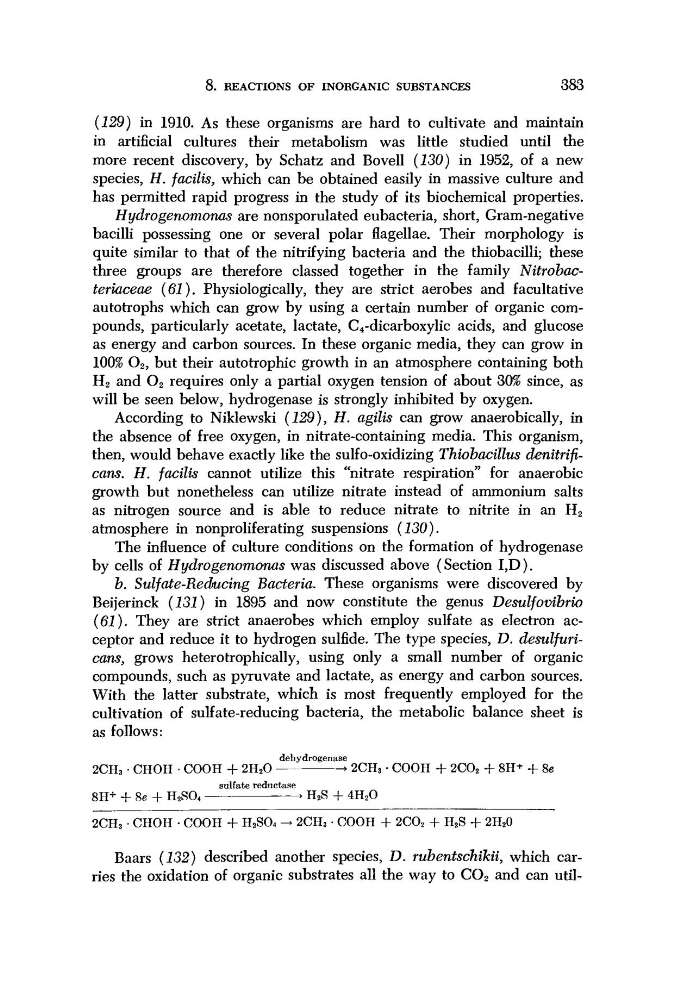
With the latter substrate, which is most frequently employed for the
cultivation of sulfate-reducing bacteria, the metabolic balance sheet is
as follows:
dehydrogenase
2CH 3 · CHOH · COOH + 2H 2 0
> 2CH 3 · COOH + 2C0 2 + 8H+ + 8e
sulfate reductase
8H+ + 8e + H 2 S0 4
> H 2 S + 4H 2 0
2CH 3 · CHOH · COOH + H 2 S0 4 -> 2CH 3 · COOH + 2C0 2 + H 2 S + 2H 2 0
Baars (132) described another species, D. rubentschikii, which carries the oxidation of organic substrates all the way to C0 2 and can util-
383
(129) in 1910. As these organisms are hard to cultivate and maintain
in artificial cultures their metabolism was little studied until the
more recent discovery, by Schatz and Bovell (130) in 1952, of a new
species, H. facilis, which can be obtained easily in massive culture and
has permitted rapid progress in the study of its biochemical properties.
Hydrogenomonas are nonsporulated eubacteria, short, Gram-negative
bacilli possessing one or several polar flagellae. Their morphology is
quite similar to that of the nitrifying bacteria and the thiobacilli; these
three groups are therefore classed together in the family Nitrobacteriaceae (61). Physiologically, they are strict aerobes and facultative
autotrophs which can grow by using a certain number of organic compounds, particularly acetate, lactate, C 4 -dicarboxylic acids, and glucose
as energy and carbon sources. In these organic media, they can grow in
100% 0 2 , but their autotrophic growth in an atmosphere containing both
H 2 and 0 2 requires only a partial oxygen tension of about 30% since, as
will be seen below, hydrogenase is strongly inhibited by oxygen.
According to Niklewski (129), H. agilis can grow anaerobically, in
the absence of free oxygen, in nitrate-containing media. This organism,
then, would behave exactly like the sulfo-oxidizing Thiobacillus denitrificans. H. facilis cannot utilize this "nitrate respiration" for anaerobic
growth but nonetheless can utilize nitrate instead of ammonium salts
as nitrogen source and is able to reduce nitrate to nitrite in an H 2
atmosphere in nonproliferating suspensions (130).
The influence of culture conditions on the formation of hydrogenase
by cells of Hydrogenomonas was discussed above (Section I,D).
b. Sulfate-Reducing Bacteria. These organisms were discovered by
Beijerinck (131) in 1895 and now constitute the genus Desulfovibrio
(61). They are strict anaerobes which employ sulfate as electron acceptor and reduce it to hydrogen sulfide. The type species, D. desulfuricans, grows heterotrophically, using only a small number of organic
compounds, such as pyruvate and lactate, as energy and carbon sources.
With the latter substrate, which is most frequently employed for the
cultivation of sulfate-reducing bacteria, the metabolic balance sheet is
as follows:
dehydrogenase
2CH 3 · CHOH · COOH + 2H 2 0
> 2CH 3 · COOH + 2C0 2 + 8H+ + 8e
sulfate reductase
8H+ + 8e + H 2 S0 4
> H 2 S + 4H 2 0
2CH 3 · CHOH · COOH + H 2 S0 4 -> 2CH 3 · COOH + 2C0 2 + H 2 S + 2H 2 0
Baars (132) described another species, D. rubentschikii, which carries the oxidation of organic substrates all the way to C0 2 and can util-