

8. REACTIONS OF INORGANIC SUBSTANCES
381
but not the second leading to the production of PAPS, the "active sulfate" of Robbins and Lipmann.
C. OXIDATION OF SULFUR AND SULFUR COMPOUNDS IN MAMMALS
In mammals, one of the major routes of mineralization of organic
sulfur leads to the formation of sulfite, which is derived in particular
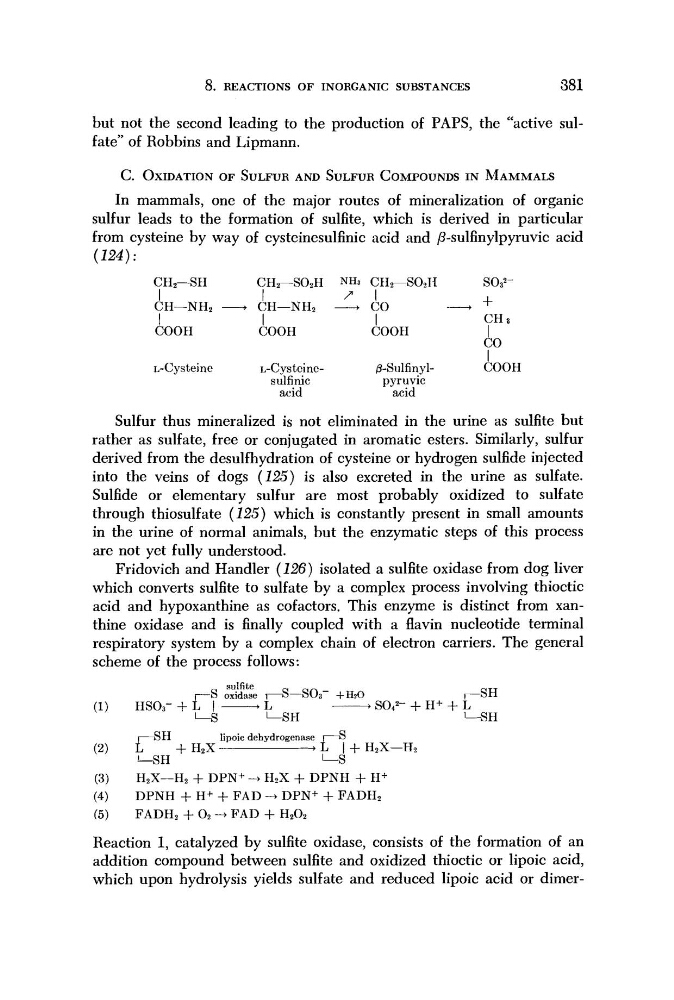
from cysteine by way of cysteinesulfinic acid and ß-sulfinylpyruvic acid
(124):
CH 2 —SH
1
CH—NH 2 —
1
COOH
L-Cysteine
CH 2 —S0 2 H
1
-* CH—NH 2
1
COOH
L-Cysteinesulfinic
acid
NH 3
Z
1
CH 2 —S0 2 H
1
1
CO
>
1
COOH
0-Sulfinylpyruvic
acid
S0 3
2 ~
+
CH 8
1
CO
1
COOH
Sulfur thus mineralized is not eliminated in the urine as sulfite but
rather as sulfate, free or conjugated in aromatic esters. Similarly, sulfur
derived from the desulfhydration of cysteine or hydrogen sulfide injected
into the veins of dogs (125) is also excreted in the urine as sulfate.
Sulfide or elementary sulfur are most probably oxidized to sulfate
through thiosulfate (125) which is constantly present in small amounts
in the urine of normal animals, but the enzymatic steps of this process
are not yet fully understood.
Fridovich and Handler (126) isolated a sulfite oxidase from dog liver
which converts sulfite to sulfate by a complex process involving thioctic
acid and hypoxanthine as cofactors. This enzyme is distinct from xanthine oxidase and is finally coupled with a flavin nucleotide terminal
respiratory system by a complex chain of electron carriers. The general
scheme of the process follows:
I o oxidase r-S—SO3- +H 2 o
r—SH
(1)
HSO3- + L I
> L
> S0 4
2 ~ + H
+ + L
L—S
·—SH
'—SH
1—SH
lipoic dehydrogenase r b
(2)
L
+ H 2 X
> L I + H 2 X—H 2
L—SH
·—S
(3)
H 2 X—H 2 + DPN+ -* H 2 X + DPNH + H
+
(4)
DPNH + H+ + FAD -* DPN+ + FADH 2
(5)
FADH 2 + 0 2 -> FAD + H 2 0 2
Reaction 1, catalyzed by sulfite oxidase, consists of the formation of an
addition compound between sulfite and oxidized thioctic or lipoic acid,
which upon hydrolysis yields sulfate and reduced lipoic acid or dimer-
381
but not the second leading to the production of PAPS, the "active sulfate" of Robbins and Lipmann.
C. OXIDATION OF SULFUR AND SULFUR COMPOUNDS IN MAMMALS
In mammals, one of the major routes of mineralization of organic
sulfur leads to the formation of sulfite, which is derived in particular
from cysteine by way of cysteinesulfinic acid and ß-sulfinylpyruvic acid
(124):
CH 2 —SH
1
CH—NH 2 —
1
COOH
L-Cysteine
CH 2 —S0 2 H
1
-* CH—NH 2
1
COOH
L-Cysteinesulfinic
acid
NH 3
Z
1
CH 2 —S0 2 H
1
1
CO
>
1
COOH
0-Sulfinylpyruvic
acid
S0 3
2 ~
+
CH 8
1
CO
1
COOH
Sulfur thus mineralized is not eliminated in the urine as sulfite but
rather as sulfate, free or conjugated in aromatic esters. Similarly, sulfur
derived from the desulfhydration of cysteine or hydrogen sulfide injected
into the veins of dogs (125) is also excreted in the urine as sulfate.
Sulfide or elementary sulfur are most probably oxidized to sulfate
through thiosulfate (125) which is constantly present in small amounts
in the urine of normal animals, but the enzymatic steps of this process
are not yet fully understood.
Fridovich and Handler (126) isolated a sulfite oxidase from dog liver
which converts sulfite to sulfate by a complex process involving thioctic
acid and hypoxanthine as cofactors. This enzyme is distinct from xanthine oxidase and is finally coupled with a flavin nucleotide terminal
respiratory system by a complex chain of electron carriers. The general
scheme of the process follows:
I o oxidase r-S—SO3- +H 2 o
r—SH
(1)
HSO3- + L I
> L
> S0 4
2 ~ + H
+ + L
L—S
·—SH
'—SH
1—SH
lipoic dehydrogenase r b
(2)
L
+ H 2 X
> L I + H 2 X—H 2
L—SH
·—S
(3)
H 2 X—H 2 + DPN+ -* H 2 X + DPNH + H
+
(4)
DPNH + H+ + FAD -* DPN+ + FADH 2
(5)
FADH 2 + 0 2 -> FAD + H 2 0 2
Reaction 1, catalyzed by sulfite oxidase, consists of the formation of an
addition compound between sulfite and oxidized thioctic or lipoic acid,
which upon hydrolysis yields sulfate and reduced lipoic acid or dimer-