

378
CLAUDE FROMAGEOT AND JACQUES C. SENEZ
which represents about 5% of the total incorporated radioactivity and has
been identified as trithionate. This observation confirms the opinion of
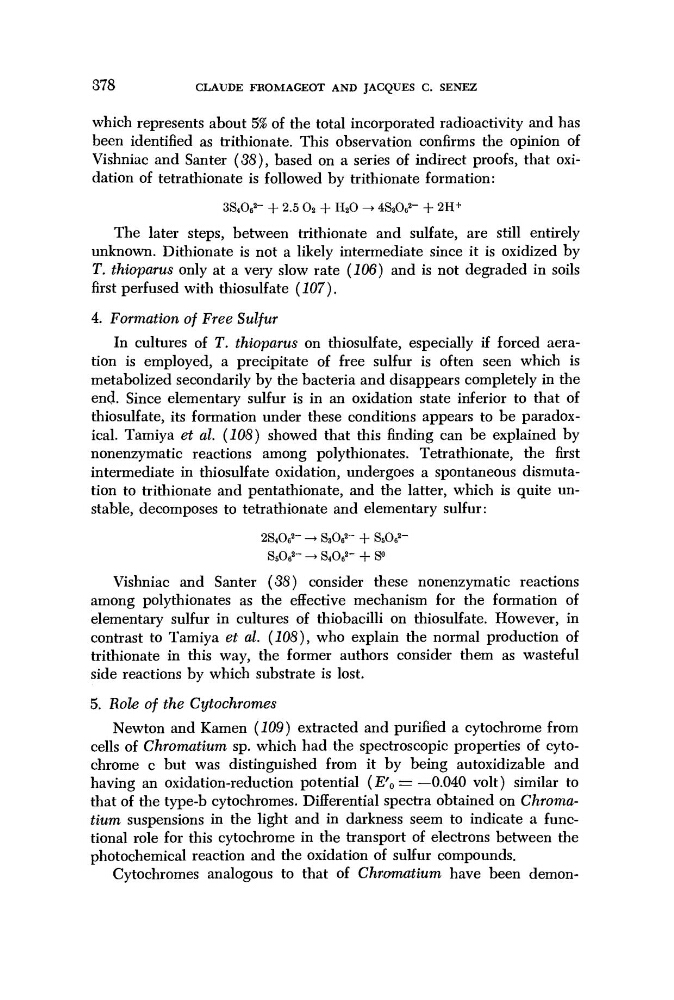
Vishniac and Santer (38), based on a series of indirect proofs, that oxidation of tetrathionate is followed by trithionate formation:
3S 4 (V- + 2.5 0 2 + H 2 0 -> 4S 3 (V- + 2H+
The later steps, between trithionate and sulfate, are still entirely
unknown. Dithionate is not a likely intermediate since it is oxidized by
T. thioparus only at a very slow rate (106) and is not degraded in soils
first perfused with thiosulfate (107).
4. Formation of Free Sulfur
In cultures of T. thioparus on thiosulfate, especially if forced aeration is employed, a precipitate of free sulfur is often seen which is
metabolized secondarily by the bacteria and disappears completely in the
en(J. Since elementary sulfur is in an oxidation state inferior to that of
thiosulfate, its formation under these conditions appears to be paradoxical. Tamiya et al. (108) showed that this finding can be explained by
nonenzymatic reactions among polythionates. Tetrathionate, the first
intermediate in thiosulfate oxidation, undergoes a spontaneous dismutation to trithionate and pentathionate, and the latter, which is quite unstable, decomposes to tetrathionate and elementary sulfur:
2S 4 0 6
2
- -> S 3 0 6
2
- + S 5 0 6
2
-
s 5 o 6
2 - -* s 4 o 6
2 - + s°
Vishniac and Santer (38) consider these nonenzymatic reactions
among polythionates as the effective mechanism for the formation of
elementary sulfur in cultures of thiobacilli on thiosulfate. However, in
contrast to Tamiya et al. (108), who explain the normal production of
trithionate in this way, the former authors consider them as wasteful
side reactions by which substrate is lost.
5. Roh of the Cytochromes
Newton and Kamen (109) extracted and purified a cytochrome from
cells of Chromatium sp. which had the spectroscopic properties of cytochrome c but was distinguished from it by being autoxidizable and
having an oxidation-reduction potential (E' 0 = —0.040 volt) similar to
that of the type-b cytochromes. Differential spectra obtained on Chromatium suspensions in the light and in darkness seem to indicate a functional role for this cytochrome in the transport of electrons between the
photochemical reaction and the oxidation of sulfur compounds.
Cytochromes analogous to that of Chromatium have been demon-
CLAUDE FROMAGEOT AND JACQUES C. SENEZ
which represents about 5% of the total incorporated radioactivity and has
been identified as trithionate. This observation confirms the opinion of
Vishniac and Santer (38), based on a series of indirect proofs, that oxidation of tetrathionate is followed by trithionate formation:
3S 4 (V- + 2.5 0 2 + H 2 0 -> 4S 3 (V- + 2H+
The later steps, between trithionate and sulfate, are still entirely
unknown. Dithionate is not a likely intermediate since it is oxidized by
T. thioparus only at a very slow rate (106) and is not degraded in soils
first perfused with thiosulfate (107).
4. Formation of Free Sulfur
In cultures of T. thioparus on thiosulfate, especially if forced aeration is employed, a precipitate of free sulfur is often seen which is
metabolized secondarily by the bacteria and disappears completely in the
en(J. Since elementary sulfur is in an oxidation state inferior to that of
thiosulfate, its formation under these conditions appears to be paradoxical. Tamiya et al. (108) showed that this finding can be explained by
nonenzymatic reactions among polythionates. Tetrathionate, the first
intermediate in thiosulfate oxidation, undergoes a spontaneous dismutation to trithionate and pentathionate, and the latter, which is quite unstable, decomposes to tetrathionate and elementary sulfur:
2S 4 0 6
2
- -> S 3 0 6
2
- + S 5 0 6
2
-
s 5 o 6
2 - -* s 4 o 6
2 - + s°
Vishniac and Santer (38) consider these nonenzymatic reactions
among polythionates as the effective mechanism for the formation of
elementary sulfur in cultures of thiobacilli on thiosulfate. However, in
contrast to Tamiya et al. (108), who explain the normal production of
trithionate in this way, the former authors consider them as wasteful
side reactions by which substrate is lost.
5. Roh of the Cytochromes
Newton and Kamen (109) extracted and purified a cytochrome from
cells of Chromatium sp. which had the spectroscopic properties of cytochrome c but was distinguished from it by being autoxidizable and
having an oxidation-reduction potential (E' 0 = —0.040 volt) similar to
that of the type-b cytochromes. Differential spectra obtained on Chromatium suspensions in the light and in darkness seem to indicate a functional role for this cytochrome in the transport of electrons between the
photochemical reaction and the oxidation of sulfur compounds.
Cytochromes analogous to that of Chromatium have been demon-